
Articles liés à Bad Samaritans: The Myth of Free Trade and the Secret...
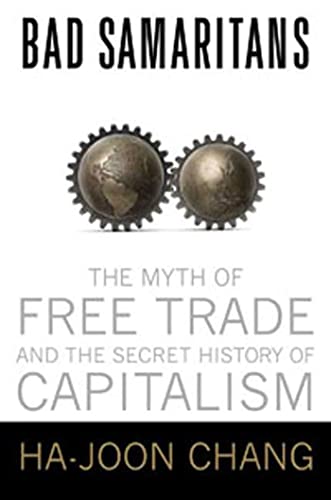
Quatrième de couverture
'A smart, lively and provocative book that offers us compelling new ways to look at globalization' - Joseph E. Stiglitz, Nobel Laureate in Economics, 2001
It's rare that a book appears with a fresh perspective on world affairs, but Ha-Joon Chang has some startlingly original things to say about globalization. In theory, he argues, the world's wealthiest countries and major institutions, such as the IMF and World Bank, want to see all nations become modern, thriving societies. In practice, though, those at the top are 'kicking away the ladder' to wealth that they themselves climbed.
In the course of his exposé Chang reveals double standards at work everywhere: in policy-makers' understanding of history, in their attitudes to such key issues as free trade and foreign investment, and in their baffling prejudices about national stereotypes and 'ideal' forms of government. He shows precisely why these double standards have become so deeply embedded, and how they have damaged - and continue to damage - the developing world. And he convincingly demonstrates how a fairer and more prosperous global economy could be created if only the Bad Samaritans would accept the evidence that is actually staring them in the face.
'This is a marvellous book. Well researched, panoramic in its scope and beautifully written, Bad Samaritans is the perfect riposte to devotees of a one-size-fits-all model of growth and globalization. I strongly urge you to read it' - Larry Elliott, Economics Editor, Guardian
'I recommend this book to people who have any interest in these issues - i.e. everyone' - Bob Geldof
Présentation de l'éditeur
It's rare that a book appears with a fresh perspective on world affairs, but renowned economist Ha-Joon Chang has some startlingly original things to say about the future of globalization. In theory, he argues, the world's wealthiest countries and supra-national institutions like the IMF, World Bank and WTO want to see all nations developing into modern industrial societies. In practice, though, those at the top are 'kicking away the ladder' to wealth that they themselves climbed.
Why? Self-interest certainly plays a part. But, more often, rich and powerful governments and institutions are actually being 'Bad Samaritans': their intentions are worthy but their simplistic free-market ideology and poor understanding of history leads them to inflict policy errors on others. Chang demonstrates this by contrasting the route to success of economically vibrant countries with the very different route now being dictated to the world's poorer nations. In the course of this, he shows just how muddled the thinking is in such key areas as trade and foreign investment. He shows that the case for privatisation and against state involvement is far from proven. And he explores the ways in which attitudes to national cultures and political ideologies are obscuring clear thinking and creating bad policy. Finally, he argues the case for new strategies for a more prosperous world that may appall the 'Bad Samaritans'.
Les informations fournies dans la section « A propos du livre » peuvent faire référence à une autre édition de ce titre.
Résultats de recherche pour Bad Samaritans: The Myth of Free Trade and the Secret...

Image fournie par le vendeur
Bad Samaritans: The Myth of Free Trade and the Secret History of Capitalism
Edité par
Bloomsbury Press, 2007
ISBN 10 : 1596913991
ISBN 13 : 9781596913998
Ancien ou d'occasion
Couverture rigide
Vendeur : Dream Books Co., Denver, CO, Etats-Unis
Évaluation du vendeur 5 sur 5 étoiles

Etat : good. Gently used with minimal wear on the corners and cover. A few pages may contain light highlighting or writing, but the text remains fully legible. Dust jacket may be missing, and supplemental materials like CDs or codes may not be included. May be ex-library with library markings. Ships promptly! N° de réf. du vendeur DBV.1596913991.G
Acheter D'occasion
EUR 4,06
Livraison gratuite
Expédition nationale : Etats-Unis
Expédition nationale : Etats-Unis
Quantité disponible : 1 disponible(s)
Image fournie par le vendeur
Bad Samaritans: The Myth of Free Trade and the Secret History of Capitalism
Edité par
Bloomsbury Press, 2007
ISBN 10 : 1596913991
ISBN 13 : 9781596913998
Ancien ou d'occasion
Couverture rigide
Vendeur : Books for Life, LAUREL, MD, Etats-Unis
Évaluation du vendeur 5 sur 5 étoiles
Etat : acceptable. Book is in acceptable condition. May have shelf wear, edge wear, and spine wear, but a very readable copy. May not come with supplemental materials if applicable. Does not include original dustcover jacket. Possibly Ex Library Copy. N° de réf. du vendeur LFM.7V4Q
Acheter D'occasion
EUR 4,95
Livraison gratuite
Expédition nationale : Etats-Unis
Expédition nationale : Etats-Unis
Quantité disponible : 1 disponible(s)
Image d'archives
Bad Samaritans: The Myth of Free Trade and the Secret History of Capitalism
Edité par
Bloomsbury Publishing PLC, 2007
ISBN 10 : 1596913991
ISBN 13 : 9781596913998
Ancien ou d'occasion
Couverture rigide
Vendeur : World of Books (was SecondSale), Montgomery, IL, Etats-Unis
Évaluation du vendeur 5 sur 5 étoiles
Hardback. Etat : Good. With irreverent wit, an engagingly personal style, and a battery of real-life examples, Ha-Joon Chang blasts holes in the World Is Flat orthodoxy of Thomas Friedman and other neo-liberal economists who argue that only unfettered capitalism and wide-open international trade can lift struggling nations out of poverty. On the contrary, Chang shows, today's economic superpowers--from the United States to Britain to his native South Korea--all attained prosperity by shameless protectionism and government intervention in industry. We in the wealthy nations have conveniently forgotten this fact, telling ourselves a fairy tale about the magic of free trade and--via our proxies such as the World Bank, International Monetary Fund, and World Trade Organization--ramming policies that suit ourselves down the throat of the developing world.Unlike typical economists who construct models of how economies are supposed to behave, Chang examines the past: what has actually happened. His pungently contrarian history demolishes one pillar after another of free-market mythology. We treat patents and copyrights as sacrosanct--but developed our own industries by studiously copying others' technologies. We insist that centrally planned economies stifle growth--but many developing countries had higher GDP growth before they were pressured into deregulating their economies. Both justice and common sense, Chang argues, demand that we reevaluate the policies we force on weaker nations. Bad Samaritans calls on America to return to its abandoned role, embodied in programs like the Marshall Plan, to offer a helping hand, instead of a closed fist, to countries struggling to follow in our footsteps. N° de réf. du vendeur 00110715476
Acheter D'occasion
EUR 5,49
Livraison gratuite
Expédition nationale : Etats-Unis
Expédition nationale : Etats-Unis
Quantité disponible : 2 disponible(s)
Image d'archives
Bad Samaritans: The Myth of Free Trade and the Secret History of Capitalism
Edité par
Bloomsbury Publishing PLC, 2007
ISBN 10 : 1596913991
ISBN 13 : 9781596913998
Ancien ou d'occasion
Couverture rigide
Vendeur : World of Books (was SecondSale), Montgomery, IL, Etats-Unis
Évaluation du vendeur 5 sur 5 étoiles
Hardback. Etat : Very Good. With irreverent wit, an engagingly personal style, and a battery of real-life examples, Ha-Joon Chang blasts holes in the World Is Flat orthodoxy of Thomas Friedman and other neo-liberal economists who argue that only unfettered capitalism and wide-open international trade can lift struggling nations out of poverty. On the contrary, Chang shows, today's economic superpowers--from the United States to Britain to his native South Korea--all attained prosperity by shameless protectionism and government intervention in industry. We in the wealthy nations have conveniently forgotten this fact, telling ourselves a fairy tale about the magic of free trade and--via our proxies such as the World Bank, International Monetary Fund, and World Trade Organization--ramming policies that suit ourselves down the throat of the developing world.Unlike typical economists who construct models of how economies are supposed to behave, Chang examines the past: what has actually happened. His pungently contrarian history demolishes one pillar after another of free-market mythology. We treat patents and copyrights as sacrosanct--but developed our own industries by studiously copying others' technologies. We insist that centrally planned economies stifle growth--but many developing countries had higher GDP growth before they were pressured into deregulating their economies. Both justice and common sense, Chang argues, demand that we reevaluate the policies we force on weaker nations. Bad Samaritans calls on America to return to its abandoned role, embodied in programs like the Marshall Plan, to offer a helping hand, instead of a closed fist, to countries struggling to follow in our footsteps. N° de réf. du vendeur CIN1596913991VG
Acheter D'occasion
EUR 5,49
Livraison gratuite
Expédition nationale : Etats-Unis
Expédition nationale : Etats-Unis
Quantité disponible : 1 disponible(s)
Image d'archives
Bad Samaritans: The Myth of Free Trade and the Secret History of Capitalism
Edité par
Bloomsbury Press, 2007
ISBN 10 : 1596913991
ISBN 13 : 9781596913998
Ancien ou d'occasion
Couverture rigide
Vendeur : ThriftBooks-Reno, Reno, NV, Etats-Unis
Évaluation du vendeur 5 sur 5 étoiles
Hardcover. Etat : Good. No Jacket. Missing dust jacket; Pages can have notes/highlighting. Spine may show signs of wear. ~ ThriftBooks: Read More, Spend Less. N° de réf. du vendeur G1596913991I3N01
Acheter D'occasion
EUR 6,12
Livraison gratuite
Expédition nationale : Etats-Unis
Expédition nationale : Etats-Unis
Quantité disponible : 1 disponible(s)
Image d'archives
Bad Samaritans: The Myth of Free Trade and the Secret History of Capitalism
Edité par
Bloomsbury Press, 2007
ISBN 10 : 1596913991
ISBN 13 : 9781596913998
Ancien ou d'occasion
Couverture rigide
Vendeur : ThriftBooks-Atlanta, AUSTELL, GA, Etats-Unis
Évaluation du vendeur 5 sur 5 étoiles
Hardcover. Etat : Good. No Jacket. Former library book; Pages can have notes/highlighting. Spine may show signs of wear. ~ ThriftBooks: Read More, Spend Less. N° de réf. du vendeur G1596913991I3N10
Acheter D'occasion
EUR 6,12
Livraison gratuite
Expédition nationale : Etats-Unis
Expédition nationale : Etats-Unis
Quantité disponible : 1 disponible(s)
Image d'archives
Bad Samaritans: The Myth of Free Trade and the Secret History of Capitalism
Edité par
Bloomsbury Press, 2007
ISBN 10 : 1596913991
ISBN 13 : 9781596913998
Ancien ou d'occasion
Couverture rigide
Vendeur : ThriftBooks-Dallas, Dallas, TX, Etats-Unis
Évaluation du vendeur 5 sur 5 étoiles
Hardcover. Etat : Good. No Jacket. Pages can have notes/highlighting. Spine may show signs of wear. ~ ThriftBooks: Read More, Spend Less. N° de réf. du vendeur G1596913991I3N00
Acheter D'occasion
EUR 6,12
Livraison gratuite
Expédition nationale : Etats-Unis
Expédition nationale : Etats-Unis
Quantité disponible : 1 disponible(s)
Image d'archives
Bad Samaritans: The Myth of Free Trade and the Secret History of Capitalism
Edité par
Bloomsbury Press, 2007
ISBN 10 : 1596913991
ISBN 13 : 9781596913998
Ancien ou d'occasion
Couverture rigide
Vendeur : ThriftBooks-Phoenix, Phoenix, AZ, Etats-Unis
Évaluation du vendeur 5 sur 5 étoiles
Hardcover. Etat : Good. No Jacket. Pages can have notes/highlighting. Spine may show signs of wear. ~ ThriftBooks: Read More, Spend Less. N° de réf. du vendeur G1596913991I3N00
Acheter D'occasion
EUR 6,12
Livraison gratuite
Expédition nationale : Etats-Unis
Expédition nationale : Etats-Unis
Quantité disponible : 1 disponible(s)
Image d'archives
Bad Samaritans: The Myth of Free Trade and the Secret History of Capitalism
Edité par
Bloomsbury Press (edition First Edition), 2007
ISBN 10 : 1596913991
ISBN 13 : 9781596913998
Ancien ou d'occasion
Couverture rigide
Edition originale
Vendeur : BooksRun, Philadelphia, PA, Etats-Unis
Évaluation du vendeur 5 sur 5 étoiles
Hardcover. Etat : Very Good. First Edition. With dust jacket. It's a well-cared-for item that has seen limited use. The item may show minor signs of wear. All the text is legible, with all pages included. It may have slight markings and/or highlighting. N° de réf. du vendeur 1596913991-11-1-29
Acheter D'occasion
EUR 6,36
Livraison gratuite
Expédition nationale : Etats-Unis
Expédition nationale : Etats-Unis
Quantité disponible : 1 disponible(s)
Image d'archives
Bad Samaritans : The Myth of Free Trade and the Secret History of Capitalism
Edité par
Bloomsbury Publishing USA, 2007
ISBN 10 : 1596913991
ISBN 13 : 9781596913998
Ancien ou d'occasion
Couverture rigide
Edition originale
Vendeur : Better World Books, Mishawaka, IN, Etats-Unis
Évaluation du vendeur 5 sur 5 étoiles
Etat : Good. First Edition. Former library copy. Pages intact with minimal writing/highlighting. The binding may be loose and creased. Dust jackets/supplements are not included. Includes library markings. Stock photo provided. Product includes identifying sticker. Better World Books: Buy Books. Do Good. N° de réf. du vendeur 4024547-6
Acheter D'occasion
EUR 6,73
Livraison gratuite
Expédition nationale : Etats-Unis
Expédition nationale : Etats-Unis
Quantité disponible : 1 disponible(s)