
Articles liés à The Secret of Father Brown
Synopsis
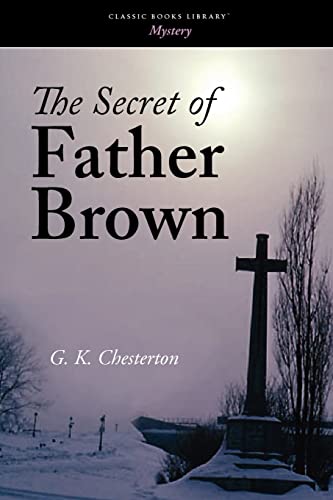
Easily the darkest of Chesterton's Father Brown collections, The Secret of Father Brown is nonetheless a masterwork of perception of the human condition, explored through the usual impossible crimes and a parade of rogues and saints--a corpse in shining armor, a thieving mystic, insouciant British aristocrats, and a Canadian journalist. We are asked to solve death by duel and pistol shot, and thefts of jewels large and small. The stories in this collection are worth reading over and over--to see how the plot unfolds, and to enjoy Chesterton's gorgeous and well-informed prose. Includes the title story, The Mirror of the Magistrate, The Man with Two Beards, The Song of the Flying Fish, The Actor and the Alibi, The Vanishing of Vaudrey, The Worst Crime in the World, The Red Moon of Meru, and The Chief Mourner of Marne. Newly designed and typeset in a modern 6-by-9-inch format by Waking Lion Press.
Les informations fournies dans la section « Synopsis » peuvent faire référence à une autre édition de ce titre.
Biographie de l'auteur
Gilbert Keith Chesterton, (29 May 1874 – 14 June 1936) better known as G. K. Chesterton, was an English writer, lay theologian, poet, philosopher, dramatist, journalist, orator, literary and art critic, biographer, and Christian apologist. Born in Campden Hill in Kensington, London, he was baptized at the age of one month into the Church of England, though his family themselves were irregularly practising Unitarians. According to his autobiography, as a young man he became fascinated with the occult and, along with his brother Cecil, experimented with Ouija boards. He was educated at St Paul's School, then attended the Slade School of Art in order to become an illustrator. In 1896 he began working for the London publisher Redway, and T. Fisher Unwin, where he remained until 1902. During this period he also undertook his first journalistic work as a freelance art and literary critic. In 1902 the Daily News gave him a weekly opinion column, followed in 1905 by a weekly column in The Illustrated London News, for which he continued to write for the next thirty years. He was a large man, standing 6 feet 4 inches and weighing around 286 pounds. His girth gave rise to a famous anecdote. During the First World War a lady in London asked why he was not "out at the Front"; he replied, "If you go round to the side, you will see that I am." On another occasion he remarked to his friend George Bernard Shaw, "To look at you, anyone would think a famine had struck England". Shaw retorted, "To look at you, anyone would think you have caused it". P. G. Wodehouse once described a very loud crash as "a sound like Chesterton falling onto a sheet of tin" He died of congestive heart failure on the morning of 14 June 1936, at his home in Beaconsfield, Buckinghamshire. His last known words were a greeting spoken to his wife. During his life, he wrote around 80 books, several hundred poems, some 200 short stories, 4000 essays, and several plays.
Présentation de l'éditeur
Easily the darkest of Chesterton’s Father Brown collections, it is nonetheless a masterwork of perception of the human condition, explored through the usual impossible crimes and a parade of rogues and saints–a corpse in shining armor, a thieving mystic, insouciant British aristocrats, and a Canadian journalist. We are asked to solve death by duel and pistol shot, and thefts of jewels large and small. The stories in this collection are worth reading over and over–to see how the plot unfolds, and to enjoy Chesterton’s gorgeous and well-informed prose. Includes the title story, The Secret of Father Brown, along with, The Mirror of the Magistrate, The Man with Two Beards, The Song of the Flying Fish, The Actor and the Alibi, The Vanishing of Vaudrey, The Worst Crime in the World, The Red Moon of Meru, and The Chief Mourner of Marne. Gilbert Keith Chesterton was an English writer with a prolific and diverse output which included philosophy, ontology, poetry, play writing, journalism, public lecturing and debating, literary and art criticism, biography, Christian apologetics, and fiction, including fantasy and detective fiction. Chesterton has been called the “prince of paradox”. Time magazine, in a review of a biography of Chesterton, observed of his writing style: “Whenever possible Chesterton made his points with popular sayings, proverbs, allegories–first carefully turning them inside out.”
Les informations fournies dans la section « A propos du livre » peuvent faire référence à une autre édition de ce titre.
Résultats de recherche pour The Secret of Father Brown

Image fournie par le vendeur
Secret Of Father Brown
Edité par
Classic Books Library, 2007
ISBN 10 : 160096835X
ISBN 13 : 9781600968358
Neuf
Couverture souple
Vendeur : GreatBookPrices, Columbia, MD, Etats-Unis
Évaluation du vendeur 5 sur 5 étoiles

Etat : New. N° de réf. du vendeur 5836695-n
Acheter neuf
EUR 13,42
Expédition à EUR 2,36
Expédition nationale : Etats-Unis
Expédition nationale : Etats-Unis
Quantité disponible : Plus de 20 disponibles
Image fournie par le vendeur
The Secret of Father Brown (Paperback or Softback)
Edité par
Classic Books Library 7/30/2008, 2008
ISBN 10 : 160096835X
ISBN 13 : 9781600968358
Neuf
Paperback or Softback
Vendeur : BargainBookStores, Grand Rapids, MI, Etats-Unis
Évaluation du vendeur 5 sur 5 étoiles
Paperback or Softback. Etat : New. The Secret of Father Brown. Book. N° de réf. du vendeur BBS-9781600968358
Acheter neuf
EUR 15,86
Livraison gratuite
Expédition nationale : Etats-Unis
Expédition nationale : Etats-Unis
Quantité disponible : 5 disponible(s)
Image fournie par le vendeur
Secret Of Father Brown
Edité par
Classic Books Library, 2007
ISBN 10 : 160096835X
ISBN 13 : 9781600968358
Ancien ou d'occasion
Couverture souple
Vendeur : GreatBookPrices, Columbia, MD, Etats-Unis
Évaluation du vendeur 5 sur 5 étoiles
Etat : As New. Unread book in perfect condition. N° de réf. du vendeur 5836695
Acheter D'occasion
EUR 14,22
Expédition à EUR 2,36
Expédition nationale : Etats-Unis
Expédition nationale : Etats-Unis
Quantité disponible : Plus de 20 disponibles
Image d'archives
The Secret of Father Brown
impression à la demandeVendeur : PBShop.store US, Wood Dale, IL, Etats-Unis
Évaluation du vendeur 5 sur 5 étoiles
PAP. Etat : New. New Book. Shipped from UK. THIS BOOK IS PRINTED ON DEMAND. Established seller since 2000. N° de réf. du vendeur L0-9781600968358
Acheter neuf
EUR 18,35
Livraison gratuite
Expédition nationale : Etats-Unis
Expédition nationale : Etats-Unis
Quantité disponible : Plus de 20 disponibles
Image d'archives
The Secret of Father Brown
Edité par
Classic Books Library, 2007
ISBN 10 : 160096835X
ISBN 13 : 9781600968358
Neuf
Couverture souple
Vendeur : California Books, Miami, FL, Etats-Unis
Évaluation du vendeur 5 sur 5 étoiles
Etat : New. N° de réf. du vendeur I-9781600968358
Acheter neuf
EUR 18,39
Expédition à EUR 2,68
Expédition nationale : Etats-Unis
Expédition nationale : Etats-Unis
Quantité disponible : Plus de 20 disponibles
Image d'archives
The Secret of Father Brown
impression à la demandeVendeur : PBShop.store UK, Fairford, GLOS, Royaume-Uni
Évaluation du vendeur 5 sur 5 étoiles
PAP. Etat : New. New Book. Delivered from our UK warehouse in 4 to 14 business days. THIS BOOK IS PRINTED ON DEMAND. Established seller since 2000. N° de réf. du vendeur L0-9781600968358
Acheter neuf
EUR 16,87
Expédition à EUR 4,97
Expédition depuis Royaume-Uni vers Etats-Unis
Expédition depuis Royaume-Uni vers Etats-Unis
Quantité disponible : Plus de 20 disponibles
Image d'archives
The Secret of Father Brown
Edité par
Classic Books Library, 2007
ISBN 10 : 160096835X
ISBN 13 : 9781600968358
Neuf
Couverture souple
Vendeur : Ria Christie Collections, Uxbridge, Royaume-Uni
Évaluation du vendeur 5 sur 5 étoiles
Etat : New. In English. N° de réf. du vendeur ria9781600968358_new
Acheter neuf
EUR 18,82
Expédition à EUR 11,19
Expédition depuis Royaume-Uni vers Etats-Unis
Expédition depuis Royaume-Uni vers Etats-Unis
Quantité disponible : Plus de 20 disponibles
Image fournie par le vendeur
Secret Of Father Brown
Edité par
Classic Books Library, 2007
ISBN 10 : 160096835X
ISBN 13 : 9781600968358
Neuf
Couverture souple
Vendeur : GreatBookPricesUK, Woodford Green, Royaume-Uni
Évaluation du vendeur 5 sur 5 étoiles
Etat : New. N° de réf. du vendeur 5836695-n
Acheter neuf
EUR 16,86
Expédition à EUR 17,91
Expédition depuis Royaume-Uni vers Etats-Unis
Expédition depuis Royaume-Uni vers Etats-Unis
Quantité disponible : Plus de 20 disponibles
Image fournie par le vendeur
Secret Of Father Brown
Edité par
Classic Books Library, 2007
ISBN 10 : 160096835X
ISBN 13 : 9781600968358
Ancien ou d'occasion
Couverture souple
Vendeur : GreatBookPricesUK, Woodford Green, Royaume-Uni
Évaluation du vendeur 5 sur 5 étoiles
Etat : As New. Unread book in perfect condition. N° de réf. du vendeur 5836695
Acheter D'occasion
EUR 17,70
Expédition à EUR 17,91
Expédition depuis Royaume-Uni vers Etats-Unis
Expédition depuis Royaume-Uni vers Etats-Unis
Quantité disponible : Plus de 20 disponibles
Image d'archives
The Secret of Father Brown
Edité par
Classic Books Library, 2007
ISBN 10 : 160096835X
ISBN 13 : 9781600968358
Neuf
Paperback / softback
Vendeur : THE SAINT BOOKSTORE, Southport, Royaume-Uni
Évaluation du vendeur 5 sur 5 étoiles
Paperback / softback. Etat : New. This item is printed on demand. New copy - Usually dispatched within 5-9 working days 309. N° de réf. du vendeur C9781600968358
Acheter neuf
EUR 19,56
Expédition à EUR 16,53
Expédition depuis Royaume-Uni vers Etats-Unis
Expédition depuis Royaume-Uni vers Etats-Unis
Quantité disponible : Plus de 20 disponibles