
Articles liés à Apocolocyntosis
Synopsis
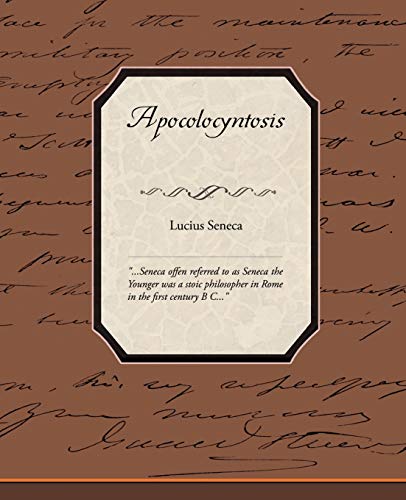
Seneca offen referred to as Seneca the Younger was a stoic philosopher in Rome in the first century B C. Besides being a statesman and dramatist, he was a tutor and advisor to Nero. In 65 A D Seneca was caught in a plot to kill Nero. Although he was probably innocent he was ordered to kill himself by opening his veins. When his old age and poor health made his blood flow too slowly it only caused pain, so Seneca tried poison, which did not work. He then jumped into a hot pool hoping to make his blood run faster. Seneca finally died of suffocation from the hot steam rising from the pool. Apocolocyntosis is a political satire about the emperor Claudius. The Pumpkinification of (the Divine) Claudius is the works alternate title. The title uses the word apotheosis which is the process by which a dead Roman emperor became recognized as a God. The story follows Claudius after his death to his eventual fall into Hades. Apocolocyntosis is a wonderful classis Roman story, which will be enjoyed by anyone interested in that historical period.
Les informations fournies dans la section « Synopsis » peuvent faire référence à une autre édition de ce titre.
Présentation de l'éditeur
Translated by W. H. D. Rouse Show Excerpt On this Jupiter bids Hercules go and find out what country he comes from; you see Hercules had travelled over the whole world, and might be expected to know all the nations in it. But Hercules, the first glimpse he got, was really much taken aback, although not all the monsters in the world could frighten him; when he saw this new kind of object, with its extraordinary gait, and the voice of no terrestrial beast, but such as you might hear in the leviathans of the deep, hoarse and inarticulate, he thought his thirteenth labour had come upon him. When he looked closer, the thing seemed to be a kind of man. Up he goes, then, and says what your Greek finds readiest to his tongue: "Who art thou, and what thy people? Who thy parents, where thy home?" [Sidenote: Od. i, 17] Claudius was delighted to find literary men up there, and began to hope there might be some corner for his own historical works. So he caps him with another Homeric verse, explaining that he was Caesar: "Breezes wafted me from Ilion unto the Ciconian land." [Sidenote: Od. ix, 39]
Biographie de l'auteur
Lucius Annaeus Seneca (c.4BC-AD65) was born in Cordoba, Spain, where he was brought up studying the traditional virtues of republican Roman life. He became a teacher of rhetoric but attracted attention for his incisive style of writing. Closely linked to Nero, his death was ordered by the emperor in AD65. Seneca committed suicide.
Les informations fournies dans la section « A propos du livre » peuvent faire référence à une autre édition de ce titre.
Résultats de recherche pour Apocolocyntosis

Image fournie par le vendeur
Apocolocyntosis
Edité par
Book Jungle, 2008
ISBN 10 : 160597434X
ISBN 13 : 9781605974347
Ancien ou d'occasion
Couverture souple
Vendeur : GreatBookPrices, Columbia, MD, Etats-Unis
Évaluation du vendeur 5 sur 5 étoiles

Etat : As New. Unread book in perfect condition. N° de réf. du vendeur 5625061
Acheter D'occasion
EUR 12,83
Expédition à EUR 2,35
Expédition nationale : Etats-Unis
Expédition nationale : Etats-Unis
Quantité disponible : 1 disponible(s)
Image fournie par le vendeur
Apocolocyntosis
Vendeur : GreatBookPrices, Columbia, MD, Etats-Unis
Évaluation du vendeur 5 sur 5 étoiles
Etat : New. N° de réf. du vendeur 5625061-n
Acheter neuf
EUR 13,76
Expédition à EUR 2,35
Expédition nationale : Etats-Unis
Expédition nationale : Etats-Unis
Quantité disponible : 1 disponible(s)
Image fournie par le vendeur
Apocolocyntosis (Paperback or Softback)
Vendeur : BargainBookStores, Grand Rapids, MI, Etats-Unis
Évaluation du vendeur 5 sur 5 étoiles
Etat : New. Apocolocyntosis (Paperback or Softback). N° de réf. du vendeur BBS-9781605974347
Acheter neuf
EUR 16,19
Livraison gratuite
Expédition nationale : Etats-Unis
Expédition nationale : Etats-Unis
Quantité disponible : 5 disponible(s)
Image d'archives
Apocolocyntosis
impression à la demandeVendeur : PBShop.store US, Wood Dale, IL, Etats-Unis
Évaluation du vendeur 5 sur 5 étoiles
PAP. Etat : New. New Book. Shipped from UK. THIS BOOK IS PRINTED ON DEMAND. Established seller since 2000. N° de réf. du vendeur L0-9781605974347
Acheter neuf
EUR 16,92
Livraison gratuite
Expédition nationale : Etats-Unis
Expédition nationale : Etats-Unis
Quantité disponible : Plus de 20 disponibles
Image d'archives
Apocolocyntosis
Vendeur : California Books, Miami, FL, Etats-Unis
Évaluation du vendeur 5 sur 5 étoiles
Etat : New. N° de réf. du vendeur I-9781605974347
Acheter neuf
EUR 17,39
Livraison gratuite
Expédition nationale : Etats-Unis
Expédition nationale : Etats-Unis
Quantité disponible : Plus de 20 disponibles
Image d'archives
Apocolocyntosis
impression à la demandeVendeur : PBShop.store UK, Fairford, GLOS, Royaume-Uni
Évaluation du vendeur 5 sur 5 étoiles
PAP. Etat : New. New Book. Delivered from our UK warehouse in 4 to 14 business days. THIS BOOK IS PRINTED ON DEMAND. Established seller since 2000. N° de réf. du vendeur L0-9781605974347
Acheter neuf
EUR 16,32
Expédition à EUR 3,87
Expédition depuis Royaume-Uni vers Etats-Unis
Expédition depuis Royaume-Uni vers Etats-Unis
Quantité disponible : Plus de 20 disponibles
Image d'archives
Apocolocyntosis
Edité par
Standard Publications, Incorporated, 2008
ISBN 10 : 160597434X
ISBN 13 : 9781605974347
Neuf
Couverture souple
Vendeur : Majestic Books, Hounslow, Royaume-Uni
Évaluation du vendeur 4 sur 5 étoiles

Etat : New. Print on Demand pp. 48 3:B&W 7.5 x 9.25 in or 235 x 191 mm Perfect Bound on White w/Gloss Lam. N° de réf. du vendeur 105355173
Acheter neuf
EUR 16,80
Expédition à EUR 7,65
Expédition depuis Royaume-Uni vers Etats-Unis
Expédition depuis Royaume-Uni vers Etats-Unis
Quantité disponible : 4 disponible(s)
Image d'archives
Apocolocyntosis
Edité par
Standard Publications, Incorporated, 2008
ISBN 10 : 160597434X
ISBN 13 : 9781605974347
Neuf
Couverture souple
Vendeur : Books Puddle, Woodside, NY, Etats-Unis
Évaluation du vendeur 4 sur 5 étoiles
Etat : New. Print on Demand pp. 48. N° de réf. du vendeur 26103819386
Acheter neuf
EUR 22,46
Expédition à EUR 3,55
Expédition nationale : Etats-Unis
Expédition nationale : Etats-Unis
Quantité disponible : 4 disponible(s)
Image d'archives
Apocolocyntosis
Edité par
Standard Publications, Incorporated, 2008
ISBN 10 : 160597434X
ISBN 13 : 9781605974347
Neuf
Couverture souple
Vendeur : Biblios, Frankfurt am main, HESSE, Allemagne
Évaluation du vendeur 4 sur 5 étoiles
Etat : New. PRINT ON DEMAND pp. 48. N° de réf. du vendeur 18103819376
Acheter neuf
EUR 17,20
Expédition à EUR 9,95
Expédition depuis Allemagne vers Etats-Unis
Expédition depuis Allemagne vers Etats-Unis
Quantité disponible : 4 disponible(s)
Image d'archives
Apocolocyntosis
Vendeur : Ria Christie Collections, Uxbridge, Royaume-Uni
Évaluation du vendeur 5 sur 5 étoiles
Etat : New. In English. N° de réf. du vendeur ria9781605974347_new
Acheter neuf
EUR 16,27
Expédition à EUR 11,03
Expédition depuis Royaume-Uni vers Etats-Unis
Expédition depuis Royaume-Uni vers Etats-Unis
Quantité disponible : Plus de 20 disponibles