
Articles liés à Mathematics Education: A Numerical Landscape
Synopsis
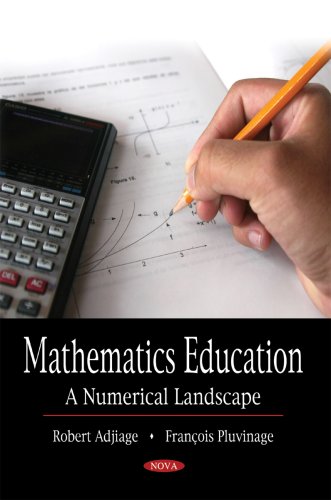
This book concerns the field of mathematics education. Today, for almost any technology, attaining the most advanced level relies on using digital systems. Therefore, the authors focus on number acquisition and use, emphasise major discussions about related topics, and introduce our personal contribution. They consider three areas: numbers in society, at school, and in the field of education. Modern society needs two kinds of number users: the first has to deal with numbers, the second has to work with numbers. According to the framework for PISA assessment, dealing with numbers concerns every citizen facing situations in which the use of a quantitative... reasoning... would help clarify, formulate or solve a problem. Working with numbers is what a professional (marketing specialist, engineer, physician, artist...) does when he has to cope with numerical theoretical frameworks, or when he collaborates with a mathematician. This brings two types of questioning: what does competence in mathematics mean? What level of achievement is desirable in number-learning to meet either numerical need? The authors examine what is proposed for teaching such a broad subject to 7-to-18-year-olds. They first observe and question the educational system, the designer of curricula, scenarios for teaching, training programmes, and national assessments. Secondly, they question the notions of problem solving and modelling as mere responses to mathematics-teaching issues. The authors then focus on what really happens in a standard classroom, particularly how teachers apply recommendations and directives, and how the generalisation of assessments affects their practice. Three aspects are considered: epistemological, cognitive, and didactical. The authors distinguish four related levels which they have named: numeracy (competence linked to whole numbers), rationacy (competence linked to ratios and rational numbers), algebracy (competence linked to algebra), and functionacy (competence linked to calculus). The cognitive aspect evokes the essential issue of semiotic registers for representing and processing numerical objects, considers the discipline-of-expression aspect of mathematics, and other issues taken into account by numerous researchers, such as process and object. The didactical is devoted to exposing our conceptual framework for teaching numbers and understanding their learning. An experiment in ratio teaching is described and analysed.
Les informations fournies dans la section « Synopsis » peuvent faire référence à une autre édition de ce titre.
Résultats de recherche pour Mathematics Education: A Numerical Landscape

Image d'archives
Mathematics Education: A Numerical Landscape
Edité par
Nova Science Publishers Inc, 2009
ISBN 10 : 1606929429
ISBN 13 : 9781606929421
Neuf
Couverture rigide
Vendeur : Revaluation Books, Exeter, Royaume-Uni
Évaluation du vendeur 5 sur 5 étoiles

Hardcover. Etat : Brand New. 82 pages. 8.75x6.00x0.25 inches. In Stock. N° de réf. du vendeur zk1606929429
Acheter neuf
EUR 43,94
Expédition à EUR 11,63
Expédition depuis Royaume-Uni vers Etats-Unis
Expédition depuis Royaume-Uni vers Etats-Unis
Quantité disponible : 1 disponible(s)
Image d'archives
Mathematics Education
Edité par
Nova Science Publishers, Incorporated, 2009
ISBN 10 : 1606929429
ISBN 13 : 9781606929421
Neuf
Couverture rigide
Vendeur : Books Puddle, Woodside, NY, Etats-Unis
Évaluation du vendeur 4 sur 5 étoiles

Etat : New. pp. viii + 82 Index. N° de réf. du vendeur 263530754
Acheter neuf
EUR 58,56
Expédition à EUR 3,51
Expédition nationale : Etats-Unis
Expédition nationale : Etats-Unis
Quantité disponible : 4 disponible(s)
Image d'archives
Mathematics Education
Edité par
Nova Science Publishers, Incorporated, 2009
ISBN 10 : 1606929429
ISBN 13 : 9781606929421
Neuf
Couverture rigide
Vendeur : Majestic Books, Hounslow, Royaume-Uni
Évaluation du vendeur 4 sur 5 étoiles
Etat : New. pp. viii + 82 Illus. N° de réf. du vendeur 4349917
Acheter neuf
EUR 56,81
Expédition à EUR 7,56
Expédition depuis Royaume-Uni vers Etats-Unis
Expédition depuis Royaume-Uni vers Etats-Unis
Quantité disponible : 4 disponible(s)
Image d'archives
Mathematics Education
Edité par
Nova Science Publishers, Incorporated, 2009
ISBN 10 : 1606929429
ISBN 13 : 9781606929421
Neuf
Couverture rigide
Vendeur : Biblios, Frankfurt am main, HESSE, Allemagne
Évaluation du vendeur 4 sur 5 étoiles
Etat : New. pp. viii + 82. N° de réf. du vendeur 183530760
Acheter neuf
EUR 57,42
Expédition à EUR 9,95
Expédition depuis Allemagne vers Etats-Unis
Expédition depuis Allemagne vers Etats-Unis
Quantité disponible : 4 disponible(s)

Edition internationale
MATHEMATICS EDUCATION A NUMERICAL LANDSCAPE (PB 2009)
Edition internationaleVendeur : UK BOOKS STORE, London, LONDO, Royaume-Uni
Évaluation du vendeur 5 sur 5 étoiles
Etat : New. Brand New! Fast Delivery This is an International Edition and ship within 24-48 hours. Deliver by FedEx and Dhl, & Aramex, UPS, & USPS and we do accept APO and PO BOX Addresses. Order can be delivered worldwide within 6-10 days and we do have flat rate for up to 2LB. Extra shipping charges will be requested if the Book weight is more than 5 LB. This Item May be shipped from India, United states & United Kingdom. Depending on your location and availability. N° de réf. du vendeur Cvs 9781606929421
Acheter neuf
EUR 147,86
Expédition à EUR 11,60
Expédition depuis Royaume-Uni vers Etats-Unis
Expédition depuis Royaume-Uni vers Etats-Unis
Quantité disponible : 3 disponible(s)
Image d'archives
Mathematics Education
Edité par
NOVA SCIENCE PUBLISHERS INC, 2009
ISBN 10 : 1606929429
ISBN 13 : 9781606929421
Ancien ou d'occasion
Couverture rigide
Vendeur : BOOKIT!, Genève, Suisse
Évaluation du vendeur 3 sur 5 étoiles

Etat : Used: Like New. LIVRE A L?ETAT DE NEUF. EXPEDIE SOUS 3 JOURS OUVRES. NUMERO DE SUIVI COMMUNIQUE AVANT ENVOI, EMBALLAGE RENFORCE. EAN:9781606929421. N° de réf. du vendeur 9781606929421
Acheter D'occasion
EUR 283,68
Expédition à EUR 53,50
Expédition depuis Suisse vers Etats-Unis
Expédition depuis Suisse vers Etats-Unis
Quantité disponible : 1 disponible(s)