
Articles liés à Trained Capacities: John Dewey, Rhetoric, and Democratic...
Trained Capacities: John Dewey, Rhetoric, and Democratic Practice - Couverture rigide
Livre 40 sur 69: Studies in Rhetoric & Communication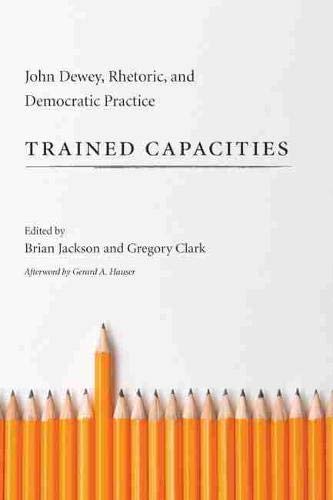
Synopsis
The essays in this collection, written by sixteen scholars in rhetoric and communications studies, demonstrate American philosopher John Dewey's wide-ranging influence on rhetoric in an intellectual tradition that addresses the national culture's fundamental conflicts between self and society, freedom and responsibility, and individual advancement and the common good. Editors Brian Jackson and Gregory Clark propose that this influence is at work both in theoretical foundations, such as science, pragmatism, and religion, and in Dewey's debates with other public intellectuals such as Jane Addams, Walter Lippmann, James Baldwin, and W. E. B. Du Bois. Jackson and Clark seek to establish Dewey as an essential source for those engaged in teaching others how to compose timely, appropriate, useful, and eloquent responses to the diverse and often-contentious rhetorical situations that develop in a democratic culture. They contend that there is more at stake than instruction in traditional modes of public discourse because democratic culture encompasses a variety of situations, private or public, civic or professional, where people must cooperate in the work of advancing a common project. What prepares people to intervene constructively in such situations is instruction in those rhetorical practices of democratic interaction that is implicit throughout Dewey's work. Dewey's writing provides a rich framework on which a distinctly American tradition of a democratic rhetorical practice can be built-a tradition that combines the most useful concepts of classical rhetoric with those of modern progressive civic engagement. Jackson and Clark believe Dewey's practice takes rhetoric beyond the traditional emphasis on political democracy to provide connections to rich veins of American thought such as individualism, liberalism, progressive education, collectivism, pragmatism, and postindustrial science and communication. They frame Dewey's voluminous work as constituting a modern expression of continuing education for the "trained capacities" required to participate in democratic culture. For Dewey human potential is best realized in the free flow of artful communication among the individuals who together constitute society. The book concludes with an afterword by Gerard A. Hauser, College Professor of Distinction in the Department of Communication at the University of Colorado Boulder.
Les informations fournies dans la section « Synopsis » peuvent faire référence à une autre édition de ce titre.
À propos de l'auteur
Gregory Clark is professor of English and associate dean of the College of Humanities at Brigham Young University. He is the author of Rhetorical Landscapes in America: Variations on a Theme from Kenneth Burke (University of South Carolina Press).
Les informations fournies dans la section « A propos du livre » peuvent faire référence à une autre édition de ce titre.
Résultats de recherche pour Trained Capacities: John Dewey, Rhetoric, and Democratic...

Image d'archives
Trained Capacities: John Dewey, Rhetoric, and Democratic Practice
Edité par
The University of South Carolina Press, 2014
ISBN 10 : 1611173183
ISBN 13 : 9781611173185
Ancien ou d'occasion
Couverture rigide
Signé
Vendeur : Mesquite Booksellers, Tucson, AZ, Etats-Unis
Évaluation du vendeur 5 sur 5 étoiles

Hardcover. Etat : Very Good. No Jacket. x,270. No jacket, as issued. Significant wear/rubbing to the hard covers, but no nicks, chips, scratches, creases or tears. One of the bottom corners, and the tail of the spine, are pressed. Bump at the bottom of the rear board. A little staining at the bottom of the fore-edge. Interior and spine/binding are pristine/as new. If you order this from outside the United States, we will almost certainly request an additional payment to help cover the postage. Please feel welcome to message us with any questions, or a request for photographs. Every order includes tracking and is wrapped and robustly packaged with care in Tucson, AZ. ~Mesquite Booksellers. Inscribed by Author(s). N° de réf. du vendeur 75830
Acheter D'occasion
EUR 36,61
Expédition à EUR 2,67
Expédition nationale : Etats-Unis
Expédition nationale : Etats-Unis
Quantité disponible : 1 disponible(s)
Image fournie par le vendeur
Trained Capacities : John Dewey, Rhetoric, and Democratic Practice
Edité par
University of South Carolina Press, 2014
ISBN 10 : 1611173183
ISBN 13 : 9781611173185
Ancien ou d'occasion
Couverture rigide
Vendeur : GreatBookPrices, Columbia, MD, Etats-Unis
Évaluation du vendeur 5 sur 5 étoiles
Etat : As New. Unread book in perfect condition. N° de réf. du vendeur 20854440
Acheter D'occasion
EUR 74,45
Expédition à EUR 2,35
Expédition nationale : Etats-Unis
Expédition nationale : Etats-Unis
Quantité disponible : Plus de 20 disponibles
Image fournie par le vendeur
Trained Capacities : John Dewey, Rhetoric, and Democratic Practice
Edité par
University of South Carolina Press, 2014
ISBN 10 : 1611173183
ISBN 13 : 9781611173185
Ancien ou d'occasion
Couverture rigide
Vendeur : GreatBookPricesUK, Woodford Green, Royaume-Uni
Évaluation du vendeur 5 sur 5 étoiles
Etat : As New. Unread book in perfect condition. N° de réf. du vendeur 20854440
Acheter D'occasion
EUR 81,75
Expédition à EUR 17,68
Expédition depuis Royaume-Uni vers Etats-Unis
Expédition depuis Royaume-Uni vers Etats-Unis
Quantité disponible : Plus de 20 disponibles
Image d'archives
Trained Capacities John Dewey, Rhetoric, and Democratic Practice
Edité par
Univ of South Carolina Pr, 2014
ISBN 10 : 1611173183
ISBN 13 : 9781611173185
Neuf
Couverture rigide
Vendeur : Revaluation Books, Exeter, Royaume-Uni
Évaluation du vendeur 5 sur 5 étoiles
Hardcover. Etat : Brand New. 256 pages. 9.25x6.25x1.00 inches. In Stock. N° de réf. du vendeur x-1611173183
Acheter neuf
EUR 94,54
Expédition à EUR 11,79
Expédition depuis Royaume-Uni vers Etats-Unis
Expédition depuis Royaume-Uni vers Etats-Unis
Quantité disponible : 2 disponible(s)
Image fournie par le vendeur
Trained Capacities : John Dewey, Rhetoric, and Democratic Practice
Edité par
University of South Carolina Press, 2014
ISBN 10 : 1611173183
ISBN 13 : 9781611173185
Neuf
Couverture rigide
Vendeur : GreatBookPrices, Columbia, MD, Etats-Unis
Évaluation du vendeur 5 sur 5 étoiles
Etat : New. N° de réf. du vendeur 20854440-n
Acheter neuf
EUR 107,09
Expédition à EUR 2,35
Expédition nationale : Etats-Unis
Expédition nationale : Etats-Unis
Quantité disponible : Plus de 20 disponibles
Image fournie par le vendeur
Trained Capacities : John Dewey, Rhetoric, and Democratic Practice
Edité par
University of South Carolina Press, 2014
ISBN 10 : 1611173183
ISBN 13 : 9781611173185
Neuf
Couverture rigide
Vendeur : GreatBookPricesUK, Woodford Green, Royaume-Uni
Évaluation du vendeur 5 sur 5 étoiles
Etat : New. N° de réf. du vendeur 20854440-n
Acheter neuf
EUR 100,58
Expédition à EUR 17,68
Expédition depuis Royaume-Uni vers Etats-Unis
Expédition depuis Royaume-Uni vers Etats-Unis
Quantité disponible : Plus de 20 disponibles
Image fournie par le vendeur
Trained Capacities
Edité par
The University of South Carolina Press, 2014
ISBN 10 : 1611173183
ISBN 13 : 9781611173185
Neuf
Couverture rigide
Vendeur : moluna, Greven, Allemagne
Évaluation du vendeur 5 sur 5 étoiles
Etat : New. Über den AutorBrian Jackson is an associate professor of English and university writing coordinator at Brigham Young University, USA. He has published articles in Rhetoric Review, Composition Studies, College Composition and Com. N° de réf. du vendeur 904505084
Acheter neuf
EUR 71,69
Expédition à EUR 48,99
Expédition depuis Allemagne vers Etats-Unis
Expédition depuis Allemagne vers Etats-Unis
Quantité disponible : Plus de 20 disponibles
Image fournie par le vendeur
Trained Capacities : John Dewey, Rhetoric, and Democratic Practice
Edité par
University Of South Carolina Press Jan 2014, 2014
ISBN 10 : 1611173183
ISBN 13 : 9781611173185
Neuf
Couverture rigide
Vendeur : AHA-BUCH GmbH, Einbeck, Allemagne
Évaluation du vendeur 5 sur 5 étoiles
Buch. Etat : Neu. Neuware - The essays in this collection, written by sixteen scholars in rhetoric and communications studies, demonstrate American philosopher John Dewey's wide-ranging influence on rhetoric in an intellectual tradition that addresses the national culture's fundamental conflicts between self and society, freedom and responsibility, and individual advancement and the common good. Editors Brian Jackson and Gregory Clark propose that this influence is at work both in theoretical foundations, such as science, pragmatism, and religion, and in Dewey's debates with other public intellectuals such as Jane Addams, Walter Lippmann, James Baldwin, and W. E. B. Du Bois.Jackson and Clark seek to establish Dewey as an essential source for those engaged in teaching others how to compose timely, appropriate, useful, and eloquent responses to the diverse and often-contentious rhetorical situations that develop in a democratic culture. They contend that there is more at stake than instruction in traditional modes of public discourse because democratic culture encompasses a variety of situations, private or public, civic or professional, where people must cooperate in the work of advancing a common project. What prepares people to intervene constructively in such situations is instruction in those rhetorical practices of democratic interaction that is implicit throughout Dewey's work.Dewey's writing provides a rich framework on which a distinctly American tradition of a democratic rhetorical practice can be built--a tradition that combines the most useful concepts of classical rhetoric with those of modern progressive civic engagement. Jackson and Clark believe Dewey's practice takes rhetoric beyond the traditional emphasis on political democracy to provide connections to rich veins of American thought such as individualism, liberalism, progressive education, collectivism, pragmatism, and postindustrial science and communication. They frame Dewey's voluminous work as constituting a modern expression of continuing education for the ''trained capacities'' required to participate in democratic culture. For Dewey human potential is best realized in the free flow of artful communication among the individuals who together constitute society.The book concludes with an afterword by Gerard A. Hauser, College Professor of Distinction in the Department of Communication at the University of Colorado Boulder, USA. N° de réf. du vendeur 9781611173185
Acheter neuf
EUR 96,14
Expédition à EUR 35
Expédition depuis Allemagne vers Etats-Unis
Expédition depuis Allemagne vers Etats-Unis
Quantité disponible : 2 disponible(s)