
Articles liés à The Idea of Disability in the Eighteenth Century
The Idea of Disability in the Eighteenth Century - Couverture souple
Livre 31 sur 76: Transits: Literature, Thought & Culture 1650-1850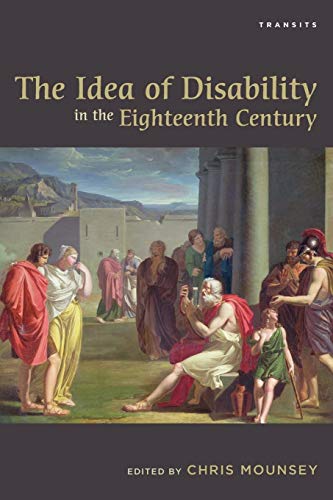
Synopsis
The Idea of Disability in the Eighteenth Century explores disabled people who lived in the eighteenth century. The first four essays consider philosophical writing dating between 1663 and 1788, when the understanding of disability altered dramatically. We begin with Margaret Cavendish, whose natural philosophy rejected ideas of superiority or inferiority between individuals based upon physical or mental difference. We then move to John Locke, the founder of empiricism in 1680, who believed that the basis of knowledge was observability, but who, faced with the lack of anything to observe, broke his own epistemological rules in his explanation of mental illness. Understanding the problems that empiricism set up, Anthony Ashley Cooper, Lord Shaftesbury, turned in 1711 to moral philosophy, but also founded his philosophy on a flaw. He believed in the harmony of "the aesthetic trinity of beauty, truth, and virtue" but he could not believe that a disabled friend, whom he knew to have been moral before his physical alteration, could change inside. Lastly, we explore Thomas Reid who in 1788 returned to the body as the ground of philosophical enquiry and saw the body as a whole-complete in itself and wanting nothing, be it missing a sense (Reid was deaf) or a physical or mental capacity.
At the heart of the study of any historical artifact is the question of where to look for evidence, and when looking for evidence of disability, we have largely to rely upon texts. However, texts come in many forms, and the next two essays explore three types-the novel, the periodical and the pamphlet-which pour out their ideas of disability in different ways.
Evidence of disabled people in the eighteenth century is sparse, and the lives the more evanescent. The last four essays bring to light little known disabled people, or people who are little known for their disability, giving various forms of biographical accounts of Susanna Harrison, Sarah Scott, Priscilla Poynton and Thomas Gills, who are all but forgotten in the academic world as well as to public consciousness.
Les informations fournies dans la section « Synopsis » peuvent faire référence à une autre édition de ce titre.
À propos des auteurs
Chris Mounsey is professor of English at the University of Winchester.
Paul Kelleher is associate professor of English at Emory University.
Les informations fournies dans la section « A propos du livre » peuvent faire référence à une autre édition de ce titre.
Résultats de recherche pour The Idea of Disability in the Eighteenth Century

Image fournie par le vendeur
Idea of Disability in the Eighteenth Century
Edité par
Bucknell University Press, 2015
ISBN 10 : 1611487390
ISBN 13 : 9781611487398
Ancien ou d'occasion
Couverture souple
Vendeur : GreatBookPrices, Columbia, MD, Etats-Unis
Évaluation du vendeur 5 sur 5 étoiles

Etat : As New. Unread book in perfect condition. N° de réf. du vendeur 24805462
Acheter D'occasion
EUR 66,96
Expédition à EUR 2,36
Expédition nationale : Etats-Unis
Expédition nationale : Etats-Unis
Quantité disponible : 10 disponible(s)
Image fournie par le vendeur
Idea of Disability in the Eighteenth Century
Edité par
Bucknell University Press, 2015
ISBN 10 : 1611487390
ISBN 13 : 9781611487398
Neuf
Couverture souple
Vendeur : GreatBookPrices, Columbia, MD, Etats-Unis
Évaluation du vendeur 5 sur 5 étoiles
Etat : New. N° de réf. du vendeur 24805462-n
Acheter neuf
EUR 70,31
Expédition à EUR 2,36
Expédition nationale : Etats-Unis
Expédition nationale : Etats-Unis
Quantité disponible : 10 disponible(s)
Image d'archives
The Idea of Disability in the Eighteenth Century
impression à la demandeVendeur : PBShop.store US, Wood Dale, IL, Etats-Unis
Évaluation du vendeur 5 sur 5 étoiles
PAP. Etat : New. New Book. Shipped from UK. THIS BOOK IS PRINTED ON DEMAND. Established seller since 2000. N° de réf. du vendeur L0-9781611487398
Acheter neuf
EUR 72,75
Livraison gratuite
Expédition nationale : Etats-Unis
Expédition nationale : Etats-Unis
Quantité disponible : Plus de 20 disponibles
Image d'archives
The Idea of Disability in the Eighteenth Century
impression à la demandeVendeur : PBShop.store UK, Fairford, GLOS, Royaume-Uni
Évaluation du vendeur 5 sur 5 étoiles
PAP. Etat : New. New Book. Delivered from our UK warehouse in 4 to 14 business days. THIS BOOK IS PRINTED ON DEMAND. Established seller since 2000. N° de réf. du vendeur L0-9781611487398
Acheter neuf
EUR 69,64
Expédition à EUR 4,97
Expédition depuis Royaume-Uni vers Etats-Unis
Expédition depuis Royaume-Uni vers Etats-Unis
Quantité disponible : Plus de 20 disponibles
Image fournie par le vendeur
The Idea of Disability in the Eighteenth Century
Edité par
Associated University Presses, US, 2015
ISBN 10 : 1611487390
ISBN 13 : 9781611487398
Neuf
Paperback
Vendeur : Rarewaves.com USA, London, LONDO, Royaume-Uni
Évaluation du vendeur 5 sur 5 étoiles
Paperback. Etat : New. The Idea of Disability in the Eighteenth Century explores disabled people who lived in the eighteenth century. The first four essays consider philosophical writing dating between 1663 and 1788, when the understanding of disability altered dramatically. We begin with Margaret Cavendish, whose natural philosophy rejected ideas of superiority or inferiority between individuals based upon physical or mental difference. We then move to John Locke, the founder of empiricism in 1680, who believed that the basis of knowledge was observability, but who, faced with the lack of anything to observe, broke his own epistemological rules in his explanation of mental illness. Understanding the problems that empiricism set up, Anthony Ashley Cooper, Lord Shaftesbury, turned in 1711 to moral philosophy, but also founded his philosophy on a flaw. He believed in the harmony of "the aesthetic trinity of beauty, truth, and virtue" but he could not believe that a disabled friend, whom he knew to have been moral before his physical alteration, could change inside. Lastly, we explore Thomas Reid who in 1788 returned to the body as the ground of philosophical enquiry and saw the body as a whole-complete in itself and wanting nothing, be it missing a sense (Reid was deaf) or a physical or mental capacity.At the heart of the study of any historical artifact is the question of where to look for evidence, and when looking for evidence of disability, we have largely to rely upon texts. However, texts come in many forms, and the next two essays explore three types-the novel, the periodical and the pamphlet-which pour out their ideas of disability in different ways.Evidence of disabled people in the eighteenth century is sparse, and the lives the more evanescent. The last four essays bring to light little known disabled people, or people who are little known for their disability, giving various forms of biographical accounts of Susanna Harrison, Sarah Scott, Priscilla Poynton and Thomas Gills, who are all but forgotten in the academic world as well as to public consciousness. N° de réf. du vendeur LU-9781611487398
Acheter neuf
EUR 74,66
Livraison gratuite
Expédition depuis Royaume-Uni vers Etats-Unis
Expédition depuis Royaume-Uni vers Etats-Unis
Quantité disponible : Plus de 20 disponibles
Image d'archives
Idea of Disability in the Eighteenth Century
Edité par
Bucknell University Press, 2015
ISBN 10 : 1611487390
ISBN 13 : 9781611487398
Neuf
Couverture souple
Vendeur : GreatBookPricesUK, Woodford Green, Royaume-Uni
Évaluation du vendeur 5 sur 5 étoiles
Etat : New. N° de réf. du vendeur 24805462-n
Acheter neuf
EUR 69,63
Expédition à EUR 17,91
Expédition depuis Royaume-Uni vers Etats-Unis
Expédition depuis Royaume-Uni vers Etats-Unis
Quantité disponible : 10 disponible(s)
Image d'archives
The Idea of Disability in the Eighteenth Century (Transits: Literature, Thought & Culture, 1650-1850)
Edité par
Bucknell University Press, 2015
ISBN 10 : 1611487390
ISBN 13 : 9781611487398
Neuf
Couverture souple
Vendeur : Ria Christie Collections, Uxbridge, Royaume-Uni
Évaluation du vendeur 5 sur 5 étoiles
Etat : New. In English. N° de réf. du vendeur ria9781611487398_new
Acheter neuf
EUR 75,77
Expédition à EUR 13,48
Expédition depuis Royaume-Uni vers Etats-Unis
Expédition depuis Royaume-Uni vers Etats-Unis
Quantité disponible : Plus de 20 disponibles
Image fournie par le vendeur
Idea of Disability in the Eighteenth Century
Edité par
Bucknell University Press, 2015
ISBN 10 : 1611487390
ISBN 13 : 9781611487398
Ancien ou d'occasion
Couverture souple
Vendeur : GreatBookPricesUK, Woodford Green, Royaume-Uni
Évaluation du vendeur 5 sur 5 étoiles
Etat : As New. Unread book in perfect condition. N° de réf. du vendeur 24805462
Acheter D'occasion
EUR 73,04
Expédition à EUR 17,91
Expédition depuis Royaume-Uni vers Etats-Unis
Expédition depuis Royaume-Uni vers Etats-Unis
Quantité disponible : 10 disponible(s)
Image d'archives
The Idea of Disability in the Eighteenth Century
Edité par
Bucknell University Press, 2015
ISBN 10 : 1611487390
ISBN 13 : 9781611487398
Neuf
Paperback / softback
Vendeur : THE SAINT BOOKSTORE, Southport, Royaume-Uni
Évaluation du vendeur 5 sur 5 étoiles
Paperback / softback. Etat : New. This item is printed on demand. New copy - Usually dispatched within 5-9 working days. N° de réf. du vendeur C9781611487398
Acheter neuf
EUR 79,99
Expédition à EUR 18,57
Expédition depuis Royaume-Uni vers Etats-Unis
Expédition depuis Royaume-Uni vers Etats-Unis
Quantité disponible : Plus de 20 disponibles
Image d'archives
The Idea of Disability in the Eighteenth Century
Vendeur : Revaluation Books, Exeter, Royaume-Uni
Évaluation du vendeur 5 sur 5 étoiles
Paperback. Etat : Brand New. reprint edition. 280 pages. 8.75x6.00x0.75 inches. In Stock. N° de réf. du vendeur x-1611487390
Acheter neuf
EUR 96,40
Expédition à EUR 11,94
Expédition depuis Royaume-Uni vers Etats-Unis
Expédition depuis Royaume-Uni vers Etats-Unis
Quantité disponible : 2 disponible(s)