
Articles liés à Proprotein Convertases: Discovery, Characteristics,...
Proprotein Convertases: Discovery, Characteristics, and Link to Tumor Progression and Metastasis - Couverture souple
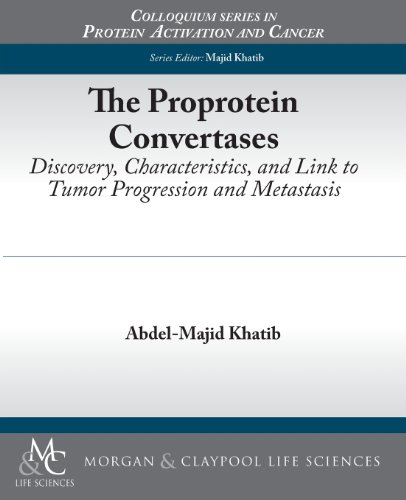
Synopsis
Proprotein convertases (PCs) are a family of proteases including PC1, PC2, Furin, PC4, PACE4, PC5, and PC7. These enzymes are involved in the maturation of many precursor proteins involved in the process of tumorigenesis and metastasis. Since their discovery, PCs were suggested as potential targets for anti-cancer therapy, and their activity was found to directly affect tumor cell proliferation, migration invasion, and the malignant phenotypes of tumor cells. Here, we discuss a number of previous and recent findings on the PCs features, their implication in the regulation of multiple cellular functions that impact on the invasive/metastatic potential of cancer cells, and their clinical relevance in cancer patients.Among the substrates of the proprotein convertases, various growth factors, their receptors, adhesion molecules, and proteases were identified. The PCs are inhibited by endogenous and exogenous inhibitors. To date, only pro7B2, a specific chaperone of PC2, and the granine-like precursor of neuroendocrine protein proSAAS, a selective ligand of PC1, have been identified as endogenous inhibitors of the PCs found in the regulated pathway. However, only PCs prosegments, several bioengineered inhibitors, peptides, and non-peptide compounds were found to inhibit the activity of the PCs found in the secretory pathway.
Les informations fournies dans la section « Synopsis » peuvent faire référence à une autre édition de ce titre.
À propos de l'auteur
University of Bordeaux, France
Les informations fournies dans la section « A propos du livre » peuvent faire référence à une autre édition de ce titre.
Résultats de recherche pour Proprotein Convertases: Discovery, Characteristics,...

Image d'archives
Proprotein Convertases: Discovery, Characteristics, and Link to Tumor Progression and Metastasis (Colloquium Series on Protein Activation and Cancer)
Edité par
Morgan & Claypool Life Sciences, 2013
ISBN 10 : 1615045368
ISBN 13 : 9781615045365
Ancien ou d'occasion
paperback
Vendeur : suffolkbooks, Center moriches, NY, Etats-Unis
Évaluation du vendeur 5 sur 5 étoiles

paperback. Etat : Very Good. Fast Shipping - Safe and Secure 7 days a week! N° de réf. du vendeur 3TWOWA001MBP
Acheter D'occasion
EUR 15,98
Expédition à EUR 3,44
Expédition nationale : Etats-Unis
Expédition nationale : Etats-Unis
Quantité disponible : 3 disponible(s)
Image fournie par le vendeur
Proprotein Convertases : Discovery, Characteristics, and Link to Tumor Progression and Metastasis
Edité par
Morgan & Claypool Life Sciences, 2013
ISBN 10 : 1615045368
ISBN 13 : 9781615045365
Neuf
Couverture souple
Vendeur : GreatBookPrices, Columbia, MD, Etats-Unis
Évaluation du vendeur 5 sur 5 étoiles
Etat : New. N° de réf. du vendeur 19503852-n
Acheter neuf
EUR 40,92
Expédition à EUR 2,28
Expédition nationale : Etats-Unis
Expédition nationale : Etats-Unis
Quantité disponible : Plus de 20 disponibles
Image fournie par le vendeur
The Proprotein Convertases: Discovery, Characteristics, and Link to Tumor Progression and Metastasis (Paperback or Softback)
Edité par
Morgan & Claypool 2/1/2013, 2013
ISBN 10 : 1615045368
ISBN 13 : 9781615045365
Neuf
Paperback or Softback
Vendeur : BargainBookStores, Grand Rapids, MI, Etats-Unis
Évaluation du vendeur 5 sur 5 étoiles
Paperback or Softback. Etat : New. The Proprotein Convertases: Discovery, Characteristics, and Link to Tumor Progression and Metastasis. Book. N° de réf. du vendeur BBS-9781615045365
Acheter neuf
EUR 43,27
Livraison gratuite
Expédition nationale : Etats-Unis
Expédition nationale : Etats-Unis
Quantité disponible : 5 disponible(s)
Image d'archives
Proprotein Convertases: Discovery, Characteristics, and Link to Tumor Progression and Metastasis (Colloquium Series on Protein Activation and Cancer)
Edité par
Morgan & Claypool Life Sciences, 2013
ISBN 10 : 1615045368
ISBN 13 : 9781615045365
Neuf
Couverture souple
Vendeur : California Books, Miami, FL, Etats-Unis
Évaluation du vendeur 4 sur 5 étoiles

Etat : New. N° de réf. du vendeur I-9781615045365
Acheter neuf
EUR 47,95
Livraison gratuite
Expédition nationale : Etats-Unis
Expédition nationale : Etats-Unis
Quantité disponible : Plus de 20 disponibles
Image d'archives
The Proprotein Convertases
Edité par
Morgan and Claypool Publishers, 2013
ISBN 10 : 1615045368
ISBN 13 : 9781615045365
Neuf
PAP
Vendeur : PBShop.store UK, Fairford, GLOS, Royaume-Uni
Évaluation du vendeur 5 sur 5 étoiles
PAP. Etat : New. New Book. Delivered from our UK warehouse in 4 to 14 business days. THIS BOOK IS PRINTED ON DEMAND. Established seller since 2000. N° de réf. du vendeur IQ-9781615045365
Acheter neuf
EUR 47,71
Expédition à EUR 4,85
Expédition depuis Royaume-Uni vers Etats-Unis
Expédition depuis Royaume-Uni vers Etats-Unis
Quantité disponible : 15 disponible(s)
Image d'archives
Proprotein Convertases: Discovery, Characteristics, and Link to Tumor Progression and Metastasis (Colloquium Series on Protein Activation and Cancer)
Edité par
Morgan & Claypool Life Sciences, 2013
ISBN 10 : 1615045368
ISBN 13 : 9781615045365
Neuf
Couverture souple
Vendeur : Ria Christie Collections, Uxbridge, Royaume-Uni
Évaluation du vendeur 5 sur 5 étoiles
Etat : New. In. N° de réf. du vendeur ria9781615045365_new
Acheter neuf
EUR 49,12
Expédition à EUR 13,17
Expédition depuis Royaume-Uni vers Etats-Unis
Expédition depuis Royaume-Uni vers Etats-Unis
Quantité disponible : Plus de 20 disponibles
Image d'archives
The Proprotein Convertases: Discovery, Characteristics, and Link to Tumor Progression and Metastasis
Vendeur : Chiron Media, Wallingford, Royaume-Uni
Évaluation du vendeur 5 sur 5 étoiles
PF. Etat : New. N° de réf. du vendeur 6666-IUK-9781615045365
Acheter neuf
EUR 46,42
Expédition à EUR 18,06
Expédition depuis Royaume-Uni vers Etats-Unis
Expédition depuis Royaume-Uni vers Etats-Unis
Quantité disponible : 10 disponible(s)
Image fournie par le vendeur
Proprotein Convertases : Discovery, Characteristics, and Link to Tumor Progression and Metastasis
Edité par
Morgan & Claypool Life Sciences, 2013
ISBN 10 : 1615045368
ISBN 13 : 9781615045365
Neuf
Couverture souple
Vendeur : GreatBookPricesUK, Woodford Green, Royaume-Uni
Évaluation du vendeur 5 sur 5 étoiles
Etat : New. N° de réf. du vendeur 19503852-n
Acheter neuf
EUR 47,69
Expédition à EUR 17,49
Expédition depuis Royaume-Uni vers Etats-Unis
Expédition depuis Royaume-Uni vers Etats-Unis
Quantité disponible : Plus de 20 disponibles
Image d'archives
Proprotein Convertases: Discovery, Characteristics, and Link to Tumor Progression and Metastasis (Colloquium Series on Protein Activation and Cancer)
Edité par
Morgan & Claypool Life Sciences, 2013
ISBN 10 : 1615045368
ISBN 13 : 9781615045365
Neuf
Paperback
Vendeur : Revaluation Books, Exeter, Royaume-Uni
Évaluation du vendeur 5 sur 5 étoiles
Paperback. Etat : Brand New. 84 pages. 9.25x7.50x0.19 inches. In Stock. N° de réf. du vendeur x-1615045368
Acheter neuf
EUR 55,60
Expédition à EUR 11,66
Expédition depuis Royaume-Uni vers Etats-Unis
Expédition depuis Royaume-Uni vers Etats-Unis
Quantité disponible : 2 disponible(s)
Image d'archives
The Proprotein Convertases
Edité par
Morgan & Claypool Publishers, 2013
ISBN 10 : 1615045368
ISBN 13 : 9781615045365
Neuf
Couverture souple
Vendeur : Majestic Books, Hounslow, Royaume-Uni
Évaluation du vendeur 4 sur 5 étoiles
Etat : New. Print on Demand pp. 86 3:B&W 7.5 x 9.25 in or 235 x 191 mm Perfect Bound on White w/Gloss Lam. N° de réf. du vendeur 130543665
Acheter neuf
EUR 60,31
Expédition à EUR 7,58
Expédition depuis Royaume-Uni vers Etats-Unis
Expédition depuis Royaume-Uni vers Etats-Unis
Quantité disponible : 4 disponible(s)