
Articles liés à Stolen Legacy: Greek Philosphy Is Stolen Egyptian Philosophy
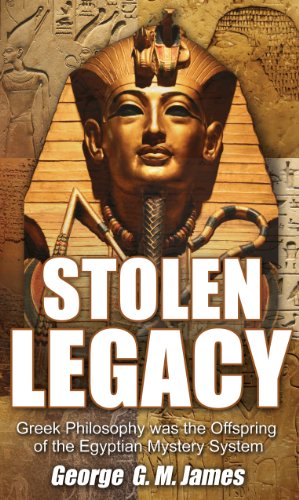
Synopsis
George James was a professor at a small black college in Arkansas during the 1950s when he wrote this book. Originally from Guyana, he was an intellectual who studied African and European classics. He soon realized something was wrong with the way the history of philosophy had been documented by Western scholars. Their biggest mistake, according to James, was they had assumed philosophy had started with the Greeks. James had found that philosophy was almost entirely from ancient Egypt and that the records of this had not only been distorted but, in many cases, deliberately falsified. His conclusion was that there was no such thing as Greek philosophy because it was stolen from the Egyptians. As a result, this was one of the first books to be banned from colleges and universities throughout North America. Although opponents have eventually found some flaws, it remains a groundbreaking book to this day. Even the famous Greek historian from the 5th century, Herodotus, admitted that the Greeks had borrowed many important ideas and concepts from the Egyptians. These ideas covered not just philosophy, but also medicine, architecture, politics and more. The purpose of this book is to restore the truth about African contributions to higher thought and culture.
Les informations fournies dans la section « Synopsis » peuvent faire référence à une autre édition de ce titre.
Présentation de l'éditeur
"Stolen Legacy," by Dr. George G. M. James, is a controversial work first published in 1954. To the consternation of some, James dared to assert that the Greeks were not the authors of Greek philosophy, and that so-called Greek philosophy was in fact based upon the primary ideas and concepts borrowed-without acknowledgement-from the ancient Egyptians. Written during Dr. James tenure at the University of Arkansas, "Stolen Legacy" raises more thought-provoking questions and uncomfortable questions than it answers. Though many may disagree with James' findings, his book confirms the words of Solomon, "there is nothing new under the sun." Truth and wisdom has been in existence since time began. Greek culture learned much from the Egyptians. Alexander the Great and the Ptolemy dynasty were Greek, but they did not disturb the religion or the customs of the Egyptians, and indeed built magnificent new temples for the Egyptian gods. Ptolemy I, perhaps with advice from Demetrius of Phalerum, founded the Museum and Library of Alexandria, a key academic, literary, and scientific center which drew the top Greek scholars. In "Stolen Legacy," James shows how famous Greek philosophers such as Socrates, Plato, and Aristotle were heavily influenced by Egyptian culture, and how many of their teachings were what they had learned from the Egyptians.
Présentation de l'éditeur
George Granville Monah James was a South American historian and author, best known for his 1954 book Stolen Legacy, in which he argued that Greek philosophy originated in ancient Egypt. "The term 'Greek philosophy,' to begin with is a misnomer, for there is no such philosophy in existence. The ancient Egyptians had developed a very complex religious system, called the Mysteries, which was also the first system of salvation. "As such, it regarded the human body as a prison house of the soul, which could be liberated from its bodily impediments, through the disciplines of the Arts and Sciences, and advanced from the level of a mortal to that of a God. This was the notion of the summum bonum or greatest good, to which all men must aspire, and it also became the basis of all ethical concepts. The Egyptian Mystery System was also a Secret Order, and membership was gained by initiation and a pledge to secrecy. The teaching was graded and delivered orally to the Neophyte; and under these circumstances of secrecy, the Egyptians developed secret systems of writing and teaching, and forbade their Initiates from writing what they had learnt. "After nearly five thousand years of prohibition against the Greeks, they were permitted to enter Egypt for the purpose of their education."
Les informations fournies dans la section « A propos du livre » peuvent faire référence à une autre édition de ce titre.
Résultats de recherche pour Stolen Legacy: Greek Philosphy Is Stolen Egyptian Philosophy

Image d'archives
Stolen Legacy
Vendeur : Lakeside Books, Benton Harbor, MI, Etats-Unis
Évaluation du vendeur 5 sur 5 étoiles

Etat : New. Brand New! Not Overstocks or Low Quality Book Club Editions! Direct From the Publisher! We're not a giant, faceless warehouse organization! We're a small town bookstore that loves books and loves it's customers! Buy from Lakeside Books! N° de réf. du vendeur OTF-S-9781617590740
Acheter neuf
EUR 6,30
Expédition à EUR 3,56
Expédition nationale : Etats-Unis
Expédition nationale : Etats-Unis
Quantité disponible : 12 disponible(s)
Image fournie par le vendeur
Stolen Legacy : Greek Philosphy Is Stolen Egyptian Philosophy
Vendeur : GreatBookPrices, Columbia, MD, Etats-Unis
Évaluation du vendeur 5 sur 5 étoiles
Etat : New. N° de réf. du vendeur 20966486-n
Acheter neuf
EUR 7,53
Expédition à EUR 2,36
Expédition nationale : Etats-Unis
Expédition nationale : Etats-Unis
Quantité disponible : 10 disponible(s)
Image fournie par le vendeur
Stolen Legacy : Greek Philosphy Is Stolen Egyptian Philosophy
Edité par
EWorld Inc., 2013
ISBN 10 : 1617590746
ISBN 13 : 9781617590740
Ancien ou d'occasion
Couverture souple
Vendeur : GreatBookPrices, Columbia, MD, Etats-Unis
Évaluation du vendeur 5 sur 5 étoiles
Etat : As New. Unread book in perfect condition. N° de réf. du vendeur 20966486
Acheter D'occasion
EUR 7,99
Expédition à EUR 2,36
Expédition nationale : Etats-Unis
Expédition nationale : Etats-Unis
Quantité disponible : 10 disponible(s)
Image d'archives
Stolen Legacy: Greek Philosophy Was the Offspring of the Egyptian Mystery System (Paperback or Softback)
Edité par
Eworld 12/12/2013, 2013
ISBN 10 : 1617590746
ISBN 13 : 9781617590740
Neuf
Paperback or Softback
Vendeur : BargainBookStores, Grand Rapids, MI, Etats-Unis
Évaluation du vendeur 5 sur 5 étoiles
Paperback or Softback. Etat : New. Stolen Legacy: Greek Philosophy Was the Offspring of the Egyptian Mystery System. Book. N° de réf. du vendeur BBS-9781617590740
Acheter neuf
EUR 10,76
Livraison gratuite
Expédition nationale : Etats-Unis
Expédition nationale : Etats-Unis
Quantité disponible : 5 disponible(s)
Image d'archives
Stolen Legacy (Paperback)
Vendeur : Grand Eagle Retail, Bensenville, IL, Etats-Unis
Évaluation du vendeur 5 sur 5 étoiles
Paperback. Etat : new. Paperback. George James was a professor at a small black college in Arkansas during the 1950s when he wrote this book. Originally from Guyana, he was an intellectual who studied African and European classics. He soon realized something was wrong with the way the history of philosophy had been documented by Western scholars. Their biggest mistake, according to James, was they had assumed philosophy had started with the Greeks. James had found that philosophy was almost entirely from ancient Egypt and that the records of this had not only been distorted but, in many cases, deliberately falsified. His conclusion was that there was no such thing as Greek philosophy because it was stolen from the Egyptians. As a result, this was one of the first books to be banned from colleges and universities throughout North America. Although opponents have eventually found some flaws, it remains a groundbreaking book to this day. Even the famous Greek historian from the 5th century, Herodotus, admitted that the Greeks had borrowed many important ideas and concepts from the Egyptians. These ideas covered not just philosophy, but also medicine, architecture, politics and more. The purpose of this book is to restore the truth about African contributions to higher thought and culture. Shipping may be from multiple locations in the US or from the UK, depending on stock availability. N° de réf. du vendeur 9781617590740
Acheter neuf
EUR 12,98
Livraison gratuite
Expédition nationale : Etats-Unis
Expédition nationale : Etats-Unis
Quantité disponible : 1 disponible(s)
Image fournie par le vendeur
Stolen Legacy
Vendeur : Rarewaves.com USA, London, LONDO, Royaume-Uni
Évaluation du vendeur 5 sur 5 étoiles
Paperback. Etat : New. N° de réf. du vendeur LU-9781617590740
Acheter neuf
EUR 13,07
Livraison gratuite
Expédition depuis Royaume-Uni vers Etats-Unis
Expédition depuis Royaume-Uni vers Etats-Unis
Quantité disponible : 5 disponible(s)
Image d'archives
Stolen Legacy
Vendeur : California Books, Miami, FL, Etats-Unis
Évaluation du vendeur 5 sur 5 étoiles
Etat : New. N° de réf. du vendeur I-9781617590740
Acheter neuf
EUR 12,87
Expédition à EUR 2,68
Expédition nationale : Etats-Unis
Expédition nationale : Etats-Unis
Quantité disponible : 12 disponible(s)
Image fournie par le vendeur
Stolen Legacy: Greek Philosophy Was the Offspring of the Egyptian Mystery System
Edité par
EWorld Inc., 2012
ISBN 10 : 1617590746
ISBN 13 : 9781617590740
Ancien ou d'occasion
Trade Paperback
Vendeur : The Book House, Inc. - St. Louis, St. Louis, MO, Etats-Unis
Évaluation du vendeur 5 sur 5 étoiles
Trade Paperback. Etat : Very Good. Very good paperback. N° de réf. du vendeur 240625-D13
Acheter D'occasion
EUR 14,67
Expédition à EUR 6,25
Expédition nationale : Etats-Unis
Expédition nationale : Etats-Unis
Quantité disponible : 1 disponible(s)
Image d'archives
Stolen Legacy: Greek Philosphy Is Stolen Egyptian Philosophy
Vendeur : Revaluation Books, Exeter, Royaume-Uni
Évaluation du vendeur 5 sur 5 étoiles
Paperback. Etat : Brand New. reprint edition. 190 pages. 8.00x5.25x0.25 inches. In Stock. N° de réf. du vendeur __1617590746
Acheter neuf
EUR 10,59
Expédition à EUR 11,94
Expédition depuis Royaume-Uni vers Etats-Unis
Expédition depuis Royaume-Uni vers Etats-Unis
Quantité disponible : 1 disponible(s)
Image d'archives
Stolen Legacy: Greek Philosphy Is Stolen Egyptian Philosophy
Vendeur : Revaluation Books, Exeter, Royaume-Uni
Évaluation du vendeur 5 sur 5 étoiles
Paperback. Etat : Brand New. reprint edition. 190 pages. 8.00x5.25x0.25 inches. In Stock. N° de réf. du vendeur xr1617590746
Acheter neuf
EUR 11,88
Expédition à EUR 11,94
Expédition depuis Royaume-Uni vers Etats-Unis
Expédition depuis Royaume-Uni vers Etats-Unis
Quantité disponible : 2 disponible(s)