
Articles liés à ADHD and the Edison Gene: A Drug-Free Approach to Managing...
ADHD and the Edison Gene: A Drug-Free Approach to Managing the Unique Qualities of Your Child - Couverture souple
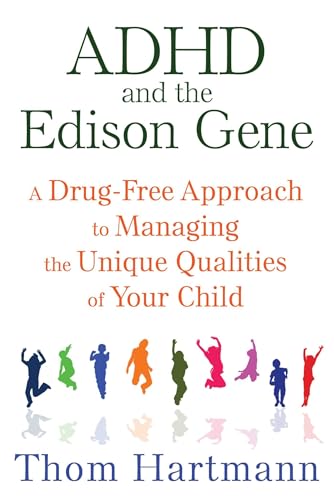
Synopsis
Explores how the ADHD gene is and has been critical to humanity’s development
• Shows how artists, inventors, and innovators carry the gene necessary for the future survival of humanity
• Explains why children with this gene are so often mislabeled in public schools as having a disorder
• Offers concrete strategies for helping children reach their full potential
In ADHD and the Edison Gene, Thom Hartmann shows that the creativity, impulsiveness, risk taking, distractibility, and novelty seeking that are characteristic of Attention Deficit Hyperactivity Disorder (ADHD) are not signs of a disorder at all but instead are components of a highly adaptive skill set utilized by our hunting and gathering ancestors. These characteristics have been critical to the survival and development of our modern civilization and will be vital as humanity faces new challenges in the future.
Hartmann, creator of the “hunter versus farmer” theory of ADHD, examines the differences in neurology between people with ADHD and those without, sharing recent discoveries that confirm the existence of an ADHD gene and the global catastrophe 40,000 years ago that triggered its development. He cites examples of significant innovators with ADHD traits, such as Ben Franklin and Thomas Edison, and argues that the children who possess the ADHD gene have neurology that is wired to give them brilliant success as artists, innovators, inventors, explorers, and entrepreneurs.
Emphasizing the role that parents and teachers can play in harnessing the advantages of ADHD, he shares the story of how Edison was expelled from school for ADHD-related behavior and luckily his mother understood how to salvage his self-esteem and prepare him for a lifetime of success. Offering concrete strategies for nurturing, educating, and helping these children reach their full potential, Hartmann shows that rather than being “problems” such children are a vital gift to our society and the world.
Les informations fournies dans la section « Synopsis » peuvent faire référence à une autre édition de ce titre.
À propos de l'auteur
Thom Hartmann is the host of the nationally and internationally syndicated talkshow The Thom Hartmann Program and the TV show The Big Picture on the Free Speech TV network. He is the award-winning New York Times bestselling author of 24 books, including Attention Deficit Disorder: A Different Perception, ADHD and the Edison Gene, and The Last Hours of Ancient Sunlight, which inspired Leonardo DiCaprio’s film The 11th Hour. A former psychotherapist and founder of the Hunter School, a residential and day school for children with ADHD, he lives in Washington, D.C.
Extrait. © Reproduit sur autorisation. Tous droits réservés.
12
Providing Discipline and Structure for the Edison-Gene Child
Separating Person from Behavior
I was in the local food co-op recently, and about four feet from me a two-year-old child in a shopping cart reached out from the cart and grabbed a bag of dried sweetened pineapple pieces. “Mine!” he said, tossing them into the cart.
His mother’s reaction was immediate. She grabbed the pineapple from the cart and put it back on the shelf, then turned and glared at her son. “Don’t be a bad boy!” she commanded, wagging her finger in his face.
His reaction looked to me like a mixture of pain and pride; the former from mother being unhappy with him, and the latter from some inner knowledge of identity, confirmed by her words. He reached into the cart and grabbed a can of soup, glancing at me, his audience, and prepared to throw it on the floor. Mom intervened by roughly grabbing the can and again demanding that he not be bad, this time giving him a slap on the hand. I found my cookies and moved away as the little boy began looking for a new audience for his behavior.
Whenever we react to a person’s behavior--particularly a child’s--we can do it in either of two primary ways. One addresses the individual’s personhood and ties it to his behavior, and the other addresses his personhood and disconnects it from his behavior. This is a critical distinction.
People who think they are their behaviors are caught in a continuous loop: in order to define themselves or to feel okay about themselves, they must continually bounce their behaviors off other people. Most people who start with this as children also become early and vulnerable targets for the advertising industry, whose primary message is that you are your possessions or that you are your body.
In each parent/child interactive situation in which the child is defined by his behavior, the “I am” center of his personhood becomes disconnected from any state of inner centeredness. Happiness and selfassurance come only with doing or getting and have no relationship to simply being, to “I know who I am, and I’m larger and deeper than what I do or what I own or what my body looks like.”
The lack of this important self-knowledge begins with parents or the media telling children that they are their behaviors. Thus the alternative to saying, “Don’t be a bad boy,” is to say, “If you do that, we won’t be able to continue shopping.” For a more severe behavior, it may even be, “I love you so much that I’m not going to let you do that.” It brings the core of the interaction back to the community of parent/child and doesn’t speak at all about the child as a bad or good person.
Break the Pattern with a Positive Message
The child in the supermarket also reminded me of one of the best lessons in childrearing that Louise and I ever learned. A friend of ours, an NLP (Neurolinguistic Programming) practitioner and psychologist, shared it with Louise back in the early 1980s.
One of our children was in the habit of throwing fits in the supermarket, demanding things and shouting loudly when the demands weren’t met. We’d tried both placating and punishing, and neither worked; the behavior just continued. Our friend had a two-part suggestion. “Do something unexpected,” he said, “and do it in a way that reinforces both your love and the idea that life can be fun.”
We started by priming our child during the day, talking about how much fun Louise was going to have shopping in the afternoon. “Would you like to have fun with me at the store?” she asked our four-year-old. “Yes!” was the enthusiastic reply.
When they got to the store and were going through the aisles, our child began to throw the predictable fit in the predictable place. At that point, Louise had a shopping cart only half full of food. “Oh,” she said, “I thought you wanted to have fun with me here. But if it’s not fun for both of us, it doesn’t work, and it’s not fun for me if you’re throwing this fit.”
She propelled the cart--complete with demanding child--to the service counter in the supermarket, where she said to the startled clerk, “I came to the supermarket to have fun shopping with my child, but my child doesn’t want us both to have fun, so I’m going to leave these groceries here, drop my child off at home, and come back alone to finish having fun shopping.”
“Okay,” said the clerk, nodding the way people do to the inmates in an asylum.
Louise picked up our child from the cart, drove the two of them home, came into the house, and said to me, “Our child wasn’t willing to let us both have fun at the supermarket, so will you baby-sit while I go back to the store to have fun shopping?”
“Of course,” I said, watching our child’s astonished expression. “I hope you have a lot of fun!”
“I will,” Louise said cheerfully as she went out the door. It was the last supermarket fit we ever experienced, and the story highlights one aspect of how many hunter-gatherer tribal children are raised: interactions are cooperative and positive, even as the adults clearly define the parameters of behavior and the values that underlie those parameters.
Les informations fournies dans la section « A propos du livre » peuvent faire référence à une autre édition de ce titre.
Résultats de recherche pour ADHD and the Edison Gene: A Drug-Free Approach to Managing...

Image d'archives
ADHD and the Edison Gene: A Dr
Edité par
Park Street Press, 2015
ISBN 10 : 1620555069
ISBN 13 : 9781620555064
Ancien ou d'occasion
Couverture souple
Vendeur : World of Books (was SecondSale), Montgomery, IL, Etats-Unis
Évaluation du vendeur 5 sur 5 étoiles

Etat : Good. Item in good condition. Textbooks may not include supplemental items i.e. CDs, access codes etc. N° de réf. du vendeur 00097015591
Acheter D'occasion
EUR 4,20
Livraison gratuite
Expédition nationale : Etats-Unis
Expédition nationale : Etats-Unis
Quantité disponible : 2 disponible(s)
Image fournie par le vendeur
ADHD and the Edison Gene: A Drug-Free Approach to Managing the Unique Qualities of Your Child
Edité par
Park Street Press, 2015
ISBN 10 : 1620555069
ISBN 13 : 9781620555064
Ancien ou d'occasion
Couverture souple
Vendeur : Dream Books Co., Denver, CO, Etats-Unis
Évaluation du vendeur 5 sur 5 étoiles
Etat : good. Gently used with minimal wear on the corners and cover. A few pages may contain light highlighting or writing, but the text remains fully legible. Dust jacket may be missing, and supplemental materials like CDs or codes may not be included. May be ex-library with library markings. Ships promptly! N° de réf. du vendeur DBV.1620555069.G
Acheter D'occasion
EUR 4,21
Livraison gratuite
Expédition nationale : Etats-Unis
Expédition nationale : Etats-Unis
Quantité disponible : 1 disponible(s)
Image d'archives
ADHD and the Edison Gene: A Drug-Free Approach to Managing the Unique Qualities of Your Child
Edité par
Park Street Press, 2015
ISBN 10 : 1620555069
ISBN 13 : 9781620555064
Ancien ou d'occasion
Paperback
Vendeur : ThriftBooks-Atlanta, AUSTELL, GA, Etats-Unis
Évaluation du vendeur 5 sur 5 étoiles
Paperback. Etat : Good. No Jacket. Pages can have notes/highlighting. Spine may show signs of wear. ~ ThriftBooks: Read More, Spend Less. N° de réf. du vendeur G1620555069I3N00
Acheter D'occasion
EUR 5,76
Livraison gratuite
Expédition nationale : Etats-Unis
Expédition nationale : Etats-Unis
Quantité disponible : 1 disponible(s)
Image d'archives
ADHD and the Edison Gene: A Drug-Free Approach to Managing the Unique Qualities of Your Child
Edité par
Park Street Press, 2015
ISBN 10 : 1620555069
ISBN 13 : 9781620555064
Ancien ou d'occasion
Paperback
Vendeur : ThriftBooks-Dallas, Dallas, TX, Etats-Unis
Évaluation du vendeur 5 sur 5 étoiles
Paperback. Etat : Very Good. No Jacket. May have limited writing in cover pages. Pages are unmarked. ~ ThriftBooks: Read More, Spend Less. N° de réf. du vendeur G1620555069I4N00
Acheter D'occasion
EUR 5,76
Livraison gratuite
Expédition nationale : Etats-Unis
Expédition nationale : Etats-Unis
Quantité disponible : 1 disponible(s)
Image d'archives
ADHD and the Edison Gene: A Drug-Free Approach to Managing the Unique Qualities of Your Child
Edité par
Park Street Press, 2015
ISBN 10 : 1620555069
ISBN 13 : 9781620555064
Ancien ou d'occasion
Paperback
Vendeur : ThriftBooks-Dallas, Dallas, TX, Etats-Unis
Évaluation du vendeur 5 sur 5 étoiles
Paperback. Etat : Very Good. No Jacket. Former library book; May have limited writing in cover pages. Pages are unmarked. ~ ThriftBooks: Read More, Spend Less. N° de réf. du vendeur G1620555069I4N10
Acheter D'occasion
EUR 5,76
Livraison gratuite
Expédition nationale : Etats-Unis
Expédition nationale : Etats-Unis
Quantité disponible : 1 disponible(s)
Image d'archives
ADHD and the Edison Gene: A Drug-Free Approach to Managing the Unique Qualities of Your Child
Edité par
Park Street Press, 2015
ISBN 10 : 1620555069
ISBN 13 : 9781620555064
Ancien ou d'occasion
Paperback
Vendeur : ThriftBooks-Phoenix, Phoenix, AZ, Etats-Unis
Évaluation du vendeur 5 sur 5 étoiles
Paperback. Etat : Very Good. No Jacket. May have limited writing in cover pages. Pages are unmarked. ~ ThriftBooks: Read More, Spend Less. N° de réf. du vendeur G1620555069I4N00
Acheter D'occasion
EUR 5,76
Livraison gratuite
Expédition nationale : Etats-Unis
Expédition nationale : Etats-Unis
Quantité disponible : 1 disponible(s)
Image d'archives
ADHD and the Edison Gene: A Drug-Free Approach to Managing the Unique Qualities of Your Child
Edité par
Inner Traditions Bear and Company, 2015
ISBN 10 : 1620555069
ISBN 13 : 9781620555064
Ancien ou d'occasion
Paperback
Vendeur : World of Books Inc, Montgomery, IL, Etats-Unis
Évaluation du vendeur 2 sur 5 étoiles

Paperback. Etat : Good. Explores how the ADHD gene is and has been critical to humanity's development. N° de réf. du vendeur CIN1620555069G
Acheter D'occasion
EUR 5,98
Livraison gratuite
Expédition nationale : Etats-Unis
Expédition nationale : Etats-Unis
Quantité disponible : 2 disponible(s)
Image d'archives
ADHD and the Edison Gene: A Drug-Free Approach to Managing the Unique Qualities of Your Child
Edité par
Park Street Press, 2015
ISBN 10 : 1620555069
ISBN 13 : 9781620555064
Ancien ou d'occasion
paperback
Vendeur : Half Price Books Inc., Dallas, TX, Etats-Unis
Évaluation du vendeur 5 sur 5 étoiles
paperback. Etat : Very Good. Connecting readers with great books since 1972! Used books may not include companion materials, and may have some shelf wear or limited writing. We ship orders daily and Customer Service is our top priority! N° de réf. du vendeur S_473258514
Acheter D'occasion
EUR 4,91
Expédition à EUR 3,23
Expédition nationale : Etats-Unis
Expédition nationale : Etats-Unis
Quantité disponible : 1 disponible(s)
Image fournie par le vendeur
ADHD and the Edison Gene: A Drug-Free Approach to Managing the Unique Qualities of Your Child
Edité par
Park Street Press, 2015
ISBN 10 : 1620555069
ISBN 13 : 9781620555064
Ancien ou d'occasion
Couverture souple
Vendeur : Goodwill of Greater Milwaukee and Chicago, Racine, WI, Etats-Unis
Évaluation du vendeur 5 sur 5 étoiles
Etat : good. Book is considered to be in good or better condition. The actual cover image may not match the stock photo. Hard cover books may show signs of wear on the spine, cover or dust jacket. Paperback book may show signs of wear on spine or cover as well as having a slight bend, curve or creasing to it. Book should have minimal to no writing inside and no highlighting. Pages should be free of tears or creasing. Stickers should not be present on cover or elsewhere, and any CD or DVD expected with the book is included. Book is not a former library copy. N° de réf. du vendeur SEWV.1620555069.G
Acheter D'occasion
EUR 5,78
Expédition à EUR 2,59
Expédition nationale : Etats-Unis
Expédition nationale : Etats-Unis
Quantité disponible : 1 disponible(s)
Image d'archives
ADHD and the Edison Gene: A Drug-Free Approach to Managing the Unique Qualities of Your Child
Edité par
Park Street Press, 2015
ISBN 10 : 1620555069
ISBN 13 : 9781620555064
Ancien ou d'occasion
paperback
Vendeur : Magers and Quinn Booksellers, Minneapolis, MN, Etats-Unis
Évaluation du vendeur 5 sur 5 étoiles
paperback. Etat : Acceptable. May have underlining, highlighting, margin notes, remainder marks, inscriptions, book plates, tears, significant wear, and/or a missing dust jacket, box, or discs. Damaged item. N° de réf. du vendeur 945442
Acheter D'occasion
EUR 5,76
Expédition à EUR 3,44
Expédition nationale : Etats-Unis
Expédition nationale : Etats-Unis
Quantité disponible : 1 disponible(s)