
Articles liés à Rudolf Steiner, Life and Work: 1890-1900: Weimar and...
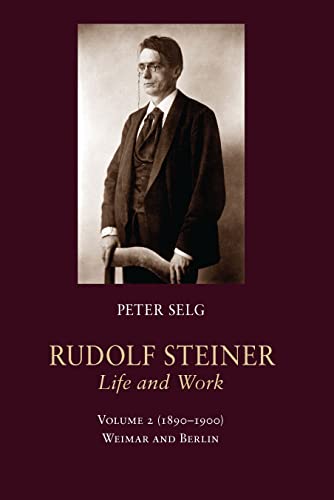
Synopsis
"It seemed to me that the turn of the century had to bring a new spiritual light to humankind. It seemed that a climax had been reached in excluding spirit from human thought and activity. A complete change in human evolution seemed an absolute necessity." -- Rudolf Steiner
The first chapter of this volume looks at Rudolf Steiner's years in Weimar, beginning with his work at the Goethe Archives editing Goethe's scientific works. It was in this capacity that Steiner was able to comprehend the great spiritual depth of Goethe's life and work, which became the foundation for his own lifework. This chapter also looks at his social circles and the writing and publication of his works Truth and Knowledge (CW 3) and The Philosophy of Freedom (CW 4). It also highlights his encounter with the work of Friedrich Nietzsche, his visits to the Nietzsche Archives in Naum-burg, and the writing of his book Friedrich Nietzsche: Fighter for Freedom (CW 5). Rudolf Steiner's time in Weimar closed with the creation of his second book on Goethe: Goethe's World View (CW 6), a fruit of his work at the Archives.
The second chapter focuses on Rudolf Steiner's time in Berlin, where he worked as editor of a cultural periodical, Magazin für Litteratur and accepted a position as lecturer at the Workers' School. There he was able to grow into his capacity as a teacher and where, although he encountered many ideological challenges, his insight into historical development found wide appreciation among students.
The third chapter covers the turn of the century and Rudolf Steiner's inner transition to speaking and writing more openly of his esoteric observations on the evolution of consciousness, the "I," and the training of cognition. His decisive 1899 essay, "Individualism in Philosophy," marked this impulse, followed by invitations to lecture freely before the Theosophical Society, where Rudolf Steiner presented the esoteric nature of Goethe's fairytale and the content of what later became his own books Mystics after Modernism (CW 7) and Christianity as Mystical Fact and the Mysteries of Antiquity (CW 8).
"It makes no sense to stop where Goethe stood. Yet we cannot progress unless we absorb Goethe deeply and allow ourselves to be wholly inspired by the impulses he brought into the world. This cannot be achieved as quickly as people today would like this to happen. There is nothing for it: anybody who was careless enough to live at the end of the nineteenth century must bear it." -- Rudolf Steiner (July 18, 1891)Rudolf Steiner, Life and Work, Seven Volumes
Vol. 1. (1861-1890): Childhood, Youth, and Study Years
(ISBN: 9781621480822 Pbk - ISBN: 9781621480839 Hbk)
Vol. 2. (1890-1900): Weimar and Berlin
(ISBN: 9781621480853 Pbk - ISBN: 9781621480860 Hbk)
Vol. 3. (1900-1914): Spiritual Science and Spiritual Community
(ISBN: 9781621480884 Pbk - ISBN: 9781621480891 Hbk)
Vol. 4. (1914-1918): The Years of World War I
(ISBN: 9781621481577 Pbk - ISBN: 9781621481584 Hbk)
Vol. 5. (1919-1922): Social Threefolding and the Waldorf School
(ISBN: 9781621481935 Pbk - ISBN: 9781621481942 Hbk)
Vol. 6. (1923): The Burning of the Goetheanum
(ISBN: 9781621482192 Pbk - ISBN: 9781621482208 Hbk)
Vol. 7. (1924-1925): The Anthroposophical Society and the School for Spiritual Science
(ISBN: 9781621482321 Pbk - ISBN: 9781621482338 Hbk)
Les informations fournies dans la section « Synopsis » peuvent faire référence à une autre édition de ce titre.
À propos des auteurs
Peter Selg studied medicine in Witten-Herdecke, Zurich, and Berlin and, until 2000, worked as the head physician of the juvenile psychiatry department of Herdecke Hospital in Germany. Dr. Selg is director of the Ita Wegman Institute for Basic Research into Anthroposophy (Arlesheim, Switzerland), professor of medicine at the Alanus University of Arts and Social Sciences (Germany), and co-leader of the General Anthroposophical Section at the Goetheanum. He is the author of numerous books on Rudolf Steiner, anthroposophy, medical ethics, and the development of culture and consciousness.
Margot M. Saar has a university degree in Applied Linguistics and Translating. She also studied Waldorf Education in Germany and Philosophy of Mind in the UK. She taught in Steiner Schools in Britain for 20 years and is an experienced translator and interpreter in specialty fields (education, medicine, philosophy, anthroposophy, homeopathy, anthroposophic medicine, general science). Margot has translated numerous books for SteinerBooks, including Peter Selg's 7-volume biography of Rudolf Steiner.
Les informations fournies dans la section « A propos du livre » peuvent faire référence à une autre édition de ce titre.
Résultats de recherche pour Rudolf Steiner, Life and Work: 1890-1900: Weimar and...

Image d'archives
Rudolf Steiner, Life and Work: 1890-1900: Weimar and Berlin (Rudolf Steiner, Life and Work, 2)
Vendeur : Lakeside Books, Benton Harbor, MI, Etats-Unis
Évaluation du vendeur 5 sur 5 étoiles

Etat : New. Brand New! Not Overstocks or Low Quality Book Club Editions! Direct From the Publisher! We're not a giant, faceless warehouse organization! We're a small town bookstore that loves books and loves it's customers! Buy from Lakeside Books! N° de réf. du vendeur OTF-S-9781621480853
Acheter neuf
EUR 23,84
Expédition à EUR 3,44
Expédition nationale : Etats-Unis
Expédition nationale : Etats-Unis
Quantité disponible : Plus de 20 disponibles
Image fournie par le vendeur
Rudolf Steiner, Life and Work : 1890-1900: Weimar and Berlin
Vendeur : GreatBookPrices, Columbia, MD, Etats-Unis
Évaluation du vendeur 5 sur 5 étoiles
Etat : New. N° de réf. du vendeur 23085596-n
Acheter neuf
EUR 25,03
Expédition à EUR 2,28
Expédition nationale : Etats-Unis
Expédition nationale : Etats-Unis
Quantité disponible : Plus de 20 disponibles
Image fournie par le vendeur
Rudolf Steiner, Life and Work: 1890-1900: Weimar and Berlin (Paperback or Softback)
Edité par
Steiner Books 11/20/2014, 2014
ISBN 10 : 1621480852
ISBN 13 : 9781621480853
Neuf
Paperback or Softback
Vendeur : BargainBookStores, Grand Rapids, MI, Etats-Unis
Évaluation du vendeur 5 sur 5 étoiles
Paperback or Softback. Etat : New. Rudolf Steiner, Life and Work: 1890-1900: Weimar and Berlin. Book. N° de réf. du vendeur BBS-9781621480853
Acheter neuf
EUR 28,71
Livraison gratuite
Expédition nationale : Etats-Unis
Expédition nationale : Etats-Unis
Quantité disponible : 5 disponible(s)
Image d'archives
Rudolf Steiner, Life and Work: 1890-1900: Weimar and Berlin (Volume 2)
Vendeur : California Books, Miami, FL, Etats-Unis
Évaluation du vendeur 5 sur 5 étoiles
Etat : New. N° de réf. du vendeur I-9781621480853
Acheter neuf
EUR 30,23
Livraison gratuite
Expédition nationale : Etats-Unis
Expédition nationale : Etats-Unis
Quantité disponible : Plus de 20 disponibles
Image fournie par le vendeur
Rudolf Steiner, Life and Work : 1890-1900: Weimar and Berlin
Edité par
SteinerBooks, 2014
ISBN 10 : 1621480852
ISBN 13 : 9781621480853
Ancien ou d'occasion
Couverture souple
Vendeur : GreatBookPrices, Columbia, MD, Etats-Unis
Évaluation du vendeur 5 sur 5 étoiles
Etat : As New. Unread book in perfect condition. N° de réf. du vendeur 23085596
Acheter D'occasion
EUR 28,61
Expédition à EUR 2,28
Expédition nationale : Etats-Unis
Expédition nationale : Etats-Unis
Quantité disponible : Plus de 20 disponibles
Image fournie par le vendeur
Rudolf Steiner, Life and Work
Vendeur : Rarewaves USA, HEBRON, KY, Etats-Unis
Évaluation du vendeur 5 sur 5 étoiles
Paperback. Etat : New. N° de réf. du vendeur LU-9781621480853
Acheter neuf
EUR 33,36
Livraison gratuite
Expédition nationale : Etats-Unis
Expédition nationale : Etats-Unis
Quantité disponible : Plus de 20 disponibles
Image fournie par le vendeur
Rudolf Steiner, Life and Work
Vendeur : Rarewaves.com USA, London, LONDO, Royaume-Uni
Évaluation du vendeur 5 sur 5 étoiles
Paperback. Etat : New. N° de réf. du vendeur LU-9781621480853
Acheter neuf
EUR 39,53
Livraison gratuite
Expédition depuis Royaume-Uni vers Etats-Unis
Expédition depuis Royaume-Uni vers Etats-Unis
Quantité disponible : Plus de 20 disponibles
Image d'archives
(1890-1900): Weimar and Berlin
Vendeur : PBShop.store UK, Fairford, GLOS, Royaume-Uni
Évaluation du vendeur 5 sur 5 étoiles
PAP. Etat : New. New Book. Shipped from UK. Established seller since 2000. N° de réf. du vendeur DB-9781621480853
Acheter neuf
EUR 35,69
Expédition à EUR 4,84
Expédition depuis Royaume-Uni vers Etats-Unis
Expédition depuis Royaume-Uni vers Etats-Unis
Quantité disponible : 1 disponible(s)
Image d'archives
Rudolf Steiner, Life and Work: 1890-1900: Weimar and Berlin (Rudolf Steiner, Life and Work, 2)
Edité par
SteinerBooks, 2014
ISBN 10 : 1621480852
ISBN 13 : 9781621480853
Ancien ou d'occasion
Paperback
Vendeur : Vintage Books and Fine Art, Oxford, MD, Etats-Unis
Évaluation du vendeur 5 sur 5 étoiles
Paperback. Etat : Very Good. Trade paperback. Square Tight Binding.Clean interior. The mildest of edge wear to wraps. A superior edition. N° de réf. du vendeur 13982
Acheter D'occasion
EUR 36,04
Expédition à EUR 7,34
Expédition nationale : Etats-Unis
Expédition nationale : Etats-Unis
Quantité disponible : 1 disponible(s)
Image d'archives
Rudolf Steiner, Life and Work (Paperback)
Edité par
SteinerBooks, Inc, Great Barrington, MA, 2014
ISBN 10 : 1621480852
ISBN 13 : 9781621480853
Neuf
Paperback
Vendeur : Grand Eagle Retail, Bensenville, IL, Etats-Unis
Évaluation du vendeur 5 sur 5 étoiles
Paperback. Etat : new. Paperback. "It makes no sense to stop where Goethe stood. Yet we cannot progress unless we absorb Goethe deeply and allow ourselves to be wholly inspired by the impulses he brought into the world. This cannot be achieved as quickly as people today would like this to happen. There is nothing for it; anyone who was careless enough to live at the end of the nineteenth century must bear it." - Rudolf Steiner, July 18, 1891 The first chapter of this volume looks at Rudolf Steiner's years in Weimar, beginning with his work at the Goethe Archives editing Goethe's scientific works. It was in this capacity that Steiner was able to comprehend the great spiritual depth of Goethe's life and work, which became the foundation for his own lifework. This chapter also looks at his social circles and the writing and publication of his works Truth and Knowledge (CW 3) and The Philosophy of Freedom (CW 4). It also highlights his encounter with the work of Friedrich Nietzsche, his visits to the Nietzsche Archives in Naumburg, and the writing of his book Friedrich Nietzsche: Fighter for Freedom (CW 5).Rudolf Steiner's time in Weimar comes to a close with the creation of his second book on Goethe: Goethe's World View (CW 6), a fruit of his work at the Archives. The second chapter focuses on Rudolf Steiner's time in Berlin, where he worked as editor of a cultural periodical, Magazin fur Litteratur, and accepted a position as lecturer at the Workers' School. There he was able to grow into his capacity as a teacher and where, although he encountered many ideological challenges, his insight into historical development found wide appreciation among students. The third chapter covers the turn of the century and Rudolf Steiner's inner transition to speaking and writing more openly of his esoteric observations on the evolution of consciousness, the "I," and the training of cognition. His decisive 1899 essay, Individualism in Philosophy, marked this impulse, followed by invitations to lecture freely before the Theosophical Society, where Rudolf Steiner presented the esoteric nature of Goethe's fairy tale and the content of what later became his own books Mystics after Modernism (CW 7) and Christianity as Mystical Fact and the Mysteries of Antiquity (CW 8).Rudolf Steiner, Life and Work, volume 2 is a translation from German of chapters 4 and 5 of Rudolf Steiner. 1861-1925: Lebens- und Werkgeschichte. Band 1: 1861-1914 (Ita Wegman Institut, 2012). Shipping may be from multiple locations in the US or from the UK, depending on stock availability. N° de réf. du vendeur 9781621480853
Acheter neuf
EUR 44,46
Livraison gratuite
Expédition nationale : Etats-Unis
Expédition nationale : Etats-Unis
Quantité disponible : 1 disponible(s)