
Articles liés à Camera Trapping for Wildlife Research
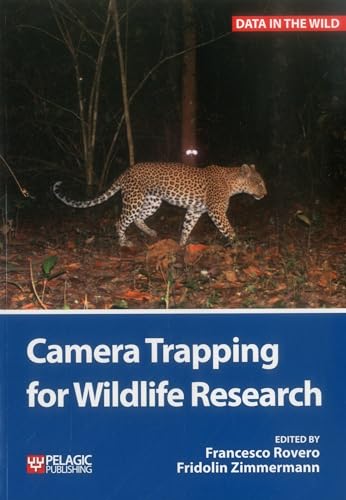
Synopsis
Camera trapping is a powerful and now widely used tool in scientific research on wildlife ecology and management. It provides a unique opportunity for collecting knowledge, investigating the presence of animals, or recording and studying behaviour. Its visual nature makes it easy to successfully convey findings to a wide audience.
This book provides a much-needed guide to the sound use of camera trapping for the most common ecological applications to wildlife research. Each phase involved in the use of camera trapping is covered:
- Selecting the right camera type
- Set-up and field deployment of your camera trap
- Defining the sampling design: presence/absence, species inventory, abundance; occupancy at species level; capture-mark-recapture for density estimation; behavioural studies; community-level analysis
- Data storage, management and analysis for your research topic, with illustrative examples for using R and Excel
- Using camera trapping for monitoring, conservation and public engagement.
Each chapter in this edited volume is essential reading for students, scientists, ecologists, educators and professionals involved in wildlife research or management.
Contents
1. Introduction
2. Camera features related to specific ecological applications
3. Field deployment of camera traps
4. Camera trap data management and interoperability
5. Presence/absence and species inventory
6. Species-level occupancy analysis
7. Capture recapture methods for density estimation
8. Behavioural studies
9. Community-level occupancy analysis
10. Camera trapping as a monitoring tool at national and global levels
11. Camera traps and public engagement
Appendices
Glossary
Index
"If you are surveying in a systematic way through trail cameras you will need to structure the sampling and analyse the results in methodical ways. It is here that a recent book from Pelagic Publishing, Camera Trapping for Wildlife Research, provides much use. With a scholarly approach and abundant references, the book has detailed advice on camera trapping for faunal inventories, occupancy studies, capture-recapture methods, and behavioural studies. The book excels in its detail on survey design, sampling design, and data management. There is an extended case study of Eurasian lynx abundance and density estimation in the NW Swiss Alps, while the behavioural studies section looks at Eurasian lynx scent marking as well as the tree rubbing behaviour of brown bears." --Rick Minter, ECOS
"...a thorough, concise handbook on how to design and conduct a study involving camera traps. It would be very useful for both under- and post-graduates and for those, like me, who are new to the subject, so I thoroughly recommend it for a university library and for anyone who is considering using camera traps as a component of a study." --Sian Waters, Barbary Macaque Awareness & Conservation
Les informations fournies dans la section « Synopsis » peuvent faire référence à une autre édition de ce titre.
À propos de l'auteur
Francesco Rovero is an ecologist and conservation scientist with a PhD in animal ecology. He is currently the Curator for Tropical Biodiversity at MUSE Science Museum in Trento, Italy. Fridolin Zimmermann is a carnivore conservation scientist with a PhD on Eurasian lynx conservation and ecology. He is currently coordinator of the large carnivore monitoring in Switzerland at Carnivore Ecology and Wildlife Management (KORA). Collectively they have nearly 30 years of professional experience in the use of camera trapping for wildlife research, and have worked on a range of species, habitat and study types.
Les informations fournies dans la section « A propos du livre » peuvent faire référence à une autre édition de ce titre.
Résultats de recherche pour Camera Trapping for Wildlife Research

Image d'archives
Camera Trapping for Wildlife Research (Data in the Wild)
Vendeur : WorldofBooks, Goring-By-Sea, WS, Royaume-Uni
Évaluation du vendeur 5 sur 5 étoiles

Paperback. Etat : Very Good. The book has been read, but is in excellent condition. Pages are intact and not marred by notes or highlighting. The spine remains undamaged. N° de réf. du vendeur GOR010707063
Acheter D'occasion
EUR 38,91
Expédition à EUR 6,50
Expédition depuis Royaume-Uni vers Etats-Unis
Expédition depuis Royaume-Uni vers Etats-Unis
Quantité disponible : 1 disponible(s)
Image d'archives
CAMERA TRAPPING FOR WILDLIFE RESEARCH Format: Paperback
Edité par
Simon and Schuster, 2016
ISBN 10 : 1784270482
ISBN 13 : 9781784270483
Ancien ou d'occasion
Couverture souple
Vendeur : INDOO, Avenel, NJ, Etats-Unis
Évaluation du vendeur 5 sur 5 étoiles
Etat : As New. Unread copy in mint condition. N° de réf. du vendeur SS9781784270483
Acheter D'occasion
EUR 46,58
Livraison gratuite
Expédition nationale : Etats-Unis
Expédition nationale : Etats-Unis
Quantité disponible : Plus de 20 disponibles
Image d'archives
Camera Trapping for Wildlife Research
Edité par
Pelagic Publishing Ltd., 2016
ISBN 10 : 1784270482
ISBN 13 : 9781784270483
Ancien ou d'occasion
Couverture souple
Vendeur : Better World Books: West, Reno, NV, Etats-Unis
Évaluation du vendeur 5 sur 5 étoiles
Etat : Very Good. Former library copy. Pages intact with possible writing/highlighting. Binding strong with minor wear. Dust jackets/supplements may not be included. Includes library markings. Stock photo provided. Product includes identifying sticker. Better World Books: Buy Books. Do Good. N° de réf. du vendeur 56953472-75
Acheter D'occasion
EUR 46,68
Livraison gratuite
Expédition nationale : Etats-Unis
Expédition nationale : Etats-Unis
Quantité disponible : 1 disponible(s)
Image d'archives
CAMERA TRAPPING FOR WILDLIFE RESEARCH Format: Paperback
Edité par
Simon and Schuster, 2016
ISBN 10 : 1784270482
ISBN 13 : 9781784270483
Neuf
Couverture souple
Vendeur : INDOO, Avenel, NJ, Etats-Unis
Évaluation du vendeur 5 sur 5 étoiles
Etat : New. Brand New. N° de réf. du vendeur 9781784270483
Acheter neuf
EUR 46,68
Livraison gratuite
Expédition nationale : Etats-Unis
Expédition nationale : Etats-Unis
Quantité disponible : Plus de 20 disponibles
Image d'archives
Camera Trapping for Wildlife Research
Vendeur : PBShop.store UK, Fairford, GLOS, Royaume-Uni
Évaluation du vendeur 5 sur 5 étoiles
PAP. Etat : New. New Book. Shipped from UK. Established seller since 2000. N° de réf. du vendeur CX-9781784270483
Acheter neuf
EUR 45,84
Expédition à EUR 5,83
Expédition depuis Royaume-Uni vers Etats-Unis
Expédition depuis Royaume-Uni vers Etats-Unis
Quantité disponible : 15 disponible(s)
Image fournie par le vendeur
Camera Trapping for Wildlife Research
Vendeur : Rarewaves.com USA, London, LONDO, Royaume-Uni
Évaluation du vendeur 5 sur 5 étoiles
Paperback. Etat : New. Camera trapping is a powerful and now widely used tool in scientific research on wildlife ecology and management. It provides a unique opportunity for collecting knowledge, investigating the presence of animals, or recording and studying behaviour. Its visual nature makes it easy to successfully convey findings to a wide audience.This book provides a much-needed guide to the sound use of camera trapping for the most common ecological applications to wildlife research. Each phase involved in the use of camera trapping is covered:- Selecting the right camera type - Set-up and field deployment of your camera trap - Defining the sampling design: presence/absence, species inventory, abundance; occupancy at species level; capture-mark-recapture for density estimation; behavioural studies; community-level analysis - Data storage, management and analysis for your research topic, with illustrative examples for using R and Excel - Using camera trapping for monitoring, conservation and public engagement.Each chapter in this edited volume is essential reading for students, scientists, ecologists, educators and professionals involved in wildlife research or management. N° de réf. du vendeur LU-9781784270483
Acheter neuf
EUR 53,25
Livraison gratuite
Expédition depuis Royaume-Uni vers Etats-Unis
Expédition depuis Royaume-Uni vers Etats-Unis
Quantité disponible : 1 disponible(s)
Image fournie par le vendeur
Camera Trapping for Wildlife Research
Vendeur : GreatBookPrices, Columbia, MD, Etats-Unis
Évaluation du vendeur 5 sur 5 étoiles
Etat : New. N° de réf. du vendeur 26058945-n
Acheter neuf
EUR 52,51
Expédition à EUR 2,32
Expédition nationale : Etats-Unis
Expédition nationale : Etats-Unis
Quantité disponible : 6 disponible(s)
Image d'archives
Camera Trapping for Wildlife Research
Vendeur : PBShop.store US, Wood Dale, IL, Etats-Unis
Évaluation du vendeur 5 sur 5 étoiles
PAP. Etat : New. New Book. Shipped from UK. Established seller since 2000. N° de réf. du vendeur CX-9781784270483
Acheter neuf
EUR 54,91
Livraison gratuite
Expédition nationale : Etats-Unis
Expédition nationale : Etats-Unis
Quantité disponible : 15 disponible(s)
Image d'archives
CAMERA TRAPPING FOR WILDLIFE RESEARCH
Vendeur : Basi6 International, Irving, TX, Etats-Unis
Évaluation du vendeur 5 sur 5 étoiles
Etat : Brand New. New. US edition. Expediting shipping for all USA and Europe orders excluding PO Box. Excellent Customer Service. N° de réf. du vendeur ABEOCT25-315907
Acheter neuf
EUR 55,87
Livraison gratuite
Expédition nationale : Etats-Unis
Expédition nationale : Etats-Unis
Quantité disponible : 1 disponible(s)
Image d'archives
CAMERA TRAPPING FOR WILDLIFE RESEARCH
Vendeur : Romtrade Corp., STERLING HEIGHTS, MI, Etats-Unis
Évaluation du vendeur 5 sur 5 étoiles
Etat : New. This is a Brand-new US Edition. This Item may be shipped from US or any other country as we have multiple locations worldwide. N° de réf. du vendeur ABBB-8856
Acheter neuf
EUR 56,83
Livraison gratuite
Expédition nationale : Etats-Unis
Expédition nationale : Etats-Unis
Quantité disponible : 1 disponible(s)