
Articles liés à Written Under the Skin: Blood and Intergenerational...
Written Under the Skin: Blood and Intergenerational Memory in South Africa - Couverture souple
Livre 3 sur 4: African Articulations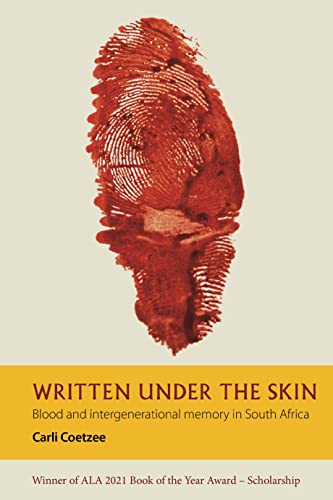
Synopsis
In this book the author argues that a younger generation of South Africans is developing important and innovative ways of understanding South African pasts, and that challenge the narratives that have over the last decades been informed by notions of forgiveness and reconciliation. The author uses the image of history-rich blood to explore these approaches to intergenerational memory. Blood under the skin is a carrier of embodied and gendered histories andusing this image, the chapters revisit older archives, as well as analyse contemporary South African cultural and literary forms.
The emphasis on blood challenges the privileged status skin has had as explanatory category inthinking about identity, and instead emphasises intergenerational transfer and continuity. The argument is that a younger generation is disputing and debating the terms through which to understand contemporary South Africa, as well as for interpreting the legacies of the past that remain under the visible layer of skin. The chapters each concern blood: Mandela's prison cell as laboratory for producing bloodless freedom; the kinship relations created and resisted in accounts of Eugene de Kock in prison; Ruth First's concern with information leaks in her accounts of her time in prison; the first human-to-human heart transplant and its relation to racialised attempts to salvage whiteidentity; the #Fallist moment; Abantu book festival; and activist scholarship and creative art works that use blood as trope for thinking about change and continuity.
Southern Africa (South Africa, Namibia, Lesotho, Zimbabwe and Swaziland): Wits University Press
Les informations fournies dans la section « Synopsis » peuvent faire référence à une autre édition de ce titre.
À propos de l'auteur
Carli Coetzee is Editor of the Journal of African Cultural Studies. Her publications include: Accented Futures: Language Activism and the Ending of Apartheid (Wits University Press, 2013) and the edited collection Afropolitanism: Reboot (Routledge, 2017). She co-edited The Handbook of African Literature (Routledge, 2019) with Moradewun Adejunmobi and Negotiating the Past: The Making of Memory in South Africa(Oxford University Press, 1998) with Sarah Nuttall.
Les informations fournies dans la section « A propos du livre » peuvent faire référence à une autre édition de ce titre.
Résultats de recherche pour Written Under the Skin: Blood and Intergenerational...

Image d'archives
Written Under the Skin : Blood and Intergenerational Memory in South Africa
Vendeur : GreatBookPrices, Columbia, MD, Etats-Unis
Évaluation du vendeur 5 sur 5 étoiles

Etat : New. N° de réf. du vendeur 43828297-n
Acheter neuf
EUR 29,88
Expédition à EUR 2,30
Expédition nationale : Etats-Unis
Expédition nationale : Etats-Unis
Quantité disponible : Plus de 20 disponibles
Image d'archives
Written under the Skin
Vendeur : PBShop.store US, Wood Dale, IL, Etats-Unis
Évaluation du vendeur 5 sur 5 étoiles
PAP. Etat : New. New Book. Shipped from UK. Established seller since 2000. N° de réf. du vendeur FW-9781847013248
Acheter neuf
EUR 32,26
Livraison gratuite
Expédition nationale : Etats-Unis
Expédition nationale : Etats-Unis
Quantité disponible : 15 disponible(s)
Image d'archives
Written Under the Skin : Blood and Intergenerational Memory in South Africa
Edité par
James Currey, 2022
ISBN 10 : 1847013244
ISBN 13 : 9781847013248
Ancien ou d'occasion
Couverture souple
Vendeur : GreatBookPrices, Columbia, MD, Etats-Unis
Évaluation du vendeur 5 sur 5 étoiles
Etat : As New. Unread book in perfect condition. N° de réf. du vendeur 43828297
Acheter D'occasion
EUR 30,07
Expédition à EUR 2,30
Expédition nationale : Etats-Unis
Expédition nationale : Etats-Unis
Quantité disponible : Plus de 20 disponibles
Image fournie par le vendeur
Written under the Skin
Vendeur : Rarewaves USA, HEBRON, KY, Etats-Unis
Évaluation du vendeur 5 sur 5 étoiles
Paperback. Etat : New. Winner of the 2021 ALA Book of the Year Award - ScholarshipThe author uses the image of blood under the skin as a way of understanding cultural and literary forms in contemporary South Africa. Chapters deal with the bloodied histories of apartheid and blood as trope for talking about change.In this book the author argues that a younger generation of South Africans is developing important and innovative ways of understanding South African pasts, and that challenge the narratives that have over the last decades been informed by notions of forgiveness and reconciliation. The author uses the image of history-rich blood to explore these approaches to intergenerational memory. Blood under the skin is a carrier of embodied and gendered histories andusing this image, the chapters revisit older archives, as well as analyse contemporary South African cultural and literary forms. The emphasis on blood challenges the privileged status skin has had as explanatory category inthinking about identity, and instead emphasises intergenerational transfer and continuity. The argument is that a younger generation is disputing and debating the terms through which to understand contemporary South Africa, as well as for interpreting the legacies of the past that remain under the visible layer of skin. The chapters each concern blood: Mandela's prison cell as laboratory for producing bloodless freedom; the kinship relations created and resisted in accounts of Eugene de Kock in prison; Ruth First's concern with information leaks in her accounts of her time in prison; the first human-to-human heart transplant and its relation to racialised attempts to salvage whiteidentity; the #Fallist moment; Abantu book festival; and activist scholarship and creative art works that use blood as trope for thinking about change and continuity. Southern Africa (South Africa, Namibia, Lesotho, Zimbabwe and Swaziland): Wits University Press. N° de réf. du vendeur LU-9781847013248
Acheter neuf
EUR 34,88
Livraison gratuite
Expédition nationale : Etats-Unis
Expédition nationale : Etats-Unis
Quantité disponible : Plus de 20 disponibles
Image d'archives
Written under the Skin: Blood and Intergenerational Memory in South Africa (eng)
Vendeur : Brook Bookstore On Demand, Napoli, NA, Italie
Évaluation du vendeur 5 sur 5 étoiles
Etat : new. N° de réf. du vendeur X127BBBJYW
Acheter neuf
EUR 29,50
Expédition à EUR 5,50
Expédition depuis Italie vers Etats-Unis
Expédition depuis Italie vers Etats-Unis
Quantité disponible : Plus de 20 disponibles
Image d'archives
Written under the Skin
Vendeur : PBShop.store UK, Fairford, GLOS, Royaume-Uni
Évaluation du vendeur 5 sur 5 étoiles
PAP. Etat : New. New Book. Shipped from UK. Established seller since 2000. N° de réf. du vendeur FW-9781847013248
Acheter neuf
EUR 30,67
Expédition à EUR 4,84
Expédition depuis Royaume-Uni vers Etats-Unis
Expédition depuis Royaume-Uni vers Etats-Unis
Quantité disponible : 15 disponible(s)
Image d'archives
Written under the Skin: Blood and Intergenerational Memory in South Africa (African Articulations, 5)
impression à la demandeVendeur : Majestic Books, Hounslow, Royaume-Uni
Évaluation du vendeur 4 sur 5 étoiles

Etat : New. Print on Demand. N° de réf. du vendeur 389387831
Acheter neuf
EUR 28,46
Expédition à EUR 7,57
Expédition depuis Royaume-Uni vers Etats-Unis
Expédition depuis Royaume-Uni vers Etats-Unis
Quantité disponible : 4 disponible(s)
Image d'archives
Written under the Skin: Blood and Intergenerational Memory in South Africa (African Articulations, 5)
impression à la demandeVendeur : Books Puddle, New York, NY, Etats-Unis
Évaluation du vendeur 4 sur 5 étoiles
Etat : New. Print on Demand. N° de réf. du vendeur 26390212072
Acheter neuf
EUR 34,27
Expédition à EUR 3,48
Expédition nationale : Etats-Unis
Expédition nationale : Etats-Unis
Quantité disponible : 4 disponible(s)
Image d'archives
Written under the Skin: Blood and Intergenerational Memory in South Africa (African Articulations, 5)
impression à la demandeVendeur : Biblios, Frankfurt am main, HESSE, Allemagne
Évaluation du vendeur 4 sur 5 étoiles
Etat : New. PRINT ON DEMAND. N° de réf. du vendeur 18390212066
Acheter neuf
EUR 29,19
Expédition à EUR 9,95
Expédition depuis Allemagne vers Etats-Unis
Expédition depuis Allemagne vers Etats-Unis
Quantité disponible : 4 disponible(s)
Image fournie par le vendeur
Written under the Skin
Vendeur : Rarewaves.com USA, London, LONDO, Royaume-Uni
Évaluation du vendeur 5 sur 5 étoiles
Paperback. Etat : New. Winner of the 2021 ALA Book of the Year Award - ScholarshipThe author uses the image of blood under the skin as a way of understanding cultural and literary forms in contemporary South Africa. Chapters deal with the bloodied histories of apartheid and blood as trope for talking about change.In this book the author argues that a younger generation of South Africans is developing important and innovative ways of understanding South African pasts, and that challenge the narratives that have over the last decades been informed by notions of forgiveness and reconciliation. The author uses the image of history-rich blood to explore these approaches to intergenerational memory. Blood under the skin is a carrier of embodied and gendered histories andusing this image, the chapters revisit older archives, as well as analyse contemporary South African cultural and literary forms. The emphasis on blood challenges the privileged status skin has had as explanatory category inthinking about identity, and instead emphasises intergenerational transfer and continuity. The argument is that a younger generation is disputing and debating the terms through which to understand contemporary South Africa, as well as for interpreting the legacies of the past that remain under the visible layer of skin. The chapters each concern blood: Mandela's prison cell as laboratory for producing bloodless freedom; the kinship relations created and resisted in accounts of Eugene de Kock in prison; Ruth First's concern with information leaks in her accounts of her time in prison; the first human-to-human heart transplant and its relation to racialised attempts to salvage whiteidentity; the #Fallist moment; Abantu book festival; and activist scholarship and creative art works that use blood as trope for thinking about change and continuity. Southern Africa (South Africa, Namibia, Lesotho, Zimbabwe and Swaziland): Wits University Press. N° de réf. du vendeur LU-9781847013248
Acheter neuf
EUR 42,50
Livraison gratuite
Expédition depuis Royaume-Uni vers Etats-Unis
Expédition depuis Royaume-Uni vers Etats-Unis
Quantité disponible : Plus de 20 disponibles