
Articles liés à Moby Dick
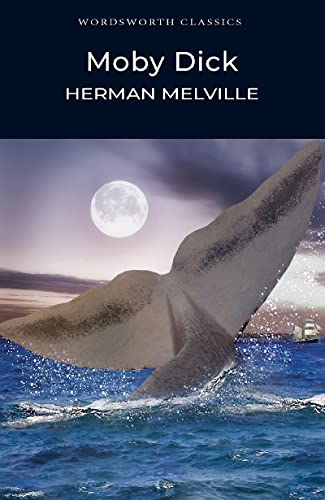
Synopsis
With an Introduction and Notes by David Herd, Lecturer in English and American Literature at the University of Kent at Canterbury and co-editor of 'Poetry Review'.
Moby Dick is the story of Captain Ahab's quest to avenge the whale that 'reaped' his leg. The quest is an obsession and the novel is a diabolical study of how a man becomes a fanatic.
But it is also a hymn to democracy. Bent as the crew is on Ahab's appalling crusade, it is equally the image of a co-operative community at work: all hands dependent on all hands, each individual responsible for the security of each.
Among the crew is Ishmael, the novel's narrator, ordinary sailor, and extraordinary reader. Digressive, allusive, vulgar, transcendent, the story Ishmael tells is above all an education:
in the practice of whaling, in the art of writing. Expanding to equal his 'mighty theme' - not only the whale but all things sublime - Melville breathes in the world's great literature. Moby Dick is the greatest novel ever written by an American.
Les informations fournies dans la section « Synopsis » peuvent faire référence à une autre édition de ce titre.
Extrait
Call me Ishmael. This resonant opening of Moby-Dick, the greatest novel in American literature, announces the narrator, Herman Melville, as he with a measure of slyness thought of himself. In the Scriptures Ishmael, a wild man sired by the overwhelming patriarch Abraham, was nevertheless the bastard son of a serving girl Hagar. The author himself was the offspring of two distinguished American families, the Melvilles of Boston and the Gansevoorts of Albany.
Melville's father cast something of a blight on the family escutcheon by his tendency to bankruptcy which passed down to his son. Dollars damn me, the son was to say over and over. When he sat down in the green landscape of Pittsfield, Massachusetts, to compose Moby-Dick he was in debt, the father of one son, and another to be born a few days after the publication of the novel in England.
Melville had published five novels previous to Moby-Dick; the first two did well, and then with the capriciousness of the public the subsequent novels failed to please. He was a known literary figure with a fading reputation. How he came upon the courage to undertake the challenging creation of the epical battle between a sea creature, a white whale called Moby Dick, and an old captain from Nantucket by the name of Ahab is one of literature's triumphant mysteries. Add to that, as one reads, that he was only thirty-two years old.
Ten years before, in 1841, he had signed up as a common seaman on the whaling vessel Acushnet bound for the South Seas. Young Ishmael was drawn by the lure of the sea and by the wonder of the whale itself, the Leviathan, the monarch of the deep, "one grand hooded phantom, like a snow hill in the air." Until the discovery of petroleum oil in 1859 and Thomas Edison's invention of the incandescent lamp in 1879, whaling was a major commercial occupation in New England. Fortunes were made, grand houses were built, often with a "widow's walk" on the roof that testified to the great dangers of the enterprise. For the crew, service on a whaler was a drastic life of unremitting labor; foul, crowded quarters; bad food in scanty servings; contractual terms for years at miserable wages; brutalized companions picked up from all the ports of the world; tyrannical captains practicing a "sultanism" which Melville abhorred. A ship afloat is after all a prison. Melville was on three whalers in his four years at sea and from each, as we read in Typee and Omoo, the struggle is to escape, as he did when the boats anchored near exotic islands. He wrote about the misery of the whaling life, but not about whaling itself until he came to Moby-Dick. His imaginary whaler, the Pequod, death bound as it is, would be called, for an ordinary seaman, an agreeable berth. Ahab has no interest left beyond his internal struggle with one whale.
Still, there is whaling, the presumption of it. When a whale is sighted small boats are detached from the main vessel and the men engage in a deadly battle to try to match, with flying harpoons, the whale's immense strength and desperation. If the great thing is captured, the deck of the main ship becomes an abattoir of blood and guts. The thick blubber is to be stripped, the huge head to be drained of its oils for soothing ambergris, for candles; the bones of the carcass make their way into corsets and umbrellas and scrimshaw trinkets. Moby-Dick is a history of cetology, an encylopedic telling of the qualities of the fin-back, the right whale, the hyena whale, the sperm whale, the killer whale, classified by size in mock academic form as folio, octavo, and so on.
Information about a vanished world is one thing, but, above all else, this astonishing book is a human tragedy of almost supernatural suspensiveness, written in a rushing flow of imaginative language, poetical intensity, metaphor and adjective of consuming beauty. It begins on the cobbled streets of New Bedford, where Ishmael is to spend a few days before boarding the Pequod in Nantucket. The opening pages have a boyish charm as he is brought to share a bed with a fellow sailor, the harpooner Queequeg, an outrageously tattoed "primitive" who will be his companion throughout the narrative. Great ships under sail gave the old ports a rich heritage of myth, gossip, exaggeration, and rhetorical flights. Ishmael, on a Sunday, visits a whaleman's chapel to hear the incomparable sermon by Father Mapple on Jonah and the whale, a majestic interlude, one of many in this torrential outburst of fictional genius.
As Ishmael and Queequeg proceed to Nantucket, the shadows of the plot begin to fall upon the pages. The recruits are interviewed by two retired sailors who will struggle to express the complicated nature of Captain Ahab. We learn that he has lost a leg, chewed off by a whale, and thus the fated voyage of the Pequod begins. Ahab has lost his leg to a white whale Moby Dick and is consumed with a passion for retribution. He will hunt the singular whale as a private destiny in the manner of ancient kings in a legendary world. However, Ahab is real and in command. The chief mate, Starbuck, understands the folly of the quest, the danger of it, and, as a thoughtful man longing to return to his wife and children, he will speak again and again the language of reason. "Vengeance on a dumb beast that simply smote thee from the blindest instinct! Madness! To be enraged with a dumb thing, Captain Ahab, seems blasphemous."
The necessity of Starbuck's human distance from the implacable imperative of Ahab's quest illustrates the brilliant formation of this harrowing tale. But it is Ahab's story, his destiny, and, if on the one hand, he is a shabby, sea-worn sailor long mesmerized by mercurial oceans, he too has a wife at home and a child of his old age. We learn, as the story proceeds, that on a time ashore after his terrible wounding, he had fallen and by way of his whalebone leg been unmanned. He has suffered an incapacity not to be peacefully borne by one who in forty years had spent only three on land. Ahab knows the wild unsuitability of his nature, his remove from the common life.
Amazon.fr
Avec Moby Dick, Melville a donné naissance à un livre-culte et inscrit dans la mémoire des hommes un nouveau mythe : celui de la baleine blanche. Fort de son expérience de marin, qui a nourri ses romans précédents et lui a assuré le succès, l'écrivain américain, alors en pleine maturité, raconte la folle quête du capitaine Achab et sa dernière rencontre avec le grand cachalot. Véritable encyclopédie de la mer, nouvelle Bible aux accents prophétiques, parabole chargée de thèmes universels, Moby Dick n'en reste pas moins construit avec une savante maîtrise, maintenant un suspense lent, qui s'accélère peu à peu jusqu'à l'apocalypse finale. L'écriture de Melville, infiniment libre et audacieuse, tour à tour balancée, puis hachée au rythme des houles, des vents et des passions humaines, est d'une richesse exceptionnelle. Il faut remonter à Shakespeare pour trouver l'exemple d'une langue aussi inventive, d'une poésie aussi grandiose. --Scarbo
Les informations fournies dans la section « A propos du livre » peuvent faire référence à une autre édition de ce titre.
Résultats de recherche pour Moby Dick

Image fournie par le vendeur
Moby Dick (Wordsworth Classics)
Edité par
Wordsworth Editions Ltd, 1999
ISBN 10 : 1853260088
ISBN 13 : 9781853260087
Ancien ou d'occasion
Couverture souple
Vendeur : Zoom Books Company, Lynden, WA, Etats-Unis
Évaluation du vendeur 5 sur 5 étoiles

Etat : very_good. Book is in very good condition and may include minimal underlining highlighting. The book can also include "From the library of" labels. May not contain miscellaneous items toys, dvds, etc. . We offer 100% money back guarantee and 24 7 customer service. N° de réf. du vendeur ZBV.1853260088.VG
Acheter D'occasion
EUR 4,25
Livraison gratuite
Expédition nationale : Etats-Unis
Expédition nationale : Etats-Unis
Quantité disponible : 3 disponible(s)
Image fournie par le vendeur
Moby Dick (Wordsworth Classics)
Edité par
Wordsworth Editions Ltd, 1999
ISBN 10 : 1853260088
ISBN 13 : 9781853260087
Ancien ou d'occasion
Couverture souple
Vendeur : The Happy Book Stack, Murfreesboro, TN, Etats-Unis
Évaluation du vendeur 4 sur 5 étoiles

Etat : good. Book is in good condition and has some writing, underlining, and or highlighting inside. Cover may have some cosmetic wear. N° de réf. du vendeur HBSV.1853260088.G
Acheter D'occasion
EUR 4,86
Livraison gratuite
Expédition nationale : Etats-Unis
Expédition nationale : Etats-Unis
Quantité disponible : 1 disponible(s)
Image fournie par le vendeur
Moby Dick (Wordsworth Classics)
Edité par
Wordsworth Editions Ltd, 1999
ISBN 10 : 1853260088
ISBN 13 : 9781853260087
Ancien ou d'occasion
Couverture souple
Vendeur : Dream Books Co., Denver, CO, Etats-Unis
Évaluation du vendeur 5 sur 5 étoiles
Etat : good. Gently used with minimal wear on the corners and cover. A few pages may contain light highlighting or writing, but the text remains fully legible. Dust jacket may be missing, and supplemental materials like CDs or codes may not be included. May be ex-library with library markings. Ships promptly! N° de réf. du vendeur DBV.1853260088.G
Acheter D'occasion
EUR 4,92
Livraison gratuite
Expédition nationale : Etats-Unis
Expédition nationale : Etats-Unis
Quantité disponible : 1 disponible(s)
Image d'archives
Moby Dick (Wordsworth Classics)
Edité par
Wordsworth Editions Ltd (edition Classic Edition), 1999
ISBN 10 : 1853260088
ISBN 13 : 9781853260087
Ancien ou d'occasion
Paperback
Vendeur : BooksRun, Philadelphia, PA, Etats-Unis
Évaluation du vendeur 5 sur 5 étoiles
Paperback. Etat : Very Good. Classic Edition. It's a well-cared-for item that has seen limited use. The item may show minor signs of wear. All the text is legible, with all pages included. It may have slight markings and/or highlighting. N° de réf. du vendeur 1853260088-11-18
Acheter D'occasion
EUR 4,97
Livraison gratuite
Expédition nationale : Etats-Unis
Expédition nationale : Etats-Unis
Quantité disponible : 1 disponible(s)
Image fournie par le vendeur
Moby Dick (Wordsworth Classics)
Edité par
Wordsworth Editions Ltd, 1999
ISBN 10 : 1853260088
ISBN 13 : 9781853260087
Ancien ou d'occasion
Couverture souple
Vendeur : Zoom Books East, Glendale Heights, IL, Etats-Unis
Évaluation du vendeur 5 sur 5 étoiles
Etat : very_good. Book is in very good condition and may include minimal underlining highlighting. The book can also include "From the library of" labels. May not contain miscellaneous items toys, dvds, etc. . We offer 100% money back guarantee and 24 7 customer service. N° de réf. du vendeur ZEV.1853260088.VG
Acheter D'occasion
EUR 5,13
Livraison gratuite
Expédition nationale : Etats-Unis
Expédition nationale : Etats-Unis
Quantité disponible : 1 disponible(s)
Image d'archives
Moby Dick (Wordsworth Classics)
Edité par
Wordsworth Editions Ltd (edition Classic Edition), 1999
ISBN 10 : 1853260088
ISBN 13 : 9781853260087
Ancien ou d'occasion
Paperback
Vendeur : BooksRun, Philadelphia, PA, Etats-Unis
Évaluation du vendeur 5 sur 5 étoiles
Paperback. Etat : Very Good. Classic Edition. It's a well-cared-for item that has seen limited use. The item may show minor signs of wear. All the text is legible, with all pages included. It may have slight markings and/or highlighting. N° de réf. du vendeur 1853260088-11-1
Acheter D'occasion
EUR 5,14
Livraison gratuite
Expédition nationale : Etats-Unis
Expédition nationale : Etats-Unis
Quantité disponible : 2 disponible(s)
Image fournie par le vendeur
Moby Dick (Wordsworth Classics)
Edité par
Wordsworth Editions Ltd, 1999
ISBN 10 : 1853260088
ISBN 13 : 9781853260087
Ancien ou d'occasion
Couverture souple
Vendeur : Greenworld Books, Arlington, TX, Etats-Unis
Évaluation du vendeur 5 sur 5 étoiles
Etat : good. Fast Free Shipping â" Good condition. It may show normal signs of use, such as light writing, highlighting, or library markings, but all pages are intact and the book is fully readable. A solid, complete copy that's ready to enjoy. N° de réf. du vendeur GWV.1853260088.G
Acheter D'occasion
EUR 5,20
Livraison gratuite
Expédition nationale : Etats-Unis
Expédition nationale : Etats-Unis
Quantité disponible : 1 disponible(s)
Image d'archives
Moby Dick (Wordsworth Classics)
Edité par
Wordsworth Editions Ltd (edition Classic Edition), 1999
ISBN 10 : 1853260088
ISBN 13 : 9781853260087
Ancien ou d'occasion
Paperback
Vendeur : BooksRun, Philadelphia, PA, Etats-Unis
Évaluation du vendeur 5 sur 5 étoiles
Paperback. Etat : Fair. Classic Edition. The item might be beaten up but readable. May contain markings or highlighting, as well as stains, bent corners, or any other major defect, but the text is not obscured in any way. N° de réf. du vendeur 1853260088-7-1
Acheter D'occasion
EUR 5,40
Livraison gratuite
Expédition nationale : Etats-Unis
Expédition nationale : Etats-Unis
Quantité disponible : 2 disponible(s)
Image fournie par le vendeur
Moby Dick (Wordsworth Classics)
Edité par
Wordsworth Editions Ltd, 1999
ISBN 10 : 1853260088
ISBN 13 : 9781853260087
Ancien ou d'occasion
Couverture souple
Vendeur : Greenworld Books, Arlington, TX, Etats-Unis
Évaluation du vendeur 5 sur 5 étoiles
Etat : very_good. Fast Free Shipping â" Very Good condition book with a firm cover and clean pages. Shows normal use and some light wear or limited notes markings. A solid, nice copy to enjoy. N° de réf. du vendeur GWV.1853260088.VG
Acheter D'occasion
EUR 5,53
Livraison gratuite
Expédition nationale : Etats-Unis
Expédition nationale : Etats-Unis
Quantité disponible : 2 disponible(s)
Image d'archives
Moby Dick
Edité par
Wordsworth Editions, 1999
ISBN 10 : 1853260088
ISBN 13 : 9781853260087
Ancien ou d'occasion
Paperback
Vendeur : ThriftBooks-Dallas, Dallas, TX, Etats-Unis
Évaluation du vendeur 5 sur 5 étoiles
Paperback. Etat : Good. No Jacket. Former library book; Pages can have notes/highlighting. Spine may show signs of wear. ~ ThriftBooks: Read More, Spend Less. N° de réf. du vendeur G1853260088I3N10
Acheter D'occasion
EUR 5,81
Livraison gratuite
Expédition nationale : Etats-Unis
Expédition nationale : Etats-Unis
Quantité disponible : 1 disponible(s)