
Articles liés à Korean Grammatical Constructions: Their Form and Meaning
Synopsis
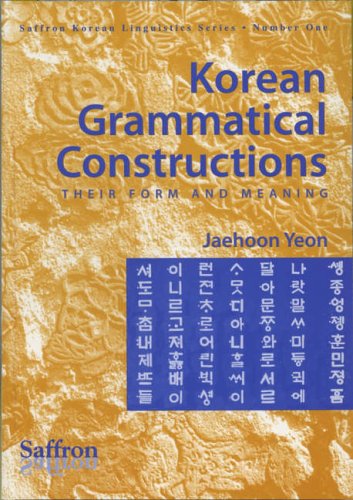
The inaugural volume in the "Saffron Korean Linguistics Series", this title is published in connection with the Centre of Korean Studies, London. The series is primarily devoted to functionally- and typologically-orientated research on the Korean language and linguistics. This volume addresses broadly defined issues rather than matters of abstract theoretical polemics. The series aims to offer an international academic forum for the dissemination of Korean linguistics as well as Korean language studies.
Les informations fournies dans la section « Synopsis » peuvent faire référence à une autre édition de ce titre.
Revue de presse
This is a functional-typological analysis of Korean grammatical constructions in which the grammatical relation, or the case-marking, alternates. The constructions discussed in this book are double-nominative constructions, dative-subject constructions, causative constructions, passive constructions, anticausative (neutral-verb) constructions, possessor ascension constructions, and space-object constructions. The author has tried to analyse those constructions by studying the relationships between coding features, grammatical relations and semantic roles. Although there is a great deal of correspondence between grammatical relations and the morphological marking, the latter sometimes fail to give a clear indication of grammatical relations, or give inconsistent indications. The grammatical relations (GR) can be changed by the operation of GR-changing processes such as causative, passive, anticausative and possessor-ascension, but the semantic roles remain unchanged in some constructions. The author has taken into account semantic (and pragmatic) factors in explaining the morpho-syntactic behaviour of Korean grammatical constructions. It was shown that differences in morphological coding features may indicate differences in semantic implication. --Sajid Rizvi, Editor in Chief, Saffron Books
Biographie de l'auteur
Dr Jaehoon Yeon is Senior Lecturer in Korean language at the School of Oriental and African Studies (SOAS), University of London. Dr Yeon received his BA and MA in Linguistics at the Seoul National University and his PhD in Linguistics at SOAS. He is the author of Korean Grammatical Constructions: Their Form and Meaning (volume 1 in Saffron Korean Linguistics Series) and co-author of Teach Yourself Korean, Elementary Korean, Continuing Korean, and Integrated Korean: Advanced 1 and 2. He has also published numerous articles on Korean grammar and linguistics.
Les informations fournies dans la section « A propos du livre » peuvent faire référence à une autre édition de ce titre.
Résultats de recherche pour Korean Grammatical Constructions: Their Form and Meaning

Image d'archives
Korean Grammatical Constructions: Their Form and Meaning (Saffron Korean Linguistics Series, 1)
Vendeur : Joseph Burridge Books, Dagenham, Royaume-Uni
Évaluation du vendeur 5 sur 5 étoiles

Soft cover. Etat : New. 231 pages : map ; 21 cm. Summary:This title is primarily devoted to functionally- and typologically-orientated research on the Korean language and linguistics. The series aims to offer an international academic forum for the dissemination of Korean linguistics as well as Korean language studies. N° de réf. du vendeur BGLANG175
Acheter neuf
EUR 27,99
Expédition à EUR 27,18
Expédition depuis Royaume-Uni vers Etats-Unis
Expédition depuis Royaume-Uni vers Etats-Unis
Quantité disponible : 1 disponible(s)
Image fournie par le vendeur
Korean grammatical constructions: their form and meaning
Edité par
Saffron Books, London, 2003
ISBN 10 : 1872843263
ISBN 13 : 9781872843261
Ancien ou d'occasion
Couverture souple
Vendeur : Tempo Books, Saint Paul, MN, Etats-Unis
Évaluation du vendeur 5 sur 5 étoiles
6" x 8.25" pp. 231. Paperback bound in orange and blue wrappers, largely clean with very minor wrinkling at the top of the spine. "With the Compliments of the Korea Foundation" sticker on half title page. Very good. N° de réf. du vendeur 625
Acheter D'occasion
EUR 59,57
Expédition à EUR 7,36
Expédition nationale : Etats-Unis
Expédition nationale : Etats-Unis
Quantité disponible : 1 disponible(s)
Image d'archives
Korean Grammatical Constructions: Their Form and Meaning (Saffron Korean Linguistics Series): 1 (Saffron Korean Linguistics Series)
Vendeur : Mispah books, Redhill, SURRE, Royaume-Uni
Évaluation du vendeur 4 sur 5 étoiles

paperback. Etat : New. NEW. SHIPS FROM MULTIPLE LOCATIONS. book. N° de réf. du vendeur ERICA82918728432636
Acheter neuf
EUR 216,63
Expédition à EUR 29,54
Expédition depuis Royaume-Uni vers Etats-Unis
Expédition depuis Royaume-Uni vers Etats-Unis
Quantité disponible : 1 disponible(s)