
Articles liés à The Light that Failed
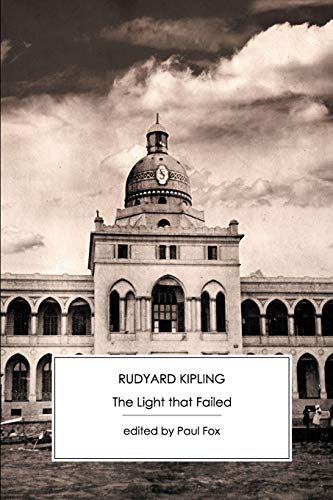
Synopsis
Originally published in 1891, The Light that Failed is Rudyard Kipling’s semi-autobiographical first novel. Critics who had praised him for Plain Tales from the Hills were shocked at the unhappy ending and deviation from his usual style, but none could deny the power of Kipling’s writing.The Light that Failed tells the story of war artist Dick Heldar, his doomed love for childhood sweetheart Maisie, and his descent into blindness. Through Dick, Kipling considers the relationship between Art and Life, espousing his belief that the artist has a duty to paint only what he knows to be true.The reality pursued by Kipling is vividly portrayed in his descriptions of the battlefields of the Sudan and the fleshpits of Port Said. These near-Naturalistic depictions led to comparisons with Zola and show a very different Kipling from the one famous for his Anglo-Indian tales.This edition includes: * critical introduction * biography of Kipling * suggestions for further reading * explanatory footnotes * alternative “happy ending” from the serialised version in Lippincott’s Magazine * contemporary reviews * extracts from The City of Dreadful Night, Fuzzy Wuzzy, Vitaï Lampada, and The Picture of Dorian Gray* Dürer’s Melencolia I
Les informations fournies dans la section « Synopsis » peuvent faire référence à une autre édition de ce titre.
Biographie de l'auteur
Rudyard Joseph Kipling was born in the then named Bombay, India on 30th December 1865. Aged six, he was sent to England to be educated, firstly in Southsea, where he was cared for in a foster home, and later at Westward Ho, a United Services College in Devon. A life of misery at the former was described in his story 'Baa Baa Black Sheep', whilst Westward Ho was used as a basis for his questioning the public school ethic in 'Stalky and Co'. Kipling returned to India in 1882 to work as an assistant editor for the Civil and Military Gazette of Lahore. His reputation as a writer was established with stories of English life in India, published there in 1888/9. 'The Phantom Rickshaw', 'Soldiers Three' and 'Under the Deodars' are amongst these early works. Returning to England in 1889, Kipling settled in London and continued to earn a living as a writer. In 1892 he married Caroline Balestier, an American. They travelled extensively in the following four years, including a spell living in America, and it was in this time most of his enduring work was written, not least 'The Jungle Book' and 'The Second Jungle Book'. Kipling once again returned to England in 1896 and continued his writing career, although tragedy hit the family when his eldest daughter, Josephine, died in 1899. Nonetheless, in 1901 he completed 'Kim', often considered to be his best work. The following year, having settled in Sussex, he published 'Just So Stories', a book he had planned to write for Josephine. Having refused the position of Poet Laureate, which was offered in 1895, he did accept the Nobel Prize for Literature, becoming the first English author to be so honoured. By 1910, however, Kipling's appeal was waning. His poems and stories were based on values that were perceived as outdated. There was widespread reaction against Victorian imperialism, highlighted by the incompetent management of the Boer War. When World War I came, Kipling had difficulty in adapting to the mood of the public and after his only son, John, was reported missing in action believed killed in 1915, he became very active on the War Graves Commission. After the war he became an increasingly isolated figure, although some of his best writing was to come, with 'Debits and Credits' in 1926 and 'Limits and Renewals' in 1932. Kipling died in 1936 in London and was buried in Westminster Abbey. Today, however, he is once again avidly read not just for the quality of his writing and storytelling, but through a renewed
Présentation de l'éditeur
Originally published in 1891, The Light that Failed is Rudyard Kipling’s semi-autobiographical first novel. Critics who had praised him for Plain Tales from the Hills were shocked at the unhappy ending and deviation from his usual style, but none could deny the power of Kipling’s writing.The Light that Failed tells the story of war artist Dick Heldar, his doomed love for childhood sweetheart Maisie, and his descent into blindness. Through Dick, Kipling considers the relationship between Art and Life, espousing his belief that the artist has a duty to paint only what he knows to be true.The reality pursued by Kipling is vividly portrayed in his descriptions of the battlefields of the Sudan and the fleshpits of Port Said. These near-Naturalistic depictions led to comparisons with Zola and show a very different Kipling from the one famous for his Anglo-Indian tales.This edition includes: * critical introduction * biography of Kipling * suggestions for further reading * explanatory footnotes * alternative “happy ending” from the serialised version in Lippincott’s Magazine * contemporary reviews * extracts from The City of Dreadful Night, Fuzzy Wuzzy, Vitaï Lampada, and The Picture of Dorian Gray* Dürer’s Melencolia I
Les informations fournies dans la section « A propos du livre » peuvent faire référence à une autre édition de ce titre.
Résultats de recherche pour The Light that Failed

Image d'archives
The Light that Failed
Edité par
Victorian Secrets, 2011
ISBN 10 : 1906469199
ISBN 13 : 9781906469191
Ancien ou d'occasion
Paperback
Vendeur : WorldofBooks, Goring-By-Sea, WS, Royaume-Uni
Évaluation du vendeur 5 sur 5 étoiles

Paperback. Etat : Very Good. The book has been read, but is in excellent condition. Pages are intact and not marred by notes or highlighting. The spine remains undamaged. N° de réf. du vendeur GOR009195670
Acheter D'occasion
EUR 6,59
Expédition à EUR 6,59
Expédition depuis Royaume-Uni vers Etats-Unis
Expédition depuis Royaume-Uni vers Etats-Unis
Quantité disponible : 2 disponible(s)