
Articles liés à Hamlet's BlackBerry: a practical philosophy for...
Hamlet's BlackBerry: a practical philosophy for building a good life in the digital age - Couverture souple
Synopsis
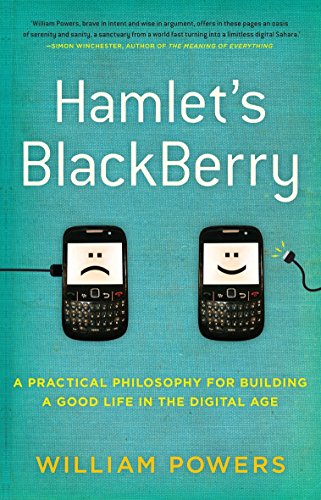
A crisp, passionately argued answer to the question that everyone who s grown dependent on digital devices is asking: Where s the rest of my life? At a time when we re all trying to make sense of our relentlessly connected lives, this revelatory book presents a bold new approach to the digital age. Part intellectual journey, part memoir, Hamlet s BlackBerry sets out to solve what William Powers calls the conundrum of connectedness. Our computers and mobile devices do wonderful things for us. But they also impose an enormous burden, making it harder for us to focus, do our best work, build strong relationships, and find the depth and fulfilment we crave. Powers argues that we need a new philosophy for life with screens. To find it, he reaches into the past, uncovering a rich trove of ideas that have helped people manage and enjoy their connected lives for thousands of years. Drawing on some of history s most brilliant thinkers, from Plato to Shakespeare to Thoreau, he shows that digital connectedness serves us best when it s balanced by its opposite, disconnectedness. Using his own life as both laboratory and object lesson, Powers demonstrates why this is the moment to revisit our relationship to screens and mobile technologies, and how profound the rewards of doing so can be. Lively, original, and entertaining, Hamlet s BlackBerry will challenge you to rethink your digital life.
Les informations fournies dans la section « Synopsis » peuvent faire référence à une autre édition de ce titre.
À propos de l'auteur
William Powers is a former staff writer for The Washington Post, has written about media, technology, and other subjects for a wide variety of publications, including The Atlantic, The New York Times, and McSweeney's. This book grew out of research he did as a fellow at Harvard University's Joan Shorenstein Center on the Press, Politics and Public Policy. A two-time winner of the Arthur Rowse Award for media criticism, he lives on Cape Cod with his wife, author Martha Sherrill, and their son. This is his first book.
Les informations fournies dans la section « A propos du livre » peuvent faire référence à une autre édition de ce titre.
Résultats de recherche pour Hamlet's BlackBerry: a practical philosophy for...

Image d'archives
Hamlet's BlackBerry: a practical philosophy for building a good life in the digital age
Vendeur : WorldofBooks, Goring-By-Sea, WS, Royaume-Uni
Évaluation du vendeur 5 sur 5 étoiles

Paperback. Etat : Very Good. The book has been read, but is in excellent condition. Pages are intact and not marred by notes or highlighting. The spine remains undamaged. N° de réf. du vendeur GOR007249829
Acheter D'occasion
EUR 13,29
Expédition à EUR 6,55
Expédition depuis Royaume-Uni vers Etats-Unis
Expédition depuis Royaume-Uni vers Etats-Unis
Quantité disponible : 1 disponible(s)
Image d'archives
Hamlet's Blackberry: A Practical Philosophy for Building a Good Life in the Digital Age
Edité par
Scribe Publications, 2013
ISBN 10 : 1921640782
ISBN 13 : 9781921640780
Ancien ou d'occasion
Paperback
Vendeur : Barclay Books, York, WA, Australie
Évaluation du vendeur 5 sur 5 étoiles
Paperback. At a time when everyone, from big businesses to ordinary individuals, is trying to make sense of their connected lives, Hamlet's BlackBerry presents a bold new paradigm for understanding the devices that now demand so much of our time and attention. It shows how our computers and mobile devices are changing the way we think, feel, and relate to others. While these technologies are tremendously helpful, they are also becoming our greatest burden, making it harder for us to focus and think clearly, do our best work and achieve the depth and fulfillment we crave. It argues that we have surrendered too much of our lives to our screens, by following a philosophy the author calls digital maximalism. He offers an alternative approach that any individual or organisation can use to manage their connectedness more wisely. Drawing on the ideas of some of the most brilliant thinkers in the history of human connectedness, from Socrates to Shakespeare and Ben Franklin to Marshall McLuhan, this new philosophy proceeds from the simple notion that connectedness serves us best when it is offset by its opposite, disconnectedness. There are ways to strike a healthy balance between the two, and Hamlet's BlackBerry shows how, using concrete examples from everyday life. 2010. A trade paperback copy in fine, unmarked condition. N° de réf. du vendeur 8889911
Acheter D'occasion
EUR 9,48
Expédition à EUR 27,82
Expédition depuis Australie vers Etats-Unis
Expédition depuis Australie vers Etats-Unis
Quantité disponible : 1 disponible(s)