
Articles liés à Francis Ormond: A Ruling Passion
Synopsis
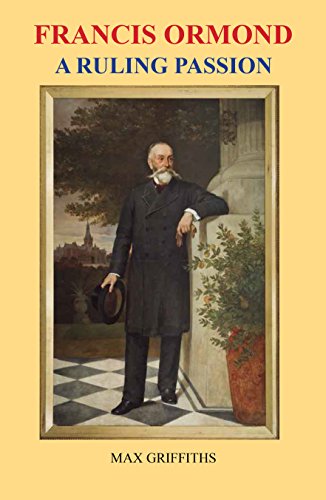
Francis Ormond was a Scottish born pastoralist, member of Parliament of Victoria, and great philanthropist in the areas of education and religion. He used his wealth to benefit others. As a young man he managed his father's sheep station near Piggoreet, south west of Ballarat. Upon discovering that the majority station hands he employed were uneducated, he started a class for his employees, devoting nearly every evening to their tutorage. This was the pattern of his life. Where he saw a need, he took practical steps to help. A devout Presbyterian and elder of the church, when the question of establishing a Presbyterian college at the University of Melbourne was raised in 1877, he pledged £10,000 to the appeal. When a Working Men's College was proposed he offered £5000 towards its establishment. It opened in 1887 with 320 students. By 1938 the number of students was 10,000. Later known as the Royal Melbourne Technical College it is now RMIT University. His attempts to found a college of music in Melbourne were unsuccessful so he gave £20,000 to found the Ormond Chair of Music at the University. This is the story of his life and times. His legacy includes the Ormond Chair of Music at the University of Melbourne, Ormond Hall at the Royal Victorian Institute for the Blind, RMIT's Francis Ormond Building, Ormond College at the University of Melbourne, Ormond Road in Geelong, the Francis Ormond Mason Lodge and the Melbourne suburb of Ormond.
Les informations fournies dans la section « Synopsis » peuvent faire référence à une autre édition de ce titre.
Présentation de l'éditeur
Francis Ormond was a Scottish born pastoralist, member of Parliament of Victoria, and great philanthropist in the areas of education and religion. He used his wealth to benefit others. As a young man he managed his father's sheep station near Piggoreet, south west of Ballarat. Upon discovering that the majority station hands he employed were uneducated, he started a class for his employees, devoting nearly every evening to their tutorage. This was the pattern of his life. Where he saw a need, he took practical steps to help. A devout Presbyterian and elder of the church, when the question of establishing a Presbyterian college at the University of Melbourne was raised in 1877, he pledged £10,000 to the appeal. When a Working Men's College was proposed he offered £5000 towards its establishment. It opened in 1887 with 320 students. By 1938 the number of students was 10,000. Later known as the Royal Melbourne Technical College it is now RMIT University. His attempts to found a college of music in Melbourne were unsuccessful so he gave £20,000 to found the Ormond Chair of Music at the University. This is the story of his life and times. His legacy includes the Ormond Chair of Music at the University of Melbourne, Ormond Hall at the Royal Victorian Institute for the Blind, RMIT's Francis Ormond Building, Ormond College at the University of Melbourne, Ormond Road in Geelong, the Francis Ormond Mason Lodge and the Melbourne suburb of Ormond.
Les informations fournies dans la section « A propos du livre » peuvent faire référence à une autre édition de ce titre.
Résultats de recherche pour Francis Ormond: A Ruling Passion

Image d'archives
Francis Ormond: A Ruling Passion
Edité par
Rosenberg Publishing Pty Ltd (AUS), 2015
ISBN 10 : 1925078531
ISBN 13 : 9781925078534
Ancien ou d'occasion
paperback
Vendeur : AwesomeBooks, Wallingford, Royaume-Uni
Évaluation du vendeur 5 sur 5 étoiles

paperback. Etat : Very Good. Francis Ormond: A Ruling Passion This book is in very good condition and will be shipped within 24 hours of ordering. The cover may have some limited signs of wear but the pages are clean, intact and the spine remains undamaged. This book has clearly been well maintained and looked after thus far. Money back guarantee if you are not satisfied. See all our books here, order more than 1 book and get discounted shipping. . N° de réf. du vendeur 7719-9781925078534
Acheter D'occasion
EUR 10,51
Expédition à EUR 4,88
Expédition depuis Royaume-Uni vers Etats-Unis
Expédition depuis Royaume-Uni vers Etats-Unis
Quantité disponible : 2 disponible(s)
Image d'archives
Francis Ormond: A Ruling Passion
Edité par
Rosenberg Publishing Pty Ltd (AUS) -, 2015
ISBN 10 : 1925078531
ISBN 13 : 9781925078534
Ancien ou d'occasion
paperback
Vendeur : Bahamut Media, Reading, Royaume-Uni
Évaluation du vendeur 4 sur 5 étoiles

paperback. Etat : Very Good. Shipped within 24 hours from our UK warehouse. Clean, undamaged book with no damage to pages and minimal wear to the cover. Spine still tight, in very good condition. Remember if you are not happy, you are covered by our 100% money back guarantee. N° de réf. du vendeur 6545-9781925078534
Acheter D'occasion
EUR 10,51
Expédition à EUR 8,26
Expédition depuis Royaume-Uni vers Etats-Unis
Expédition depuis Royaume-Uni vers Etats-Unis
Quantité disponible : 2 disponible(s)
Image d'archives
Francis Ormond: A Ruling Passion
Edité par
Rosenberg Publishing, 2015
ISBN 10 : 1925078531
ISBN 13 : 9781925078534
Ancien ou d'occasion
Soft cover
Vendeur : Wallace Books, Portland, OR, Etats-Unis
Évaluation du vendeur 5 sur 5 étoiles
Soft cover. Etat : Very Good. Softcover book in VG+ condition. Pages are crisp and completely clean bearing no additional markings whatsoever. Item appears to be unread. Binding is tight with a smooth spine. Front cover is spotless but the back cover bears two creases that run its entire length. NOT an ex-library copy. We ship promptly from the United States and in a box. N° de réf. du vendeur 38,288x
Acheter D'occasion
EUR 18,37
Expédition à EUR 3,79
Expédition nationale : Etats-Unis
Expédition nationale : Etats-Unis
Quantité disponible : 1 disponible(s)
Image d'archives
Francis Ormond: A Ruling Passion
Vendeur : The Book Corner, Beaverton, OR, Etats-Unis
Évaluation du vendeur 4 sur 5 étoiles
paperback. Etat : New. Brand new. Paperback. Ships from Friends bookstore to benefit Beaverton (Oregon) library. N° de réf. du vendeur mon0000026386
Acheter neuf
EUR 22,47
Expédition à EUR 4,46
Expédition nationale : Etats-Unis
Expédition nationale : Etats-Unis
Quantité disponible : 1 disponible(s)
Image d'archives
FRANCIS ORMOND: A RULING PASSION.
Edité par
Rosenberg Publishing, 2015., 2015
ISBN 10 : 1925078531
ISBN 13 : 9781925078534
Ancien ou d'occasion
Couverture souple
Signé
Vendeur : Sainsbury's Books Pty. Ltd., Camberwell, VIC, Australie
Évaluation du vendeur 4 sur 5 étoiles
8vo, 208pp. Colour and black & white illustrations. A very good paperback copy. Signed by author. N° de réf. du vendeur 127073
Acheter D'occasion
EUR 15,89
Expédition à EUR 21,40
Expédition depuis Australie vers Etats-Unis
Expédition depuis Australie vers Etats-Unis
Quantité disponible : 1 disponible(s)