
Articles liés à Evasive Entrepreneurs & the Future of Governance:...
Evasive Entrepreneurs & the Future of Governance: How Innovation Improves Economies and Governments - Couverture souple
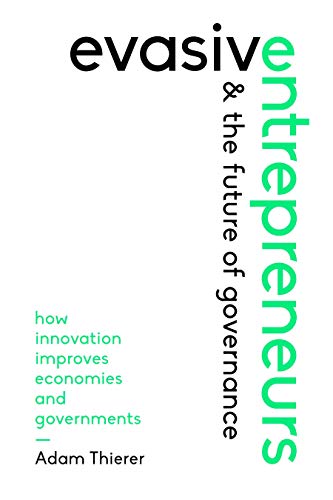
Synopsis
Innovators of all stripes--like Airbnb and Uber--are increasingly using new technological capabilities to circumvent traditional regulatory systems, or at least put pressure on public policymakers to reform laws and regulations that are outmoded, inefficient, or illogical. Other disruptive innovators are emerging in other fields using technologies as wide-ranging as 3-D printers, drones, driverless cars, Bitcoin and blockchain, virtual reality, the "Internet of Things," and more. Some of these innovators just love to tinker. Others want to change the world with new life-enriching products. And many more are just looking to earn a living and support their families. Regardless of why they are doing it, these "evasive entrepreneurs"--innovators who don't always conform to social or legal norms--are changing the world and challenging their governments.
Beyond boosting economic growth and raising our living standards, evasive entrepreneurialism can play an important role in constraining unaccountable governmental activities that often fail to reflect common sense or the consent of the governed. In essence, evasive entrepreneurialism and technological civil disobedience are new "checks and balances" that help us rein in the excesses of the state, make government more transparent and accountable, and ensure that our civil rights and economic liberties are respected.
This book will explain to the reader why evasive entrepreneurs are increasingly engaged in different forms of technological civil disobedience and also make the case that we should accept--and often even embrace--a certain amount of that activity as a way to foster innovation, economic growth, and more accountable government.
Les informations fournies dans la section « Synopsis » peuvent faire référence à une autre édition de ce titre.
À propos de l'auteur
Adam Thierer is a Senior Research Fellow at the Mercatus Center at George Mason University. He specializes in innovation, entrepreneurialism, Internet, and free-speech issues, with a particular focus on the public policy concerns surrounding emerging technologies. Thierer has authored or edited eight books on topics ranging from media regulation and child safety issues to the role of federalism in high-technology markets. His latest book is Permissionless Innovation: The Continuing Case for Comprehensive Technological Freedom.
Les informations fournies dans la section « A propos du livre » peuvent faire référence à une autre édition de ce titre.
Résultats de recherche pour Evasive Entrepreneurs & the Future of Governance:...

Image d'archives
Evasive Entrepreneurs and the Future of Governance: How Innovation Improves Economies and Governments
Edité par
Cato Institute,U.S., 2020
ISBN 10 : 1948647761
ISBN 13 : 9781948647762
Ancien ou d'occasion
Paperback
Vendeur : World of Books (was SecondSale), Montgomery, IL, Etats-Unis
Évaluation du vendeur 5 sur 5 étoiles

Paperback. Etat : Very Good. Innovators of all stripes--like Airbnb and Uber--are increasingly using new technological capabilities to circumvent traditional regulatory systems, or at least put pressure on public policymakers to reform laws and regulations that are outmoded, inefficient, or illogical. Other disruptive innovators are emerging in other fields using technologies as wide-ranging as 3-D printers, drones, driverless cars, Bitcoin and blockchain, virtual reality, the Internet of Things, and more. Some of these innovators just love to tinker. Others want to change the world with new life-enriching products. And many more are just looking to earn a living and support their families. Regardless of why they are doing it, these evasive entrepreneurs--innovators who don't always conform to social or legal norms--are changing the world and challenging their governments. Beyond boosting economic growth and raising our living standards, evasive entrepreneurialism can play an important role in constraining unaccountable governmental activities that often fail to reflect common sense or the consent of the governed. In essence, evasive entrepreneurialism and technological civil disobedience are new checks and balances that help us rein in the excesses of the state, make government more transparent and accountable, and ensure that our civil rights and economic liberties are respected. This book will explain to the reader why evasive entrepreneurs are increasingly engaged in different forms of technological civil disobedience and also make the case that we should accept--and often even embrace--a certain amount of that activity as a way to foster innovation, economic growth, and more accountable government. N° de réf. du vendeur 00099734522
Acheter D'occasion
EUR 4,73
Livraison gratuite
Expédition nationale : Etats-Unis
Expédition nationale : Etats-Unis
Quantité disponible : 2 disponible(s)
Image d'archives
Evasive Entrepreneurs and the Future of Governance: How Innovation Improves Economies and Governments
Edité par
Cato Institute,U.S., 2020
ISBN 10 : 1948647761
ISBN 13 : 9781948647762
Ancien ou d'occasion
Paperback
Vendeur : World of Books (was SecondSale), Montgomery, IL, Etats-Unis
Évaluation du vendeur 5 sur 5 étoiles
Paperback. Etat : Good. Innovators of all stripes--like Airbnb and Uber--are increasingly using new technological capabilities to circumvent traditional regulatory systems, or at least put pressure on public policymakers to reform laws and regulations that are outmoded, inefficient, or illogical. Other disruptive innovators are emerging in other fields using technologies as wide-ranging as 3-D printers, drones, driverless cars, Bitcoin and blockchain, virtual reality, the Internet of Things, and more. Some of these innovators just love to tinker. Others want to change the world with new life-enriching products. And many more are just looking to earn a living and support their families. Regardless of why they are doing it, these evasive entrepreneurs--innovators who don't always conform to social or legal norms--are changing the world and challenging their governments. Beyond boosting economic growth and raising our living standards, evasive entrepreneurialism can play an important role in constraining unaccountable governmental activities that often fail to reflect common sense or the consent of the governed. In essence, evasive entrepreneurialism and technological civil disobedience are new checks and balances that help us rein in the excesses of the state, make government more transparent and accountable, and ensure that our civil rights and economic liberties are respected. This book will explain to the reader why evasive entrepreneurs are increasingly engaged in different forms of technological civil disobedience and also make the case that we should accept--and often even embrace--a certain amount of that activity as a way to foster innovation, economic growth, and more accountable government. N° de réf. du vendeur 00107039886
Acheter D'occasion
EUR 4,73
Livraison gratuite
Expédition nationale : Etats-Unis
Expédition nationale : Etats-Unis
Quantité disponible : 1 disponible(s)
Image d'archives
Evasive Entrepreneurs and the Future of Governance: How Innovation Improves Economies and Governments
Edité par
Cato Institute (edition DC), 2020
ISBN 10 : 1948647761
ISBN 13 : 9781948647762
Ancien ou d'occasion
Paperback
Vendeur : BooksRun, Philadelphia, PA, Etats-Unis
Évaluation du vendeur 5 sur 5 étoiles
Paperback. Etat : Very Good. DC. It's a well-cared-for item that has seen limited use. The item may show minor signs of wear. All the text is legible, with all pages included. It may have slight markings and/or highlighting. N° de réf. du vendeur 1948647761-8-1
Acheter D'occasion
EUR 4,74
Livraison gratuite
Expédition nationale : Etats-Unis
Expédition nationale : Etats-Unis
Quantité disponible : 1 disponible(s)
Image d'archives
Evasive Entrepreneurs and the Future of Governance: How Innovation Improves Economies and Governments
Edité par
Cato Institute, 2020
ISBN 10 : 1948647761
ISBN 13 : 9781948647762
Ancien ou d'occasion
Couverture souple
Vendeur : BookHolders, Towson, MD, Etats-Unis
Évaluation du vendeur 5 sur 5 étoiles
Etat : Fair. [ No Hassle 30 Day Returns ][ Ships Daily ] [ Underlining/Highlighting: NONE ] [ Writing: NONE ] [ Edition: First ] Publisher: Cato Institute Pub Date: 5/14/2020 Binding: Paperback Pages: 250 First edition. N° de réf. du vendeur 6931422
Acheter D'occasion
EUR 5,57
Livraison gratuite
Expédition nationale : Etats-Unis
Expédition nationale : Etats-Unis
Quantité disponible : 1 disponible(s)
Image d'archives
Evasive Entrepreneurs and the Future of Governance: How Innovation Improves Economies and Governments
Edité par
Cato Institute, 2020
ISBN 10 : 1948647761
ISBN 13 : 9781948647762
Ancien ou d'occasion
Paperback
Vendeur : Bookmans, Tucson, AZ, Etats-Unis
Évaluation du vendeur 5 sur 5 étoiles
Paperback. Etat : Good. Satisfaction 100% guaranteed. N° de réf. du vendeur mon0002483536
Acheter D'occasion
EUR 2,30
Expédition à EUR 3,56
Expédition nationale : Etats-Unis
Expédition nationale : Etats-Unis
Quantité disponible : 1 disponible(s)
Image d'archives
Evasive Entrepreneurs and the Future of Governance: How Innovation Improves Economies and Governments
Edité par
Cato Institute, 2020
ISBN 10 : 1948647761
ISBN 13 : 9781948647762
Ancien ou d'occasion
Paperback
Vendeur : ThriftBooks-Dallas, Dallas, TX, Etats-Unis
Évaluation du vendeur 5 sur 5 étoiles
Paperback. Etat : Good. No Jacket. Pages can have notes/highlighting. Spine may show signs of wear. ~ ThriftBooks: Read More, Spend Less. N° de réf. du vendeur G1948647761I3N00
Acheter D'occasion
EUR 5,96
Livraison gratuite
Expédition nationale : Etats-Unis
Expédition nationale : Etats-Unis
Quantité disponible : 1 disponible(s)
Image d'archives
Evasive Entrepreneurs and the Future of Governance: How Innovation Improves Economies and Governments
Edité par
Cato Institute, 2020
ISBN 10 : 1948647761
ISBN 13 : 9781948647762
Ancien ou d'occasion
Paperback
Vendeur : ThriftBooks-Dallas, Dallas, TX, Etats-Unis
Évaluation du vendeur 5 sur 5 étoiles
Paperback. Etat : Very Good. No Jacket. May have limited writing in cover pages. Pages are unmarked. ~ ThriftBooks: Read More, Spend Less. N° de réf. du vendeur G1948647761I4N00
Acheter D'occasion
EUR 5,96
Livraison gratuite
Expédition nationale : Etats-Unis
Expédition nationale : Etats-Unis
Quantité disponible : 1 disponible(s)
Image d'archives
Evasive Entrepreneurs and the Future of Governance: How Innovation Improves Economies and Governments
Edité par
Cato Institute, 2020
ISBN 10 : 1948647761
ISBN 13 : 9781948647762
Ancien ou d'occasion
Paperback
Vendeur : ThriftBooks-Atlanta, AUSTELL, GA, Etats-Unis
Évaluation du vendeur 5 sur 5 étoiles
Paperback. Etat : Fair. No Jacket. Readable copy. Pages may have considerable notes/highlighting. ~ ThriftBooks: Read More, Spend Less. N° de réf. du vendeur G1948647761I5N00
Acheter D'occasion
EUR 5,96
Livraison gratuite
Expédition nationale : Etats-Unis
Expédition nationale : Etats-Unis
Quantité disponible : 1 disponible(s)
Image d'archives
Evasive Entrepreneurs and the Future of Governance: How Innovation Improves Economies and Governments
Edité par
Cato Institute, 2020
ISBN 10 : 1948647761
ISBN 13 : 9781948647762
Ancien ou d'occasion
Paperback
Vendeur : ThriftBooks-Dallas, Dallas, TX, Etats-Unis
Évaluation du vendeur 5 sur 5 étoiles
Paperback. Etat : Very Good. No Jacket. Former library book; May have limited writing in cover pages. Pages are unmarked. ~ ThriftBooks: Read More, Spend Less. N° de réf. du vendeur G1948647761I4N10
Acheter D'occasion
EUR 5,96
Livraison gratuite
Expédition nationale : Etats-Unis
Expédition nationale : Etats-Unis
Quantité disponible : 1 disponible(s)
Image d'archives
Evasive Entrepreneurs and the Future of Governance: How Innovation Improves Economies and Governments
Edité par
Cato Institute,U.S., 2020
ISBN 10 : 1948647761
ISBN 13 : 9781948647762
Ancien ou d'occasion
Paperback
Vendeur : World of Books Inc, Montgomery, IL, Etats-Unis
Évaluation du vendeur 4 sur 5 étoiles

Paperback. Etat : Very Good. Innovators of all stripes--like Airbnb and Uber--are increasingly using new technological capabilities to circumvent traditional regulatory systems, or at least put pressure on public policymakers to reform laws and regulations that are outmoded, inefficient, or illogical. Other disruptive innovators are emerging in other fields using technologies as wide-ranging as 3-D printers, drones, driverless cars, Bitcoin and blockchain, virtual reality, the Internet of Things, and more. Some of these innovators just love to tinker. Others want to change the world with new life-enriching products. And many more are just looking to earn a living and support their families. Regardless of why they are doing it, these evasive entrepreneurs--innovators who don't always conform to social or legal norms--are changing the world and challenging their governments. Beyond boosting economic growth and raising our living standards, evasive entrepreneurialism can play an important role in constraining unaccountable governmental activities that often fail to reflect common sense or the consent of the governed. In essence, evasive entrepreneurialism and technological civil disobedience are new checks and balances that help us rein in the excesses of the state, make government more transparent and accountable, and ensure that our civil rights and economic liberties are respected. This book will explain to the reader why evasive entrepreneurs are increasingly engaged in different forms of technological civil disobedience and also make the case that we should accept--and often even embrace--a certain amount of that activity as a way to foster innovation, economic growth, and more accountable government. N° de réf. du vendeur CIN1948647761VG
Acheter D'occasion
EUR 6,57
Livraison gratuite
Expédition nationale : Etats-Unis
Expédition nationale : Etats-Unis
Quantité disponible : 2 disponible(s)