
Articles liés à Adding more PHY to the MAC: Exploiting Physical Layer...
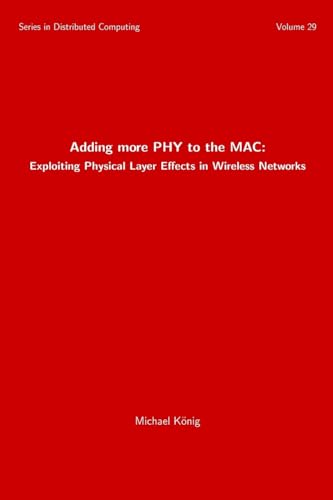
Adding more PHY to the MAC: Exploiting Physical Layer Effects in Wireless Networks - Couverture souple
Synopsis
Traditional wireless algorithms all too often ignore the special qualities of the wireless medium. In this thesis, we propose new wireless transmission primitives for various applications and evaluate each of them on a wireless sensor network. In particular, we focus on integrating two properties into our primitives: the availability of transmission power control and the capture effect. First, we consider the problems of traffic prioritization and running multiple wireless algorithms in parallel. We propose a technique allowing to simultaneously run multiple algorithms of different priorities, with minimal overhead in terms of bandwidth and latency. This is done by assigning each priority a range of admissible received signal strengths at each node, and employing the capture effect to automatically enable reception of only the strongest incoming signal. The setup is transparent to the algorithms: each appears to have complete access to the network's resources as long as no algorithm of a higher priority wishes to use them. We discuss which properties of the network graph and the wireless hardware are beneficial to our technique. Second, we demonstrate the feasibility of achieving constructive interference using commodity wireless sensor nodes. In contrast to previous work, our technique does not rely on global external events as reference, but instead aims to minimize the errors in clock synchronization and transmission timing. Our evaluation shows that our technique is able to achieve constructive interference in over 30% of cases, even after multiple minutes of sleep. Third, we propose a class of transmission primitives which decouple packets' synchronization headers from their payloads, such that two or more different senders may contribute to a single received packet. We explore 2 applications: 1) enabling reception attempts of very weak packets, e.g., across a network chasm, and 2) the injection of shorter packets into longer ongoing transmissions. We investigate ways to vastly reduce the problems incurred by using a mismatching synchronization header for reception. In practice, we are able to successfully decode up to 30% of cross-chasm packets and up to 70% of injected packets. Fourth, we examine how transmission power control can improve wireless schedules. Based on the classic RAND scheduling algorithm we develop a version employing power control called PowerRAND. The schedules generated by PowerRAND are 20-25% shorter, i.e., achieve a 25-33% higher throughput than RAND. Our practical evaluation shows that these schedules are just as feasible in practice. Further, we discuss how power control provides flexibility to schedules in the face of changing environments.
Les informations fournies dans la section « Synopsis » peuvent faire référence à une autre édition de ce titre.
À propos de l'auteur
Michael König received his M. Sc. degree in computer science from ETH Zurich, Switzerland, in 2012. In 2012 he joined the Distributed Computing Group of Professor Roger Wattenhofer at ETH Zurich as a Ph.D. student and research assistant. In 2017 he earned his Ph.D. degree for his work on wireless transmission primitives and network algorithms.
Les informations fournies dans la section « A propos du livre » peuvent faire référence à une autre édition de ce titre.
Résultats de recherche pour Adding more PHY to the MAC: Exploiting Physical Layer...

Image fournie par le vendeur
Adding More Phy to the MAC : Exploiting Physical Layer Effects in Wireless Networks
Edité par
CreateSpace Independent Publishing Platform, 2017
ISBN 10 : 1981628029
ISBN 13 : 9781981628025
Ancien ou d'occasion
Couverture souple
Vendeur : GreatBookPrices, Columbia, MD, Etats-Unis
Évaluation du vendeur 5 sur 5 étoiles

Etat : As New. Unread book in perfect condition. N° de réf. du vendeur 31240072
Acheter D'occasion
EUR 33
Expédition à EUR 2,35
Expédition nationale : Etats-Unis
Expédition nationale : Etats-Unis
Quantité disponible : Plus de 20 disponibles
Image d'archives
Adding more PHY to the MAC: Exploiting Physical Layer Effects in Wireless Networks (Series in Distributed Computing)
Edité par
CreateSpace Independent Publishing Platform, 2017
ISBN 10 : 1981628029
ISBN 13 : 9781981628025
Neuf
Couverture souple
Vendeur : California Books, Miami, FL, Etats-Unis
Évaluation du vendeur 5 sur 5 étoiles
Etat : New. Print on Demand. N° de réf. du vendeur I-9781981628025
Acheter neuf
EUR 34,89
Expédition à EUR 2,67
Expédition nationale : Etats-Unis
Expédition nationale : Etats-Unis
Quantité disponible : Plus de 20 disponibles
Image fournie par le vendeur
Adding More Phy to the MAC : Exploiting Physical Layer Effects in Wireless Networks
Edité par
CreateSpace Independent Publishing Platform, 2017
ISBN 10 : 1981628029
ISBN 13 : 9781981628025
Neuf
Couverture souple
Vendeur : GreatBookPrices, Columbia, MD, Etats-Unis
Évaluation du vendeur 5 sur 5 étoiles
Etat : New. N° de réf. du vendeur 31240072-n
Acheter neuf
EUR 35,21
Expédition à EUR 2,35
Expédition nationale : Etats-Unis
Expédition nationale : Etats-Unis
Quantité disponible : Plus de 20 disponibles
Image fournie par le vendeur
Adding More Phy to the MAC : Exploiting Physical Layer Effects in Wireless Networks
Edité par
CreateSpace Independent Publishing Platform, 2017
ISBN 10 : 1981628029
ISBN 13 : 9781981628025
Ancien ou d'occasion
Couverture souple
Vendeur : GreatBookPricesUK, Woodford Green, Royaume-Uni
Évaluation du vendeur 5 sur 5 étoiles
Etat : As New. Unread book in perfect condition. N° de réf. du vendeur 31240072
Acheter D'occasion
EUR 39,05
Expédition à EUR 17,89
Expédition depuis Royaume-Uni vers Etats-Unis
Expédition depuis Royaume-Uni vers Etats-Unis
Quantité disponible : Plus de 20 disponibles
Image d'archives
Adding more PHY to the MAC: Exploiting Physical Layer Effects in Wireless Networks
Edité par
Createspace Independent Publishing Platform, 2017
ISBN 10 : 1981628029
ISBN 13 : 9781981628025
Neuf
Paperback / softback
Vendeur : THE SAINT BOOKSTORE, Southport, Royaume-Uni
Évaluation du vendeur 5 sur 5 étoiles
Paperback / softback. Etat : New. This item is printed on demand. New copy - Usually dispatched within 5-9 working days. N° de réf. du vendeur C9781981628025
Acheter neuf
EUR 43,68
Expédition à EUR 16,39
Expédition depuis Royaume-Uni vers Etats-Unis
Expédition depuis Royaume-Uni vers Etats-Unis
Quantité disponible : Plus de 20 disponibles
Image fournie par le vendeur
Adding More Phy to the MAC : Exploiting Physical Layer Effects in Wireless Networks
Edité par
CreateSpace Independent Publishing Platform, 2017
ISBN 10 : 1981628029
ISBN 13 : 9781981628025
Neuf
Couverture souple
Vendeur : GreatBookPricesUK, Woodford Green, Royaume-Uni
Évaluation du vendeur 5 sur 5 étoiles
Etat : New. N° de réf. du vendeur 31240072-n
Acheter neuf
EUR 43,77
Expédition à EUR 17,89
Expédition depuis Royaume-Uni vers Etats-Unis
Expédition depuis Royaume-Uni vers Etats-Unis
Quantité disponible : Plus de 20 disponibles