
Articles liés à The Adventures of Percival: A phylogenetic tale
Synopsis
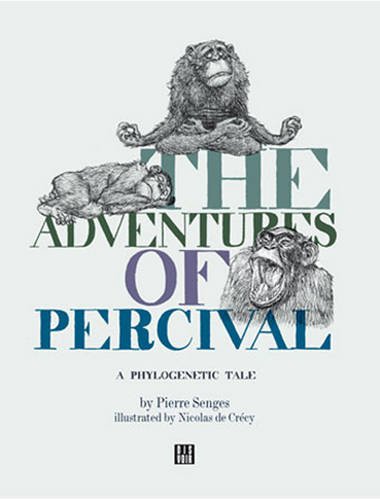
We all know the tale of the ape sitting for all eternity at the typewriter hoping to compose, through sheer chance, a comedy by Shakespeare. This fable is used tu give the idea of the improbabilily of things, like the emergence of intelligence in primates. But there's a slight hitch:to accept that story assumes one imagines the ape as a pure immortal mechanism coupled to another machine made out of keys and an ink ribbon.That amounts to denying him any intelligence, any artistic sensitivity, or even the slightest embryonic common sense. What would happen if, instead of an imaginary chimpanzee, one invited a real chimpanzee, equipped with a real cortex and a no less authentic conscience, to sit at the tvpewriter ? That's the experiment undertaken by Samuel Mclntosh, gardener, nrathematician, Doctor in Probability and Animal Behaviour. Will Percival, formerly the typist ape end by writing Shakespeare's Works ? Will he type away blindly, or will he pervert chance by letting his genius express itself ? Will he obey his destiny as metaphorical animal or will he take a malicious pleasure in deceiving the prédictions of the ethologists ? Will Samuel Mclntosh successfully complete his experiment ? Reading these pages should help yon answer those questions. However, nothing is less certain: several versions of the same fable exist, and they don't always agree. This book draws inspiration front the works of Dominique Lestel, a philosopher-ethologist, and Alain Richert, a landscaper-botanist. It takes into account (as it pleases) the most récent speculations as far as ethology is concerned, and twists the use of ethograms (description of behaviours) in order to find other ways of telling fables. Nicolas de Crécy's drawings are there to bring a bit of scientific rigour to the fantasy, and vice-versa.
Les informations fournies dans la section « Synopsis » peuvent faire référence à une autre édition de ce titre.
Présentation de l'éditeur
We all know the tale of the ape sitting for all eternity at the typewriter hoping to compose, through sheer chance, a comedy by Shakespeare. This fable is used tu give the idea of the improbabilily of things, like the emergence of intelligence in primates. But there's a slight hitch:to accept that story assumes one imagines the ape as a pure immortal mechanism coupled to another machine made out of keys and an ink ribbon.That amounts to denying him any intelligence, any artistic sensitivity, or even the slightest embryonic common sense. What would happen if, instead of an imaginary chimpanzee, one invited a real chimpanzee, equipped with a real cortex and a no less authentic conscience, to sit at the tvpewriter ? That's the experiment undertaken by Samuel Mclntosh, gardener, nrathematician, Doctor in Probability and Animal Behaviour. Will Percival, formerly the typist ape end by writing Shakespeare's Works ? Will he type away blindly, or will he pervert chance by letting his genius express itself ? Will he obey his destiny as metaphorical animal or will he take a malicious pleasure in deceiving the prédictions of the ethologists ? Will Samuel Mclntosh successfully complete his experiment ? Reading these pages should help yon answer those questions. However, nothing is less certain: several versions of the same fable exist, and they don't always agree. This book draws inspiration front the works of Dominique Lestel, a philosopher-ethologist, and Alain Richert, a landscaper-botanist. It takes into account (as it pleases) the most récent speculations as far as ethology is concerned, and twists the use of ethograms (description of behaviours) in order to find other ways of telling fables. Nicolas de Crécy's drawings are there to bring a bit of scientific rigour to the fantasy, and vice-versa.
Les informations fournies dans la section « A propos du livre » peuvent faire référence à une autre édition de ce titre.
Résultats de recherche pour The Adventures of Percival: A phylogenetic tale

Image d'archives
The Adventures of Percival: A Phylogenetic Tale (Illustrated Fairy Tales for Adults)
Edité par
Dis Voir, 2009
ISBN 10 : 2914563477
ISBN 13 : 9782914563475
Ancien ou d'occasion
Paperback
Vendeur : Midtown Scholar Bookstore, Harrisburg, PA, Etats-Unis
Évaluation du vendeur 5 sur 5 étoiles

Paperback. Etat : Good. Good - Bumped and creased book with tears to the extremities, but not affecting the text block, may have remainder mark or previous owner's name - GOOD PAPERBACK Standard-sized. N° de réf. du vendeur M2914563477Z3
Acheter D'occasion
EUR 17,71
Expédition à EUR 5,35
Expédition nationale : Etats-Unis
Expédition nationale : Etats-Unis
Quantité disponible : 1 disponible(s)
Image fournie par le vendeur
Adventures of Percival : A Phylogenetic Tale
Edité par
Dis Voir, 2009
ISBN 10 : 2914563477
ISBN 13 : 9782914563475
Ancien ou d'occasion
Couverture souple
Vendeur : GreatBookPrices, Columbia, MD, Etats-Unis
Évaluation du vendeur 5 sur 5 étoiles
Etat : As New. Unread book in perfect condition. N° de réf. du vendeur 6906367
Acheter D'occasion
EUR 20,81
Expédition à EUR 2,35
Expédition nationale : Etats-Unis
Expédition nationale : Etats-Unis
Quantité disponible : 5 disponible(s)
Image fournie par le vendeur
Adventures of Percival : A Phylogenetic Tale
Vendeur : GreatBookPrices, Columbia, MD, Etats-Unis
Évaluation du vendeur 5 sur 5 étoiles
Etat : New. N° de réf. du vendeur 6906367-n
Acheter neuf
EUR 20,98
Expédition à EUR 2,35
Expédition nationale : Etats-Unis
Expédition nationale : Etats-Unis
Quantité disponible : 5 disponible(s)
Image fournie par le vendeur
The Adventures of Percival
Vendeur : Rarewaves.com USA, London, LONDO, Royaume-Uni
Évaluation du vendeur 5 sur 5 étoiles
Paperback. Etat : New. N° de réf. du vendeur LU-9782914563475
Acheter neuf
EUR 23,40
Livraison gratuite
Expédition depuis Royaume-Uni vers Etats-Unis
Expédition depuis Royaume-Uni vers Etats-Unis
Quantité disponible : 3 disponible(s)
Image fournie par le vendeur
The Adventures of Percival
Vendeur : Rarewaves USA, HEBRON, KY, Etats-Unis
Évaluation du vendeur 5 sur 5 étoiles
Paperback. Etat : New. N° de réf. du vendeur LU-9782914563475
Acheter neuf
EUR 25,14
Livraison gratuite
Expédition nationale : Etats-Unis
Expédition nationale : Etats-Unis
Quantité disponible : Plus de 20 disponibles
Image d'archives
The Adventures of Percival (Paperback)
Vendeur : Grand Eagle Retail, Bensenville, IL, Etats-Unis
Évaluation du vendeur 5 sur 5 étoiles
Paperback. Etat : new. Paperback. The first installment in Dis Voir's new 'illustrated fairy tales for adults,' The Adventures of Percival is based on the classic probability proposition that a chimpanzee randomly typing will eventually type a Shakespeare sonnet. Here, McIntosh, a gardener-mathematician (and spiritual cousin of Baron Mdnchhausen), decides to take the fable seriously, and with the assistance of a typewriter and a chimpanzee called Percival, undertakes to enact the experiment. Naturally things don't go as planned, as the chimpanzee proves to be less compliant than expected and bizarre behavioral mergings occur between man and animal. Nicolas de Crecy's comic drawings sometimes illustrate and sometimes contradict Senges' narrative, or inveigle themselves between his lines like a creeper. Inspired by research in animal behavior led by Dominique Lestel, and by the work of the landscape artist-gardener Alain Richert, Senges' tale of interspecies cognition makes a conscious nod towards contemporary debates within the cognitive sciences. By Pierre Senges. Edited by Daniele Riviere. Text by Dominique Lestel, Alain Richert. Illustrations by Nicolas de Crecy. Shipping may be from multiple locations in the US or from the UK, depending on stock availability. N° de réf. du vendeur 9782914563475
Acheter neuf
EUR 30,53
Livraison gratuite
Expédition nationale : Etats-Unis
Expédition nationale : Etats-Unis
Quantité disponible : 1 disponible(s)
Image d'archives
The Adventures of Percival (Illustrated Fairy Tales for Adults)
Vendeur : Majestic Books, Hounslow, Royaume-Uni
Évaluation du vendeur 4 sur 5 étoiles

Etat : New. N° de réf. du vendeur 6512253
Acheter neuf
EUR 24,07
Expédition à EUR 7,66
Expédition depuis Royaume-Uni vers Etats-Unis
Expédition depuis Royaume-Uni vers Etats-Unis
Quantité disponible : 3 disponible(s)
Image d'archives
Adventures of Percival (Illustrated Fairy Tales for Adults)
Vendeur : Revaluation Books, Exeter, Royaume-Uni
Évaluation du vendeur 5 sur 5 étoiles
Paperback. Etat : Brand New. illustrated edition. 96 pages. 8.30x6.50x0.60 inches. In Stock. N° de réf. du vendeur __2914563477
Acheter neuf
EUR 20,27
Expédition à EUR 11,78
Expédition depuis Royaume-Uni vers Etats-Unis
Expédition depuis Royaume-Uni vers Etats-Unis
Quantité disponible : 2 disponible(s)
Image d'archives
Adventures of Percival
Vendeur : Kennys Bookshop and Art Galleries Ltd., Galway, GY, Irlande
Évaluation du vendeur 5 sur 5 étoiles
Etat : New. Illustrator(s): Crecy, Nicolas de. Num Pages: 128 pages, 10 b & w illustrations. BIC Classification: ABA; AFF; AGB. Category: (G) General (US: Trade). Dimension: 220 x 170 x 15. Weight in Grams: 295. . 2009. Paperback. . . . . N° de réf. du vendeur V9782914563475
Acheter neuf
EUR 24,47
Expédition à EUR 9,50
Expédition depuis Irlande vers Etats-Unis
Expédition depuis Irlande vers Etats-Unis
Quantité disponible : 5 disponible(s)
Image d'archives
The Adventures of Percival (Illustrated Fairy Tales for Adults)
Vendeur : Books Puddle, Woodside, NY, Etats-Unis
Évaluation du vendeur 4 sur 5 étoiles
Etat : New. N° de réf. du vendeur 261368482
Acheter neuf
EUR 34,70
Expédition à EUR 3,56
Expédition nationale : Etats-Unis
Expédition nationale : Etats-Unis
Quantité disponible : 3 disponible(s)