
Articles liés à Proceedings of ELM-2017
Proceedings of ELM-2017 - Couverture souple
Livre 6 sur 10: Proceedings in Adaptation, Learning and Optimization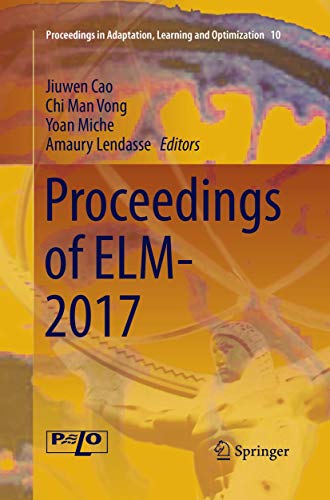
Synopsis
This book contains some selected papers from the International Conference on Extreme Learning Machine (ELM) 2017, held in Yantai, China, October 4–7, 2017. The book covers theories, algorithms and applications of ELM.
Extreme Learning Machines (ELM) aims to enable pervasive learning and pervasive intelligence. As advocated by ELM theories, it is exciting to see the convergence of machine learning and biological learning from the long-term point of view. ELM may be one of the fundamental `learning particles’ filling the gaps between machine learning and biological learning (of which activation functions are even unknown). ELM represents a suite of (machine and biological) learning techniques in which hidden neurons need not be tuned: inherited from their ancestors or randomly generated. ELM learning theories show that effective learning algorithms can be derived based on randomly generated hidden neurons (biological neurons, artificial neurons, wavelets, Fourier series,etc) as long as they are nonlinear piecewise continuous, independent of training data and application environments. Increasingly, evidence from neuroscience suggests that similar principles apply in biological learning systems. ELM theories and algorithms argue that “random hidden neurons” capture an essential aspect of biological learning mechanisms as well as the intuitive sense that the efficiency of biological learning need not rely on computing power of neurons. ELM theories thus hint at possible reasons why the brain is more intelligent and effective than current computers.
This conference will provide a forum for academics, researchers and engineers to share and exchange R&D experience on both theoretical studies and practical applications of the ELM technique and brain learning.
It gives readers a glance of the most recent advances of ELM.
Les informations fournies dans la section « Synopsis » peuvent faire référence à une autre édition de ce titre.
Résultats de recherche pour Proceedings of ELM-2017

Image d'archives
Proceedings of ELM-2017 (eng)
impression à la demandeVendeur : Brook Bookstore On Demand, Napoli, NA, Italie
Évaluation du vendeur 5 sur 5 étoiles

Etat : new. Questo è un articolo print on demand. N° de réf. du vendeur 46d4a2f90d5d9d0725449df04ee7e76e
Acheter neuf
EUR 166,29
Expédition à EUR 6,80
Expédition depuis Italie vers Etats-Unis
Expédition depuis Italie vers Etats-Unis
Quantité disponible : Plus de 20 disponibles
Image fournie par le vendeur
Proceedings of ELM-2017
Edité par
Springer International Publishing, 2019
ISBN 10 : 3030131823
ISBN 13 : 9783030131821
Neuf
Couverture souple
Vendeur : moluna, Greven, Allemagne
Évaluation du vendeur 5 sur 5 étoiles
Etat : New. N° de réf. du vendeur 448673298
Acheter neuf
EUR 180,07
Expédition à EUR 48,99
Expédition depuis Allemagne vers Etats-Unis
Expédition depuis Allemagne vers Etats-Unis
Quantité disponible : Plus de 20 disponibles
Image fournie par le vendeur
Proceedings of ELM-2017
Edité par
Springer International Publishing Dez 2019, 2019
ISBN 10 : 3030131823
ISBN 13 : 9783030131821
Neuf
Taschenbuch
Vendeur : BuchWeltWeit Ludwig Meier e.K., Bergisch Gladbach, Allemagne
Évaluation du vendeur 5 sur 5 étoiles
Taschenbuch. Etat : Neu. This item is printed on demand - it takes 3-4 days longer - Neuware -This book contains some selected papers from the International Conference on Extreme Learning Machine (ELM) 2017, held in Yantai, China, October 4-7, 2017. The book covers theories, algorithms and applications of ELM.Extreme Learning Machines (ELM) aims to enable pervasive learning and pervasive intelligence. As advocated by ELM theories, it is exciting to see the convergence of machine learning and biological learning from the long-term point of view. ELM may be one of the fundamental `learning particles' filling the gaps between machine learning and biological learning (of which activation functions are even unknown). ELM represents a suite of (machine and biological) learning techniques in which hidden neurons need not be tuned: inherited from their ancestors or randomly generated. ELM learning theories show that effective learning algorithms can be derived based on randomly generated hidden neurons (biological neurons, artificial neurons, wavelets, Fourier series, etc) as long as they are nonlinear piecewise continuous, independent of training data and application environments. Increasingly, evidence from neuroscience suggests that similar principles apply in biological learning systems. ELM theories and algorithms argue that 'random hidden neurons' capture an essential aspect of biological learning mechanisms as well as the intuitive sense that the efficiency of biological learning need not rely on computing power of neurons. ELM theories thus hint at possible reasons why the brain is more intelligent and effective than current computers.This conference will provide a forum for academics, researchers and engineers to share and exchange R&D experience on both theoretical studies and practical applications of the ELM technique and brain learning.It gives readers a glance of the most recent advances of ELM. 348 pp. Englisch. N° de réf. du vendeur 9783030131821
Acheter neuf
EUR 213,99
Expédition à EUR 23
Expédition depuis Allemagne vers Etats-Unis
Expédition depuis Allemagne vers Etats-Unis
Quantité disponible : 2 disponible(s)
Image d'archives
Proceedings of Elm-2017
Vendeur : GreatBookPrices, Columbia, MD, Etats-Unis
Évaluation du vendeur 5 sur 5 étoiles
Etat : New. N° de réf. du vendeur 39636396-n
Acheter neuf
EUR 239,06
Expédition à EUR 2,36
Expédition nationale : Etats-Unis
Expédition nationale : Etats-Unis
Quantité disponible : 15 disponible(s)
Image fournie par le vendeur
Proceedings of ELM-2017
Vendeur : preigu, Osnabrück, Allemagne
Évaluation du vendeur 5 sur 5 étoiles
Taschenbuch. Etat : Neu. Proceedings of ELM-2017 | Jiuwen Cao (u. a.) | Taschenbuch | Proceedings in Adaptation, Learning and Optimization | vii | Englisch | 2019 | Springer | EAN 9783030131821 | Verantwortliche Person für die EU: Springer Verlag GmbH, Tiergartenstr. 17, 69121 Heidelberg, juergen[dot]hartmann[at]springer[dot]com | Anbieter: preigu. N° de réf. du vendeur 117473906
Acheter neuf
EUR 184,95
Expédition à EUR 70
Expédition depuis Allemagne vers Etats-Unis
Expédition depuis Allemagne vers Etats-Unis
Quantité disponible : 5 disponible(s)
Image fournie par le vendeur
Proceedings of ELM-2017
Vendeur : AHA-BUCH GmbH, Einbeck, Allemagne
Évaluation du vendeur 5 sur 5 étoiles
Taschenbuch. Etat : Neu. Druck auf Anfrage Neuware - Printed after ordering - This book contains some selected papers from the International Conference on Extreme Learning Machine (ELM) 2017, held in Yantai, China, October 4-7, 2017. The book covers theories, algorithms and applications of ELM.Extreme Learning Machines (ELM) aims to enable pervasive learning and pervasive intelligence. As advocated by ELM theories, it is exciting to see the convergence of machine learning and biological learning from the long-term point of view. ELM may be one of the fundamental `learning particles' filling the gaps between machine learning and biological learning (of which activation functions are even unknown). ELM represents a suite of (machine and biological) learning techniques in which hidden neurons need not be tuned: inherited from their ancestors or randomly generated. ELM learning theories show that effective learning algorithms can be derived based on randomly generated hidden neurons (biological neurons, artificial neurons, wavelets, Fourier series,etc) as long as they are nonlinear piecewise continuous, independent of training data and application environments. Increasingly, evidence from neuroscience suggests that similar principles apply in biological learning systems. ELM theories and algorithms argue that 'random hidden neurons' capture an essential aspect of biological learning mechanisms as well as the intuitive sense that the efficiency of biological learning need not rely on computing power of neurons. ELM theories thus hint at possible reasons why the brain is more intelligent and effective than current computers.This conference will provide a forum for academics, researchers and engineers to share and exchange R&D experience on both theoretical studies and practical applications of the ELM technique and brain learning.It gives readers a glance of the most recent advances of ELM. N° de réf. du vendeur 9783030131821
Acheter neuf
EUR 226,39
Expédition à EUR 35
Expédition depuis Allemagne vers Etats-Unis
Expédition depuis Allemagne vers Etats-Unis
Quantité disponible : 1 disponible(s)
Image d'archives
Proceedings Of Elm-2017
Vendeur : Kennys Bookshop and Art Galleries Ltd., Galway, GY, Irlande
Évaluation du vendeur 5 sur 5 étoiles
Etat : New. N° de réf. du vendeur V9783030131821
Acheter neuf
EUR 252,27
Expédition à EUR 9,50
Expédition depuis Irlande vers Etats-Unis
Expédition depuis Irlande vers Etats-Unis
Quantité disponible : 15 disponible(s)
Image d'archives
Proceedings of ELM-2017 (Proceedings in Adaptation, Learning and Optimization, 10)
Vendeur : Ria Christie Collections, Uxbridge, Royaume-Uni
Évaluation du vendeur 5 sur 5 étoiles
Etat : New. In English. N° de réf. du vendeur ria9783030131821_new
Acheter neuf
EUR 253,03
Expédition à EUR 13,32
Expédition depuis Royaume-Uni vers Etats-Unis
Expédition depuis Royaume-Uni vers Etats-Unis
Quantité disponible : Plus de 20 disponibles
Image d'archives
Proceedings of Elm-2017
Edité par
Springer, 2019
ISBN 10 : 3030131823
ISBN 13 : 9783030131821
Ancien ou d'occasion
Couverture souple
Vendeur : GreatBookPrices, Columbia, MD, Etats-Unis
Évaluation du vendeur 5 sur 5 étoiles
Etat : As New. Unread book in perfect condition. N° de réf. du vendeur 39636396
Acheter D'occasion
EUR 265,12
Expédition à EUR 2,36
Expédition nationale : Etats-Unis
Expédition nationale : Etats-Unis
Quantité disponible : 15 disponible(s)
Image fournie par le vendeur
Proceedings of ELM-2017
Edité par
Springer, Springer Dez 2019, 2019
ISBN 10 : 3030131823
ISBN 13 : 9783030131821
Neuf
Taschenbuch
Vendeur : buchversandmimpf2000, Emtmannsberg, BAYE, Allemagne
Évaluation du vendeur 5 sur 5 étoiles
Taschenbuch. Etat : Neu. This item is printed on demand - Print on Demand Titel. Neuware -This book contains some selected papers from the International Conference on Extreme Learning Machine (ELM) 2017, held in Yantai, China, October 4-7, 2017. The book covers theories, algorithms and applications of ELM.Extreme Learning Machines (ELM) aims to enable pervasive learning and pervasive intelligence. As advocated by ELM theories, it is exciting to see the convergence of machine learning and biological learning from the long-term point of view. ELM may be one of the fundamental `learning particles' filling the gaps between machine learning and biological learning (of which activation functions are even unknown). ELM represents a suite of (machine and biological) learning techniques in which hidden neurons need not be tuned: inherited from their ancestors or randomly generated. ELM learning theories show that effective learning algorithms can be derived based on randomly generated hidden neurons (biological neurons, artificial neurons, wavelets, Fourier series,etc) as long as they are nonlinear piecewise continuous, independent of training data and application environments. Increasingly, evidence from neuroscience suggests that similar principles apply in biological learning systems. ELM theories and algorithms argue that 'random hidden neurons' capture an essential aspect of biological learning mechanisms as well as the intuitive sense that the efficiency of biological learning need not rely on computing power of neurons. ELM theories thus hint at possible reasons why the brain is more intelligent and effective than current computers.This conference will provide a forum for academics, researchers and engineers to share and exchange R&D experience on both theoretical studies and practical applications of the ELM technique and brain learning.It gives readers a glance of the most recent advances of ELM.Springer-Verlag KG, Sachsenplatz 4-6, 1201 Wien 348 pp. Englisch. N° de réf. du vendeur 9783030131821
Acheter neuf
EUR 213,99
Expédition à EUR 60
Expédition depuis Allemagne vers Etats-Unis
Expédition depuis Allemagne vers Etats-Unis
Quantité disponible : 1 disponible(s)