
Articles liés à The Existential Husserl: A Collection of Critical Essays
The Existential Husserl: A Collection of Critical Essays - Couverture rigide
Livre 118 sur 119: Contributions to Phenomenology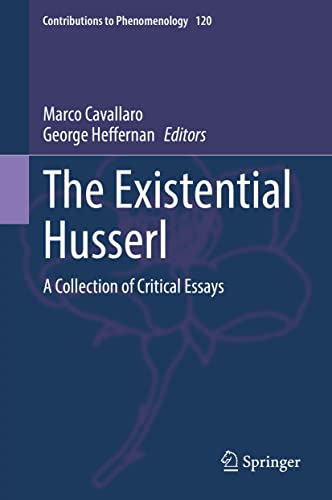
Synopsis
This book examines Husserl's approach to the question concerning meaning in life and demonstrates that his philosophy includes a phenomenology of existence. Given his critique of the fashionable "philosophy of existence" of the late 1920s and early 1930s, one might think that Husserl posited an opposition between transcendental phenomenology and existential philosophy, as well as that in this respect he differed from existential phenomenologists after him. But texts composed between 1908 and 1937 and recently published in Husserliana XLII, Grenzprobleme der Phänomenologie (2014), show that the existential Husserl was not opposed but open to the phenomenological investigation of several basic topics of a philosophy of existence. A collection of contributions from a team of internationally recognized scholars drawing on these and other sources, the present volume offers insights into the relationship between phenomenology and philosophy of existence.It does so by (1) delineating the basic outlines of Husserl's phenomenology of existence, (2) reinterpreting the tension between Husserl's transcendental phenomenology and Jaspers's and Heidegger's philosophy of existence as well as Kierkegaard's and Sartre's existentialism, and (3) investigating the existential aspects of Husserl's phenomenological ethics. Thus focusing on neglected aspects of Husserl's thought, the volume shows that there is a consensus between classical phenomenology and existential phenomenology on the urgency of addressing the existential questions that in The Crisis of the European Sciences and Transcendental Phenomenology (1936) Husserl calls "the questions concerning the meaning or meaninglessness of this entire human existence". The Existential Husserl represents a major contribution to the clarification of the historical and philosophical developments from transcendental phenomenology to existential phenomenology. The book should appeal to a wide audience of many readers at all levels looking for phenomenological answers to existential questions.
Les informations fournies dans la section « Synopsis » peuvent faire référence à une autre édition de ce titre.
À propos de l'auteur
Marco Cavallaro (Ph.D., University of Cologne) is Assistant Professor at the Institute for Philosophy of the University of Koblenz-Landau. He earned his Ph.D. degree with a thesis on Husserl's System of a Theory of Science (forthcoming). He has published several articles on Husserl and phenomenology, including in Husserl Studies, Phänomenologische Forschungen, and Journal of the British Society for Phenomenology. He is co-editor of the volume Phenomenology of Phantasy and Emotions (WBG, 2022). His current research focuses on phenomenological ethics, philosophy of digitality, and philosophical anthropology.
George Heffernan (Ph.D., University of Cologne) is Professor of Philosophy at Merrimack College. He specializes in phenomenology, existentialism, and hermeneutics. He has presented numerous papers, including at the Husserl Circle, the Society for Phenomenology and Existential Philosophy, and the World Congress ofPhilosophy, and published numerous papers, including in Husserl Studies, The New Yearbook for Phenomenology and Phenomenological Philosophy, and Studia phaenomenologica. He has also published several books, including Isagoge in die phänomenologische Apophantik (in Phaenomenologica). He has received numerous awards, including from the Basselin Foundation, the German Academic Exchange Service, and the National Endowment for the Humanities.Les informations fournies dans la section « A propos du livre » peuvent faire référence à une autre édition de ce titre.
Résultats de recherche pour The Existential Husserl: A Collection of Critical Essays

Image d'archives
The Existential Husserl (eng)
impression à la demandeVendeur : Brook Bookstore On Demand, Napoli, NA, Italie
Évaluation du vendeur 5 sur 5 étoiles

Etat : new. Questo è un articolo print on demand. N° de réf. du vendeur 4NTWD3BDNM
Acheter neuf
EUR 110,26
Expédition à EUR 6,80
Expédition depuis Italie vers Etats-Unis
Expédition depuis Italie vers Etats-Unis
Quantité disponible : Plus de 20 disponibles
Image fournie par le vendeur
The Existential Husserl: A Collection of Critical Essays (Contributions to Phenomenology, 120, Band 120) : A Collection of Critical Essays
Edité par
Springer, 2022
ISBN 10 : 3031050940
ISBN 13 : 9783031050947
Ancien ou d'occasion
Couverture rigide
Vendeur : AHA-BUCH GmbH, Einbeck, Allemagne
Évaluation du vendeur 5 sur 5 étoiles
Hardcover. Etat : Sehr gut. Gebraucht - Sehr gut SG - leichte Beschädigungen oder Verschmutzungen, ungelesenes Mängelexemplar, gestempelt - This book examines Husserl's approach to the question concerning meaning in life and demonstrates that his philosophy includes a phenomenology of existence. Given his critique of the fashionable 'philosophy of existence' of the late 1920s and early 1930s, one might think that Husserl posited an opposition between transcendental phenomenology and existential philosophy, as well as that in this respect he differed from existential phenomenologists after him. But texts composed between 1908 and 1937 and recently published in Husserliana XLII,Grenzprobleme der Phänomenologie(2014), show thatthe existential Husserlwas not opposed but open to the phenomenological investigation of several basic topics of a philosophy of existence. A collection of contributions from a team of internationally recognized scholars drawing on these and other sources, the present volume offers insights into the relationship between phenomenology and philosophy of existence.It does so by (1) delineating the basic outlines of Husserl's phenomenology of existence, (2) reinterpreting the tension between Husserl's transcendental phenomenology and Jaspers's and Heidegger's philosophy of existence as well as Kierkegaard's and Sartre's existentialism, and (3) investigating the existential aspects of Husserl's phenomenological ethics. Thus focusing on neglected aspects of Husserl's thought, the volume shows that there is a consensus between classical phenomenology and existential phenomenology on the urgency of addressing the existential questions that inThe Crisis of the European Sciences and Transcendental Phenomenology(1936) Husserl calls 'the questions concerning the meaning or meaninglessness of this entire human existence'.The Existential Husserlrepresents a major contribution to the clarification of the historical and philosophical developments from transcendental phenomenology to existential phenomenology. The book should appeal to a wide audience of many readers at all levels looking for phenomenological answers to existential questions. N° de réf. du vendeur INF1000725829
Acheter D'occasion
EUR 88,43
Expédition à EUR 35
Expédition depuis Allemagne vers Etats-Unis
Expédition depuis Allemagne vers Etats-Unis
Quantité disponible : 1 disponible(s)
Image d'archives
Existential Husserl : A Collection of Critical Essays
Vendeur : GreatBookPrices, Columbia, MD, Etats-Unis
Évaluation du vendeur 5 sur 5 étoiles
Etat : New. N° de réf. du vendeur 44923846-n
Acheter neuf
EUR 150,96
Expédition à EUR 2,35
Expédition nationale : Etats-Unis
Expédition nationale : Etats-Unis
Quantité disponible : 15 disponible(s)
Image d'archives
The Existential Husserl: A Collection of Critical Essays (Contributions to Phenomenology, 120)
Vendeur : California Books, Miami, FL, Etats-Unis
Évaluation du vendeur 5 sur 5 étoiles
Etat : New. N° de réf. du vendeur I-9783031050947
Acheter neuf
EUR 153,39
Livraison gratuite
Expédition nationale : Etats-Unis
Expédition nationale : Etats-Unis
Quantité disponible : Plus de 20 disponibles
Image d'archives
The Existential Husserl: A Collection of Critical Essays (Contributions to Phenomenology, 120)
Vendeur : Ria Christie Collections, Uxbridge, Royaume-Uni
Évaluation du vendeur 5 sur 5 étoiles
Etat : New. In English. N° de réf. du vendeur ria9783031050947_new
Acheter neuf
EUR 144,24
Expédition à EUR 13,40
Expédition depuis Royaume-Uni vers Etats-Unis
Expédition depuis Royaume-Uni vers Etats-Unis
Quantité disponible : Plus de 20 disponibles
Image fournie par le vendeur
The Existential Husserl
ISBN 10 : 3031050940
ISBN 13 : 9783031050947
Neuf
Couverture rigide
Vendeur : BuchWeltWeit Ludwig Meier e.K., Bergisch Gladbach, Allemagne
Évaluation du vendeur 5 sur 5 étoiles
Buch. Etat : Neu. This item is printed on demand - it takes 3-4 days longer - Neuware -This book examines Husserl's approach to the question concerning meaning in life and demonstrates that his philosophy includes a phenomenology of existence. Given his critique of the fashionable 'philosophy of existence' of the late 1920s and early 1930s, one might think that Husserl posited an opposition between transcendental phenomenology and existential philosophy, as well as that in this respect he differed from existential phenomenologists after him. But texts composed between 1908 and 1937 and recently published in Husserliana XLII,Grenzprobleme der Phänomenologie(2014), show thatthe existential Husserlwas not opposed but open to the phenomenological investigation of several basic topics of a philosophy of existence. A collection of contributions from a team of internationally recognized scholars drawing on these and other sources, the present volume offers insights into the relationship between phenomenology and philosophy of existence.It does so by (1) delineating the basic outlines of Husserl's phenomenology of existence, (2) reinterpreting the tension between Husserl's transcendental phenomenology and Jaspers's and Heidegger's philosophy of existence as well as Kierkegaard's and Sartre's existentialism, and (3) investigating the existential aspects of Husserl's phenomenological ethics. Thus focusing on neglected aspects of Husserl's thought, the volume shows that there is a consensus between classical phenomenology and existential phenomenology on the urgency of addressing the existential questions that inThe Crisis of the European Sciences and Transcendental Phenomenology(1936) Husserl calls 'the questions concerning the meaning or meaninglessness of this entire human existence'.The Existential Husserlrepresents a major contribution to the clarification of the historical and philosophical developments from transcendental phenomenology to existential phenomenology. The book should appeal to a wide audience of many readers at all levels looking for phenomenological answers to existential questions. 372 pp. Englisch. N° de réf. du vendeur 9783031050947
Acheter neuf
EUR 139,09
Expédition à EUR 23
Expédition depuis Allemagne vers Etats-Unis
Expédition depuis Allemagne vers Etats-Unis
Quantité disponible : 2 disponible(s)
Image d'archives
Existential Husserl : A Collection of Critical Essays
Edité par
Springer, 2022
ISBN 10 : 3031050940
ISBN 13 : 9783031050947
Ancien ou d'occasion
Couverture rigide
Vendeur : GreatBookPrices, Columbia, MD, Etats-Unis
Évaluation du vendeur 5 sur 5 étoiles
Etat : As New. Unread book in perfect condition. N° de réf. du vendeur 44923846
Acheter D'occasion
EUR 160,19
Expédition à EUR 2,35
Expédition nationale : Etats-Unis
Expédition nationale : Etats-Unis
Quantité disponible : 15 disponible(s)
Image fournie par le vendeur
The Existential Husserl
Edité par
Springer, Berlin|Springer International Publishing|Faculty Development Committee, Merrimack College|Springer, 2022
ISBN 10 : 3031050940
ISBN 13 : 9783031050947
Neuf
Couverture rigide
Vendeur : moluna, Greven, Allemagne
Évaluation du vendeur 5 sur 5 étoiles
Gebunden. Etat : New. Dieser Artikel ist ein Print on Demand Artikel und wird nach Ihrer Bestellung fuer Sie gedruckt. This book examines Husserl s approach to the question concerning meaning in life and demonstrates that his philosophy includes a phenomenology of existence. Given his critique of the fashionable philosophy of existence of the late 1920s and early 1930s. N° de réf. du vendeur 577697768
Acheter neuf
EUR 118,61
Expédition à EUR 48,99
Expédition depuis Allemagne vers Etats-Unis
Expédition depuis Allemagne vers Etats-Unis
Quantité disponible : Plus de 20 disponibles
Image d'archives
The Existential Husserl : A Collection O
Vendeur : Kennys Bookshop and Art Galleries Ltd., Galway, GY, Irlande
Évaluation du vendeur 5 sur 5 étoiles
Etat : New. N° de réf. du vendeur V9783031050947
Acheter neuf
EUR 164,60
Expédition à EUR 9,50
Expédition depuis Irlande vers Etats-Unis
Expédition depuis Irlande vers Etats-Unis
Quantité disponible : 15 disponible(s)
Image fournie par le vendeur
The Existential Husserl : A Collection of Critical Essays
Edité par
Palgrave Macmillan, 2022
ISBN 10 : 3031050940
ISBN 13 : 9783031050947
Neuf
Couverture rigide
Vendeur : AHA-BUCH GmbH, Einbeck, Allemagne
Évaluation du vendeur 5 sur 5 étoiles
Buch. Etat : Neu. nach der Bestellung gedruckt Neuware - Printed after ordering - This book examines Husserl's approach to the question concerning meaning in life and demonstrates that his philosophy includes a phenomenology of existence. Given his critique of the fashionable 'philosophy of existence' of the late 1920s and early 1930s, one might think that Husserl posited an opposition between transcendental phenomenology and existential philosophy, as well as that in this respect he differed from existential phenomenologists after him. But texts composed between 1908 and 1937 and recently published in Husserliana XLII,Grenzprobleme der Phänomenologie(2014), show thatthe existential Husserlwas not opposed but open to the phenomenological investigation of several basic topics of a philosophy of existence. A collection of contributions from a team of internationally recognized scholars drawing on these and other sources, the present volume offers insights into the relationship between phenomenology and philosophy of existence.It does so by (1) delineating the basic outlines of Husserl's phenomenology of existence, (2) reinterpreting the tension between Husserl's transcendental phenomenology and Jaspers's and Heidegger's philosophy of existence as well as Kierkegaard's and Sartre's existentialism, and (3) investigating the existential aspects of Husserl's phenomenological ethics. Thus focusing on neglected aspects of Husserl's thought, the volume shows that there is a consensus between classical phenomenology and existential phenomenology on the urgency of addressing the existential questions that inThe Crisis of the European Sciences and Transcendental Phenomenology(1936) Husserl calls 'the questions concerning the meaning or meaninglessness of this entire human existence'.The Existential Husserlrepresents a major contribution to the clarification of the historical and philosophical developments from transcendental phenomenology to existential phenomenology. The book should appeal to a wide audience of many readers at all levels looking for phenomenological answers to existential questions. N° de réf. du vendeur 9783031050947
Acheter neuf
EUR 159,92
Expédition à EUR 35
Expédition depuis Allemagne vers Etats-Unis
Expédition depuis Allemagne vers Etats-Unis
Quantité disponible : 1 disponible(s)