
Articles liés à Circularity in Textiles
Circularity in Textiles - Couverture rigide
Livre 43 sur 45: Textile Science and Clothing Technology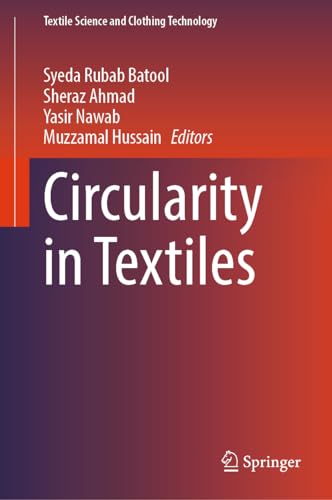
Synopsis
This book explains the basic principles of recycling and circularity in textiles. With the emergence of "quick fashion," textile manufacturing has expanded significantly over the past few decades. The importance of textiles to human society goes beyond their practical uses in providing warmth, protection, and comfort. Therefore, the usage and production of textiles are enhanced substantially compared to the past globally. As a result, rates of textile production and trash output have grown drastically. The other side of the story is the drastic rate at which they are dumped into landfills which is almost a garbage truck every second. If this alarming trend continues, there will be serious environmental consequences. It is well known that the textile sector is recognized as the second largest industrial polluter in the world, producing 20% of the global wastewater and accounting for 10% of carbon emissions. Additionally, harmful chemicals are utilized and emitted during the manufacture of textiles, which has an impact on ecosystems and public health The last 150 years of the textile industrial system fundamentally follow the "take-make-dispose" principle, in which resources are continuously taken out of a natural system (take), changed during production (make), and used for various purposes within the human system (use), and then released back into the environment (dispose of). In this way, manufacturing industries produce waste-producing commodities to make money, which eventually has a negative impact leading to the lack of resources resulting in price volatility, uncertainty, and economic crises. This book consists of 11 potential chapters to cover all the aspects of "circularity in textiles."
Les informations fournies dans la section « Synopsis » peuvent faire référence à une autre édition de ce titre.
Résultats de recherche pour Circularity in Textiles

Image d'archives
Circularity in Textiles (eng)
impression à la demandeVendeur : Brook Bookstore On Demand, Napoli, NA, Italie
Évaluation du vendeur 5 sur 5 étoiles

Etat : new. Questo è un articolo print on demand. N° de réf. du vendeur CC0CM4WVIL
Acheter neuf
EUR 134,27
Expédition à EUR 6,80
Expédition depuis Italie vers Etats-Unis
Expédition depuis Italie vers Etats-Unis
Quantité disponible : Plus de 20 disponibles
Image d'archives
Circularity in Textiles (Textile Science and Clothing Technology)
Vendeur : Ria Christie Collections, Uxbridge, Royaume-Uni
Évaluation du vendeur 5 sur 5 étoiles
Etat : New. In English. N° de réf. du vendeur ria9783031494789_new
Acheter neuf
EUR 177,87
Expédition à EUR 13,17
Expédition depuis Royaume-Uni vers Etats-Unis
Expédition depuis Royaume-Uni vers Etats-Unis
Quantité disponible : Plus de 20 disponibles
Image fournie par le vendeur
Circularity in Textiles
Edité par
Springer Nature Switzerland, 2024
ISBN 10 : 3031494784
ISBN 13 : 9783031494789
Neuf
Couverture rigide
Vendeur : moluna, Greven, Allemagne
Évaluation du vendeur 5 sur 5 étoiles
Gebunden. Etat : New. Dieser Artikel ist ein Print on Demand Artikel und wird nach Ihrer Bestellung fuer Sie gedruckt. Offers a comprehensive review of circularity in TextilesPresents a comprehensive review of sustainable raw materials used in textile productionCovers manufacturing processes that minimize waste and resource consumptionThis book e. N° de réf. du vendeur 1215161027
Acheter neuf
EUR 144,94
Expédition à EUR 48,99
Expédition depuis Allemagne vers Etats-Unis
Expédition depuis Allemagne vers Etats-Unis
Quantité disponible : Plus de 20 disponibles
Image fournie par le vendeur
Circularity in Textiles
ISBN 10 : 3031494784
ISBN 13 : 9783031494789
Neuf
Couverture rigide
Vendeur : BuchWeltWeit Ludwig Meier e.K., Bergisch Gladbach, Allemagne
Évaluation du vendeur 5 sur 5 étoiles
Buch. Etat : Neu. This item is printed on demand - it takes 3-4 days longer - Neuware -This book explains the basic principles of recycling and circularity in textiles. With the emergence of 'quick fashion,' textile manufacturing has expanded significantly over the past few decades. The importance of textiles to human society goes beyond their practical uses in providing warmth, protection, and comfort. Therefore, the usage and production of textiles are enhanced substantially compared to the past globally. As a result, rates of textile production and trash output have grown drastically. The other side of the story is the drastic rate at which they are dumped into landfills which is almost a garbage truck every second. If this alarming trend continues, there will be serious environmental consequences. It is well known that the textile sector is recognized as the second largest industrial polluter in the world, producing 20% of the global wastewater and accounting for 10% of carbon emissions. Additionally, harmful chemicals are utilized and emitted during the manufacture of textiles, which has an impact on ecosystems and public health The last 150 years of the textile industrial system fundamentally follow the 'take-make-dispose' principle, in which resources are continuously taken out of a natural system (take), changed during production (make), and used for various purposes within the human system (use), and then released back into the environment (dispose of). In this way, manufacturing industries produce waste-producing commodities to make money, which eventually has a negative impact leading to the lack of resources resulting in price volatility, uncertainty, and economic crises.This book consists of 11 potential chapters to cover all the aspects of 'circularity in textiles.' 288 pp. Englisch. N° de réf. du vendeur 9783031494789
Acheter neuf
EUR 171,19
Expédition à EUR 23
Expédition depuis Allemagne vers Etats-Unis
Expédition depuis Allemagne vers Etats-Unis
Quantité disponible : 2 disponible(s)
Image d'archives
Circularity in Textiles (Textile Science and Clothing Technology)
Vendeur : California Books, Miami, FL, Etats-Unis
Évaluation du vendeur 4 sur 5 étoiles

Etat : New. N° de réf. du vendeur I-9783031494789
Acheter neuf
EUR 204,46
Livraison gratuite
Expédition nationale : Etats-Unis
Expédition nationale : Etats-Unis
Quantité disponible : Plus de 20 disponibles
Image d'archives
Circularity in Textiles (Textile Science and Clothing Technology)
Vendeur : Books Puddle, New York, NY, Etats-Unis
Évaluation du vendeur 4 sur 5 étoiles
Etat : New. 1st ed. 2023 edition NO-PA16APR2015-KAP. N° de réf. du vendeur 26398954141
Acheter neuf
EUR 227,14
Expédition à EUR 3,47
Expédition nationale : Etats-Unis
Expédition nationale : Etats-Unis
Quantité disponible : 4 disponible(s)
Image fournie par le vendeur
Circularity in Textiles
Edité par
Springer, Birkhäuser Dez 2023, 2023
ISBN 10 : 3031494784
ISBN 13 : 9783031494789
Neuf
Couverture rigide
Vendeur : buchversandmimpf2000, Emtmannsberg, BAYE, Allemagne
Évaluation du vendeur 5 sur 5 étoiles
Buch. Etat : Neu. This item is printed on demand - Print on Demand Titel. Neuware -This book explains the basic principles of recycling and circularity in textiles. With the emergence of 'quick fashion,' textile manufacturing has expanded significantly over the past few decades. The importance of textiles to human society goes beyond their practical uses in providing warmth, protection, and comfort. Therefore, the usage and production of textiles are enhanced substantially compared to the past globally. As a result, rates of textile production and trash output have grown drastically. The other side of the story is the drastic rate at which they are dumped into landfills which is almost a garbage truck every second. If this alarming trend continues, there will be serious environmental consequences. It is well known that the textile sector is recognized as the second largest industrial polluter in the world, producing 20% of the global wastewater and accounting for 10% of carbon emissions. Additionally, harmful chemicals are utilized and emitted during the manufacture of textiles, which has an impact on ecosystems and public health The last 150 years of the textile industrial system fundamentally follow the 'take-make-dispose' principle, in which resources are continuously taken out of a natural system (take), changed during production (make), and used for various purposes within the human system (use), and then released back into the environment (dispose of). In this way, manufacturing industries produce waste-producing commodities to make money, which eventually has a negative impact leading to the lack of resources resulting in price volatility, uncertainty, and economic crises. This book consists of 11 potential chapters to cover all the aspects of 'circularity in textiles.'Springer-Verlag KG, Sachsenplatz 4-6, 1201 Wien 288 pp. Englisch. N° de réf. du vendeur 9783031494789
Acheter neuf
EUR 171,19
Expédition à EUR 60
Expédition depuis Allemagne vers Etats-Unis
Expédition depuis Allemagne vers Etats-Unis
Quantité disponible : 1 disponible(s)
Image d'archives
Circularity in Textiles (Textile Science and Clothing Technology)
impression à la demandeVendeur : Majestic Books, Hounslow, Royaume-Uni
Évaluation du vendeur 4 sur 5 étoiles
Etat : New. Print on Demand. N° de réf. du vendeur 397422914
Acheter neuf
EUR 235,35
Expédition à EUR 7,58
Expédition depuis Royaume-Uni vers Etats-Unis
Expédition depuis Royaume-Uni vers Etats-Unis
Quantité disponible : 4 disponible(s)
Image d'archives
Circularity in Textiles (Textile Science and Clothing Technology)
impression à la demandeVendeur : Biblios, Frankfurt am main, HESSE, Allemagne
Évaluation du vendeur 4 sur 5 étoiles
Etat : New. PRINT ON DEMAND. N° de réf. du vendeur 18398954135
Acheter neuf
EUR 238,31
Expédition à EUR 9,95
Expédition depuis Allemagne vers Etats-Unis
Expédition depuis Allemagne vers Etats-Unis
Quantité disponible : 4 disponible(s)
Image d'archives
Circularity in Textiles
Vendeur : Revaluation Books, Exeter, Royaume-Uni
Évaluation du vendeur 5 sur 5 étoiles
Hardcover. Etat : Brand New. 287 pages. 9.25x6.10x9.21 inches. In Stock. N° de réf. du vendeur x-3031494784
Acheter neuf
EUR 251,68
Expédition à EUR 14,58
Expédition depuis Royaume-Uni vers Etats-Unis
Expédition depuis Royaume-Uni vers Etats-Unis
Quantité disponible : 2 disponible(s)