
Articles liés à Dynamics of Architecture in Late Baroque Rome: Cardinal...
Dynamics of Architecture in Late Baroque Rome: Cardinal Pietro Ottoboni at the Cancelleria - Couverture rigide
Synopsis
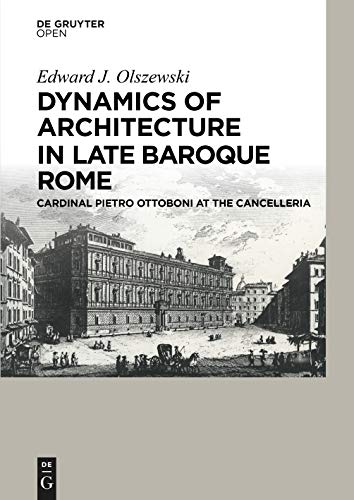
This is the first study to characterize the architectural patronage of Cardinal Pietro Ottoboni (1667-1740), and to identify twelve architects during his half century of patronage in his Ecclesiastical court of the Cancelleria. Most eminent among them were Filippo Juvarra and Domenico Gregorini. Commercial and private theaters in the palace are located from archival data, room measurements, drawings, diary accounts, Correspondence of the French Academy, and palimpsests of architectural details. The size, shape, appearance, capacity, and location of Filippo Juvarra's theater are discussed. Archival documents are cited to reveal why, how, and when it vanished. Detailed analysis is devoted to Juvarra's stage construction with its elaborate sets and moving apparatus. In his official function as Vice-Chancellor of the Church, it is well known that Ottoboni was positioned as a major patron of music, theater, and painting in late Baroque Rome. He was a librettist for oratorios performed by his resident composer, Arcangelo Corelli, and by Alessandro Scarlatti in venues in the palace, and in his basilica of San Lorenzo in Damaso, located in the palace grounds. His resident painters included Francesco Trevisani and Sebastiano Conca. He completed the construction of Bernini's Confessione in the nave of his basilica. As the sponsor of the Arcadian Academy, Ottoboni dictated taste in Roman cultural circles. His involvement in the competition for the façade of St. John Lateran is amplified. A grand overview is provided for the cardinal's commission of devotional machine constructed to rival the Lenten carnivals. As ephemeral constructions, and normally ignored liturgical phenomena, these are explored in detail for the first time.
Late Baroque architecture, architectural patronage, Roman palace architecture
Edward J. Olszewski, Case Western Reserve University, Cleveland, Ohio, U.S.A.
Les informations fournies dans la section « Synopsis » peuvent faire référence à une autre édition de ce titre.
À propos de l'auteur
Edward J. Olszewski, Case Western Reserve University, U.S.A.
Les informations fournies dans la section « A propos du livre » peuvent faire référence à une autre édition de ce titre.
Résultats de recherche pour Dynamics of Architecture in Late Baroque Rome: Cardinal...

Image fournie par le vendeur
Dynamics of Architecture in Late Baroque Rome
Edité par
De Gruyter Open Poland Aug 2015, 2015
ISBN 10 : 3110452456
ISBN 13 : 9783110452457
Neuf
Couverture rigide
Vendeur : BuchWeltWeit Ludwig Meier e.K., Bergisch Gladbach, Allemagne
Évaluation du vendeur 5 sur 5 étoiles

Buch. Etat : Neu. This item is printed on demand - it takes 3-4 days longer - Neuware -This is the first study to characterize the architectural patronage of Cardinal Pietro Ottoboni (1667-1740), and to identify twelve architects during his half century of patronage in his Ecclesiastical court of the Cancelleria. Most eminent among them were Filippo Juvarra and Domenico Gregorini. Commercial and private theaters in the palace are located from archival data, room measurements, drawings, diary accounts, Correspondence of the French Academy, and palimpsests of architectural details. The size, shape, appearance, capacity, and location of Filippo Juvarra's theater are discussed. Archival documents are cited to reveal why, how, and when it vanished. Detailed analysis is devoted to Juvarra's stage construction with its elaborate sets and moving apparatus. In his official function as Vice-Chancellor of the Church, it is well known that Ottoboni was positioned as a major patron of music, theater, and painting in late Baroque Rome. He was a librettist for oratorios performed by his resident composer, Arcangelo Corelli, and by Alessandro Scarlatti in venues in the palace, and in his basilica of San Lorenzo in Damaso, located in the palace grounds. His resident painters included Francesco Trevisani and Sebastiano Conca. He completed the construction of Bernini's Confessione in the nave of his basilica. As the sponsor of the Arcadian Academy, Ottoboni dictated taste in Roman cultural circles. His involvement in the competition for the façade of St. John Lateran is amplified. A grand overview is provided for the cardinal's commission of devotional machine constructed to rival the Lenten carnivals. As ephemeral constructions, and normally ignored liturgical phenomena, these are explored in detail for the first time. Late Baroque architecture, architectural patronage, Roman palace architecture Edward J. Olszewski, Case Western Reserve University, Cleveland, Ohio, U.S.A. 156 pp. Englisch. N° de réf. du vendeur 9783110452457
Acheter neuf
EUR 65,95
Expédition à EUR 23
Expédition depuis Allemagne vers Etats-Unis
Expédition depuis Allemagne vers Etats-Unis
Quantité disponible : 2 disponible(s)
Image fournie par le vendeur
Dynamics of Architecture in Late Baroque Rome : Cardinal Pietro Ottoboni at the Cancelleria
impression à la demandeVendeur : AHA-BUCH GmbH, Einbeck, Allemagne
Évaluation du vendeur 5 sur 5 étoiles
Buch. Etat : Neu. nach der Bestellung gedruckt Neuware - Printed after ordering - This is the first study to characterize the architectural patronage of Cardinal Pietro Ottoboni (1667-1740), and to identify twelve architects during his half century of patronage in his Ecclesiastical court of the Cancelleria. Most eminent among them were Filippo Juvarra and Domenico Gregorini. Commercial and private theaters in the palace are located from archival data, room measurements, drawings, diary accounts, Correspondence of the French Academy, and palimpsests of architectural details. The size, shape, appearance, capacity, and location of Filippo Juvarra's theater are discussed. Archival documents are cited to reveal why, how, and when it vanished. Detailed analysis is devoted to Juvarra's stage construction with its elaborate sets and moving apparatus. In his official function as Vice-Chancellor of the Church, it is well known that Ottoboni was positioned as a major patron of music, theater, and painting in late Baroque Rome. He was a librettist for oratorios performed by his resident composer, Arcangelo Corelli, and by Alessandro Scarlatti in venues in the palace, and in his basilica of San Lorenzo in Damaso, located in the palace grounds. His resident painters included Francesco Trevisani and Sebastiano Conca. He completed the construction of Bernini's Confessione in the nave of his basilica. As the sponsor of the Arcadian Academy, Ottoboni dictated taste in Roman cultural circles. His involvement in the competition for the façade of St. John Lateran is amplified. A grand overview is provided for the cardinal's commission of devotional machine constructed to rival the Lenten carnivals. As ephemeral constructions, and normally ignored liturgical phenomena, these are explored in detail for the first time. Late Baroque architecture, architectural patronage, Roman palace architecture Edward J. Olszewski, Case Western Reserve University, Cleveland, Ohio, U.S.A. N° de réf. du vendeur 9783110452457
Acheter neuf
EUR 76,86
Expédition à EUR 30,50
Expédition depuis Allemagne vers Etats-Unis
Expédition depuis Allemagne vers Etats-Unis
Quantité disponible : 1 disponible(s)
Image fournie par le vendeur
Dynamics of Architecture in Late Baroque Rome
Edité par
De Gruyter Poland, 2015
ISBN 10 : 3110452456
ISBN 13 : 9783110452457
Neuf
Couverture rigide
Vendeur : moluna, Greven, Allemagne
Évaluation du vendeur 5 sur 5 étoiles
Etat : New. Dieser Artikel ist ein Print on Demand Artikel und wird nach Ihrer Bestellung fuer Sie gedruckt. N° de réf. du vendeur 448704390
Acheter neuf
EUR 60,72
Expédition à EUR 48,99
Expédition depuis Allemagne vers Etats-Unis
Expédition depuis Allemagne vers Etats-Unis
Quantité disponible : Plus de 20 disponibles
Image fournie par le vendeur
Dynamics of Architecture in Late Baroque Rome
Edité par
De Gruyter Aug 2015, 2015
ISBN 10 : 3110452456
ISBN 13 : 9783110452457
Neuf
Couverture rigide
Vendeur : buchversandmimpf2000, Emtmannsberg, BAYE, Allemagne
Évaluation du vendeur 5 sur 5 étoiles
Buch. Etat : Neu. This item is printed on demand - Print on Demand Titel. Neuware -This is the first study to characterize the architectural patronage of Cardinal Pietro Ottoboni (1667-1740), and to identify twelve architects during his half century of patronage in his Ecclesiastical court of the Cancelleria. Most eminent among them were Filippo Juvarra and Domenico Gregorini. Commercial and private theaters in the palace are located from archival data, room measurements, drawings, diary accounts, Correspondence of the French Academy, and palimpsests of architectural details. The size, shape, appearance, capacity, and location of Filippo Juvarra's theater are discussed. Archival documents are cited to reveal why, how, and when it vanished. Detailed analysis is devoted to Juvarra's stage construction with its elaborate sets and moving apparatus. In his official function as Vice-Chancellor of the Church, it is well known that Ottoboni was positioned as a major patron of music, theater, and painting in late Baroque Rome. He was a librettist for oratorios performed by his resident composer, Arcangelo Corelli, and by Alessandro Scarlatti in venues in the palace, and in his basilica of San Lorenzo in Damaso, located in the palace grounds. His resident painters included Francesco Trevisani and Sebastiano Conca. He completed the construction of Bernini's Confessione in the nave of his basilica. As the sponsor of the Arcadian Academy, Ottoboni dictated taste in Roman cultural circles. His involvement in the competition for the façade of St. John Lateran is amplified. A grand overview is provided for the cardinal's commission of devotional machine constructed to rival the Lenten carnivals. As ephemeral constructions, and normally ignored liturgical phenomena, these are explored in detail for the first time.Late Baroque architecture, architectural patronage, Roman palace architectureEdward J. Olszewski, Case Western Reserve University, Cleveland, Ohio, U.S.A.Gruyter, de Open, Genthiner Straße 13, 10785 Berlin 156 pp. Englisch. N° de réf. du vendeur 9783110452457
Acheter neuf
EUR 65,95
Expédition à EUR 60
Expédition depuis Allemagne vers Etats-Unis
Expédition depuis Allemagne vers Etats-Unis
Quantité disponible : 1 disponible(s)
Image fournie par le vendeur
Dynamics of Architecture in Late Baroque Rome | Cardinal Pietro Ottoboni at the Cancelleria
impression à la demandeVendeur : preigu, Osnabrück, Allemagne
Évaluation du vendeur 5 sur 5 étoiles
Buch. Etat : Neu. Dynamics of Architecture in Late Baroque Rome | Cardinal Pietro Ottoboni at the Cancelleria | Edward Olszewski | Buch | 155 S. | Englisch | 2015 | De Gruyter | EAN 9783110452457 | Verantwortliche Person für die EU: Walter de Gruyter GmbH, De Gruyter GmbH, Genthiner Str. 13, 10785 Berlin, productsafety[at]degruyterbrill[dot]com | Anbieter: preigu Print on Demand. N° de réf. du vendeur 104257568
Acheter neuf
EUR 63
Expédition à EUR 70
Expédition depuis Allemagne vers Etats-Unis
Expédition depuis Allemagne vers Etats-Unis
Quantité disponible : 5 disponible(s)
Image d'archives
Dynamics of Architecture in Late Baroque Rome : Cardinal Pietro Ottoboni at the Cancelleria
Edité par
Sciendo, 2015
ISBN 10 : 3110452456
ISBN 13 : 9783110452457
Ancien ou d'occasion
Couverture rigide
Vendeur : Buchpark, Trebbin, Allemagne
Évaluation du vendeur 5 sur 5 étoiles
Etat : Sehr gut. Zustand: Sehr gut | Sprache: Englisch | Produktart: Bücher | This is the first study to characterize the architectural patronage of Cardinal Pietro Ottoboni (1667-1740), and to identify twelve architects during his half century of patronage in his Ecclesiastical court of the Cancelleria. Most eminent among them were Filippo Juvarra and Domenico Gregorini. Commercial and private theaters in the palace are located from archival data, room measurements, drawings, diary accounts, Correspondence of the French Academy, and palimpsests of architectural details. The size, shape, appearance, capacity, and location of Filippo Juvarra's theater are discussed. Archival documents are cited to reveal why, how, and when it vanished. Detailed analysis is devoted to Juvarra's stage construction with its elaborate sets and moving apparatus. In his official function as Vice-Chancellor of the Church, it is well known that Ottoboni was positioned as a major patron of music, theater, and painting in late Baroque Rome. He was a librettist for oratorios performed by his resident composer, Arcangelo Corelli, and by Alessandro Scarlatti in venues in the palace, and in his basilica of San Lorenzo in Damaso, located in the palace grounds. His resident painters included Francesco Trevisani and Sebastiano Conca. He completed the construction of Bernini's Confessione in the nave of his basilica. As the sponsor of the Arcadian Academy, Ottoboni dictated taste in Roman cultural circles. His involvement in the competition for the façade of St. John Lateran is amplified. A grand overview is provided for the cardinal's commission of devotional machine constructed to rival the Lenten carnivals. As ephemeral constructions, and normally ignored liturgical phenomena, these are explored in detail for the first time. Late Baroque architecture, architectural patronage, Roman palace architecture Edward J. Olszewski, Case Western Reserve University, Cleveland, Ohio, U.S.A. N° de réf. du vendeur 26116120/2
Acheter D'occasion
EUR 59,53
Expédition à EUR 105
Expédition depuis Allemagne vers Etats-Unis
Expédition depuis Allemagne vers Etats-Unis
Quantité disponible : 1 disponible(s)