
Articles liés à Aligning Organizations Through Measurement: The GQM+...
Aligning Organizations Through Measurement: The GQM+ Strategies Approach - Couverture rigide
Livre 3 sur 4: The Fraunhofer IESE Series on Software and Systems Engineering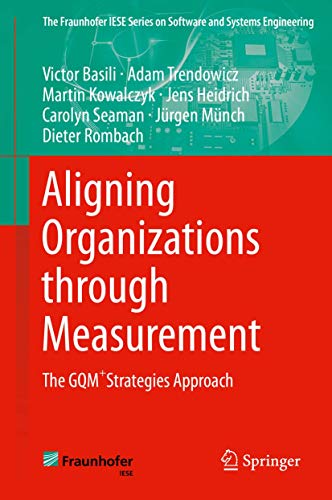
Synopsis
Aligning an organization's goals and strategies requires specifying their rationales and connections so that the links are explicit and allow for analytic reasoning about what is successful and where improvement is necessary.
This book provides guidance on how to achieve this alignment, how to monitor the success of goals and strategies and use measurement to recognize potential failures, and how to close alignment gaps. It uses the GQM+Strategies approach, which provides concepts and actionable steps for creating the link between goals and strategies across an organization and allows for measurement-based decision-making.
After outlining the general motivation for organizational alignment through measurement, the GQM+Strategies approach is described concisely, with a focus on the basic model that is created and the process for creating and using this model. The recommended steps of all six phases of the process are then described in detail with the help of a comprehensive application example. Finally, the industrial challenges addressed by the method and cases of its application in industry are presented, and the relations to other approaches, such as Balanced Scorecard, are described. The book concludes with supplementary material, such as checklists and guidelines, to support the application of the method.
This book is aimed at organization leaders, managers, decision makers, and other professionals interested in aligning their organization's goals and strategies and establishing an efficient strategic measurement program. It is also interesting for academic researchers looking for mechanisms to integrate their research results into organizational environments.
Les informations fournies dans la section « Synopsis » peuvent faire référence à une autre édition de ce titre.
À propos de l'auteur
Victor Basili is Professor Emeritus of Computer Science at the University of Maryland. He has worked on measuring, evaluating, and improving the software development process and product by applying methods such as Iterative Enhancement (IE), the Goal Question Metric Approach (GQM), the Quality Improvement Paradigm (QIP), and the Experience Factory (EF). He is the recipient of several awards including the NASA Group Achievement Award (1996), ACM SIGSOFT Outstanding Research Award (2000), and the IEEE Computer Society Harlan Mills Award (2003); and he is an IEEE and ACM Fellow.
Adam Trendowicz is a senior consultant at the Fraunhofer Institute for Experimental Software Engineering IESE (Process Management Division) in Kaiserslautern, Germany, where he leads the "Measurement and Prediction" team. He has led multiple measurement-based software improvement activities in software companies of different sizes and various domains worldwide. He has been involved in functional software size estimation and productivity benchmarking in organizations from both industry and the public sector. Last but not least, he has led the development of measurement-based project governance initiatives in the context of software development organizations.
Martin Kowalczyk is a researcher at Technische Universität Darmstadt, Germany. His current research focuses on Business Intelligence and Analytics in the context of organizational decision making processes. Prior to his current position, Martin was a researcher and consultant at Fraunhofer IESE and member of the Processes Management Division. In this position, he provided consulting services for several international organizations from the aerospace, finance, and services industries regarding software process improvement and measurement.
Jens Heidrich is head of the Process Management Division at the Fraunhofer Institute for Experimental Software Engineering IESE and a lecturer at theUniversity of Kaiserslautern, Germany. His research interests are in the areas of software project control, cost estimation, software quality modeling, quality assessment, and measurement of software engineering products and processes.
Carolyn Seaman is an associate professor of information systems at the University of Maryland Baltimore County (UMBC). Her research generally falls under the umbrella of empirical studies of software engineering, with particular emphases on maintenance, organizational structure, communication, measurement, COTS-based development, and qualitative research methods. Prior to this position, she worked in the software industry as a software engineer and consultant, and has conducted most of her research in industrial and governmental settings (e.g., IBM, NASA, Xerox).
Jürgen Münch is a professor in the Department of Computer Science at the University of Helsinki, Finland, and heads its Software Systems Research Group. His research focuses on software measurement and quantitative analysis, process and quality engineering, global software development, and empirical software engineering. Jürgen has been a principal investigator in numerous research and industrial development projects. He was awarded the Distinguished Professor Award FiDiPro of Tekes, and the IFIP TC2 Manfred Paul Award for Excellence in Software Theory and Practice.
H. Dieter Rombach has held the Software Engineering Chair in the Department of Computer Science at the University of Kaiserslautern, Germany, since 1992. In addition, he is the founding and Executive Director of the Fraunhofer Institute for Experimental Software Engineering IESE in Kaiserslautern, Germany. Among the many awards he has received are the "Presidential Young Investigator Award" of the National Science Foundation (NSF) in the U.S. (1990) and the Federal Cross of Merit on Ribbon of the Federal Republic of Germany (2009). He is a Fellow of both the ACM and the IEEEComputer Society.Les informations fournies dans la section « A propos du livre » peuvent faire référence à une autre édition de ce titre.
Résultats de recherche pour Aligning Organizations Through Measurement: The GQM+...

Image d'archives
Aligning Organizations through Measurement. The GQM+Strategies Approach.
Edité par
Cham, Springer International Publishing., 2014
ISBN 10 : 331905046X
ISBN 13 : 9783319050461
Ancien ou d'occasion
Couverture rigide
Vendeur : Universitätsbuchhandlung Herta Hold GmbH, Berlin, Allemagne
Évaluation du vendeur 3 sur 5 étoiles

Aufl. 2014. XXVI, 205 p. Hardcover. Versand aus Deutschland / We dispatch from Germany via Air Mail. Einband bestoßen, daher Mängelexemplar gestempelt, sonst sehr guter Zustand. Imperfect copy due to slightly bumped cover, apart from this in very good condition. Stamped. Stamped. The Fraunhofer IESE Series on Software and Systems Engineering. Sprache: Englisch. N° de réf. du vendeur 4484IB
Acheter D'occasion
EUR 13
Expédition à EUR 30
Expédition depuis Allemagne vers Etats-Unis
Expédition depuis Allemagne vers Etats-Unis
Quantité disponible : 1 disponible(s)
Image d'archives
Basili:Aligning Organizations through M (eng)
impression à la demandeVendeur : Brook Bookstore On Demand, Napoli, NA, Italie
Évaluation du vendeur 5 sur 5 étoiles

Etat : new. Questo è un articolo print on demand. N° de réf. du vendeur 2d70f880ad996241ebffc1273f8d79c6
Acheter neuf
EUR 46,22
Expédition à EUR 5,50
Expédition depuis Italie vers Etats-Unis
Expédition depuis Italie vers Etats-Unis
Quantité disponible : Plus de 20 disponibles
Image fournie par le vendeur
Aligning Organizations Through Measurement : The GQM+ Strategies Approach
Vendeur : GreatBookPrices, Columbia, MD, Etats-Unis
Évaluation du vendeur 5 sur 5 étoiles
Etat : New. N° de réf. du vendeur 21282381-n
Acheter neuf
EUR 52,34
Expédition à EUR 2,35
Expédition nationale : Etats-Unis
Expédition nationale : Etats-Unis
Quantité disponible : Plus de 20 disponibles
Image fournie par le vendeur
Aligning Organizations Through Measurement : The GQM+ Strategies Approach
Edité par
Springer, 2014
ISBN 10 : 331905046X
ISBN 13 : 9783319050461
Ancien ou d'occasion
Couverture rigide
Vendeur : GreatBookPrices, Columbia, MD, Etats-Unis
Évaluation du vendeur 5 sur 5 étoiles
Etat : As New. Unread book in perfect condition. N° de réf. du vendeur 21282381
Acheter D'occasion
EUR 61,74
Expédition à EUR 2,35
Expédition nationale : Etats-Unis
Expédition nationale : Etats-Unis
Quantité disponible : Plus de 20 disponibles
Image fournie par le vendeur
Aligning Organizations Through Measurement
Edité par
Springer International Publishing Jun 2014, 2014
ISBN 10 : 331905046X
ISBN 13 : 9783319050461
Neuf
Couverture rigide
Vendeur : BuchWeltWeit Ludwig Meier e.K., Bergisch Gladbach, Allemagne
Évaluation du vendeur 5 sur 5 étoiles
Buch. Etat : Neu. This item is printed on demand - it takes 3-4 days longer - Neuware -Aligning an organization's goals and strategies requires specifying their rationales and connections so that the links are explicit and allow for analytic reasoning about what is successful and where improvement is necessary. This book provides guidance on how to achieve this alignment, how to monitor the success of goals and strategies and use measurement to recognize potential failures, and how to close alignment gaps. It uses the GQM+Strategies approach, which provides concepts and actionable steps for creating the link between goals and strategies across an organization and allows for measurement-based decision-making.After outlining the general motivation for organizational alignment through measurement, the GQM+Strategies approach is described concisely, with a focus on the basic model that is created and the process for creating and using this model. The recommended steps of all six phases of the process are then described in detail with the help of a comprehensive application example. Finally, the industrial challenges addressed by the method and cases of its application in industry are presented, and the relations to other approaches, such as Balanced Scorecard, are described. The book concludes with supplementary material, such as checklists and guidelines, to support the application of the method.This book is aimed at organization leaders, managers, decision makers, and other professionals interested in aligning their organization's goals and strategies and establishing an efficient strategic measurement program. It is also interesting for academic researchers looking for mechanisms to integrate their research results into organizational environments. 232 pp. Englisch. N° de réf. du vendeur 9783319050461
Acheter neuf
EUR 53,49
Expédition à EUR 23
Expédition depuis Allemagne vers Etats-Unis
Expédition depuis Allemagne vers Etats-Unis
Quantité disponible : 2 disponible(s)
Image d'archives
Aligning Organizations Through Measurement: The GQM+Strategies Approach (The Fraunhofer IESE Series on Software and Systems Engineering)
Vendeur : Ria Christie Collections, Uxbridge, Royaume-Uni
Évaluation du vendeur 5 sur 5 étoiles
Etat : New. In English. N° de réf. du vendeur ria9783319050461_new
Acheter neuf
EUR 68,84
Expédition à EUR 13,49
Expédition depuis Royaume-Uni vers Etats-Unis
Expédition depuis Royaume-Uni vers Etats-Unis
Quantité disponible : Plus de 20 disponibles
Image d'archives
Aligning Organizations Through Measurement : The GQM+ Strategies Approach
Vendeur : GreatBookPricesUK, Woodford Green, Royaume-Uni
Évaluation du vendeur 5 sur 5 étoiles
Etat : New. N° de réf. du vendeur 21282381-n
Acheter neuf
EUR 68,50
Expédition à EUR 17,92
Expédition depuis Royaume-Uni vers Etats-Unis
Expédition depuis Royaume-Uni vers Etats-Unis
Quantité disponible : Plus de 20 disponibles
Image fournie par le vendeur
Aligning Organizations Through Measurement : The GQM+ Strategies Approach
Edité par
Springer, 2014
ISBN 10 : 331905046X
ISBN 13 : 9783319050461
Ancien ou d'occasion
Couverture rigide
Vendeur : GreatBookPricesUK, Woodford Green, Royaume-Uni
Évaluation du vendeur 5 sur 5 étoiles
Etat : As New. Unread book in perfect condition. N° de réf. du vendeur 21282381
Acheter D'occasion
EUR 68,81
Expédition à EUR 17,92
Expédition depuis Royaume-Uni vers Etats-Unis
Expédition depuis Royaume-Uni vers Etats-Unis
Quantité disponible : Plus de 20 disponibles
Image d'archives
Aligning Organizations Through Measurement
Vendeur : Books Puddle, Woodside, NY, Etats-Unis
Évaluation du vendeur 4 sur 5 étoiles

Etat : New. pp. 232. N° de réf. du vendeur 2698255172
Acheter neuf
EUR 87,76
Expédition à EUR 3,56
Expédition nationale : Etats-Unis
Expédition nationale : Etats-Unis
Quantité disponible : 4 disponible(s)
Image d'archives
Aligning Organizations Through Measurement: The GQM+ Strategies Approach
Edité par
Springer-Verlag New York Inc, 2014
ISBN 10 : 331905046X
ISBN 13 : 9783319050461
Neuf
Couverture rigide
Vendeur : Revaluation Books, Exeter, Royaume-Uni
Évaluation du vendeur 5 sur 5 étoiles
Hardcover. Etat : Brand New. 2014 edition. 205 pages. 9.25x6.25x0.75 inches. In Stock. N° de réf. du vendeur x-331905046X
Acheter neuf
EUR 82,47
Expédition à EUR 11,94
Expédition depuis Royaume-Uni vers Etats-Unis
Expédition depuis Royaume-Uni vers Etats-Unis
Quantité disponible : 2 disponible(s)