
Articles liés à Advances in Plan-Based Control of Robotic Agents: Internatio...
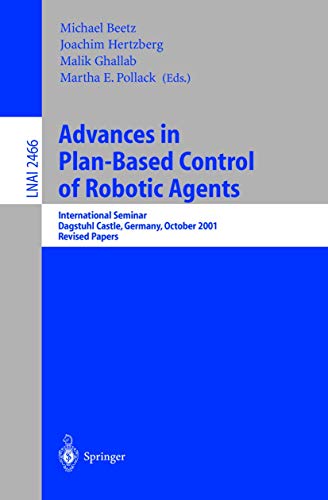
Advances in Plan-Based Control of Robotic Agents: International Seminar, Dagstuhl Castle, Germany, October 21-26, 2001, Revised Papers - Couverture souple
Synopsis
In recent years, autonomous robots, including Xavier, Martha [1], Rhino [2,3], Minerva, and Remote Agent, have shown impressive performance in long-term demonstrations. In NASA's Deep Space program, for example, an - tonomous spacecraft controller, called the Remote Agent [5], has autonomously performed a scienti?c experiment in space. At Carnegie Mellon University, Xavier [6], another autonomous mobile robot, navigated through an o?ce - vironment for more than a year, allowing people to issue navigation commands and monitor their execution via the Internet. In 1998, Minerva [7] acted for 13 days as a museum tourguide in the Smithsonian Museum, and led several thousand people through an exhibition. These autonomous robots have in common that they rely on plan-based c- trol in order to achieve better problem-solving competence. In the plan-based approach, robots generate control actions by maintaining and executing a plan that is e?ective and has a high expected utility with respect to the robots' c- rent goals and beliefs. Plans are robot control programs that a robot can not only execute but also reason about and manipulate [4]. Thus, a plan-based c- troller is able to manage and adapt the robot's intended course of action -- the plan -- while executing it and can thereby better achieve complex and changing tasks.
Les informations fournies dans la section « Synopsis » peuvent faire référence à une autre édition de ce titre.
Résultats de recherche pour Advances in Plan-Based Control of Robotic Agents: Internatio...

Image fournie par le vendeur
Advances in Plan-Based Control of Robotic Agents : International Seminar, Dagstuhl Castle, Germany, October 21-26, 2001 : Revised Papers
Vendeur : GreatBookPrices, Columbia, MD, Etats-Unis
Évaluation du vendeur 5 sur 5 étoiles

Etat : New. N° de réf. du vendeur 1699645-n
Acheter neuf
EUR 57,59
Expédition à EUR 2,35
Expédition nationale : Etats-Unis
Expédition nationale : Etats-Unis
Quantité disponible : Plus de 20 disponibles
Image fournie par le vendeur
Advances in Plan-Based Control of Robotic Agents: International Seminar, Dagstuhl Castle, Germany, October 21-26, 2001, Revised Papers (Paperback or Softback)
Edité par
Springer 11/1/2002, 2002
ISBN 10 : 3540001689
ISBN 13 : 9783540001683
Neuf
Paperback or Softback
Vendeur : BargainBookStores, Grand Rapids, MI, Etats-Unis
Évaluation du vendeur 5 sur 5 étoiles
Paperback or Softback. Etat : New. Advances in Plan-Based Control of Robotic Agents: International Seminar, Dagstuhl Castle, Germany, October 21-26, 2001, Revised Papers. Book. N° de réf. du vendeur BBS-9783540001683
Acheter neuf
EUR 60,02
Livraison gratuite
Expédition nationale : Etats-Unis
Expédition nationale : Etats-Unis
Quantité disponible : 5 disponible(s)
Image d'archives
Advances in Plan-Based Control of Robotic Agents
Vendeur : California Books, Miami, FL, Etats-Unis
Évaluation du vendeur 5 sur 5 étoiles
Etat : New. N° de réf. du vendeur I-9783540001683
Acheter neuf
EUR 62,46
Livraison gratuite
Expédition nationale : Etats-Unis
Expédition nationale : Etats-Unis
Quantité disponible : Plus de 20 disponibles
Image fournie par le vendeur
Advances in Plan-Based Control of Robotic Agents : International Seminar, Dagstuhl Castle, Germany, October 21-26, 2001 : Revised Papers
Edité par
Springer, 2002
ISBN 10 : 3540001689
ISBN 13 : 9783540001683
Ancien ou d'occasion
Couverture souple
Vendeur : GreatBookPrices, Columbia, MD, Etats-Unis
Évaluation du vendeur 5 sur 5 étoiles
Etat : As New. Unread book in perfect condition. N° de réf. du vendeur 1699645
Acheter D'occasion
EUR 63,88
Expédition à EUR 2,35
Expédition nationale : Etats-Unis
Expédition nationale : Etats-Unis
Quantité disponible : Plus de 20 disponibles
Image fournie par le vendeur
Advances in Plan-Based Control of Robotic Agents
Edité par
Springer-Verlag Berlin and Heidelberg GmbH and Co. KG, DE, 2002
ISBN 10 : 3540001689
ISBN 13 : 9783540001683
Neuf
Paperback
Vendeur : Rarewaves.com USA, London, LONDO, Royaume-Uni
Évaluation du vendeur 5 sur 5 étoiles
Paperback. Etat : New. 2002 ed. In recent years, autonomous robots, including Xavier, Martha [1], Rhino [2,3], Minerva,and Remote Agent, have shown impressive performance in long-term demonstrations. In NASA's Deep Space program, for example, an - tonomous spacecraft controller, called the Remote Agent [5], has autonomously performed a scienti?c experiment in space. At Carnegie Mellon University, Xavier [6], another autonomous mobile robot, navigated through an o?ce - vironment for more than a year, allowing people to issue navigation commands and monitor their execution via the Internet. In 1998, Minerva [7] acted for 13 days as a museum tourguide in the Smithsonian Museum, and led several thousand people through an exhibition. These autonomous robots have in common that they rely on plan-based c- trol in order to achieve better problem-solving competence. In the plan-based approach, robots generate control actions by maintaining and executing a plan that is e?ective and has a high expected utility with respect to the robots' c- rent goals and beliefs. Plans are robot control programs that a robot can not only execute but also reason about and manipulate [4]. Thus, a plan-based c- troller is able to manage and adapt the robot's intended course of action - the plan - while executing it and can thereby better achieve complex and changing tasks. N° de réf. du vendeur LU-9783540001683
Acheter neuf
EUR 67,40
Livraison gratuite
Expédition depuis Royaume-Uni vers Etats-Unis
Expédition depuis Royaume-Uni vers Etats-Unis
Quantité disponible : Plus de 20 disponibles
Image d'archives
Advances in Plan-Based Control of Robotic Agents : International Seminar, Dagstuhl Castle, Germany, October 21-26, 2001, Revised Papers
Vendeur : Chiron Media, Wallingford, Royaume-Uni
Évaluation du vendeur 5 sur 5 étoiles
PF. Etat : New. N° de réf. du vendeur 6666-IUK-9783540001683
Acheter neuf
EUR 58,03
Expédition à EUR 18,27
Expédition depuis Royaume-Uni vers Etats-Unis
Expédition depuis Royaume-Uni vers Etats-Unis
Quantité disponible : 10 disponible(s)
Image fournie par le vendeur
Advances in Plan-Based Control of Robotic Agents
Edité par
Springer Berlin Heidelberg Nov 2002, 2002
ISBN 10 : 3540001689
ISBN 13 : 9783540001683
Neuf
Taschenbuch
Vendeur : BuchWeltWeit Ludwig Meier e.K., Bergisch Gladbach, Allemagne
Évaluation du vendeur 5 sur 5 étoiles
Taschenbuch. Etat : Neu. This item is printed on demand - it takes 3-4 days longer - Neuware -In recent years, autonomous robots, including Xavier, Martha [1], Rhino [2,3], Minerva,and Remote Agent, have shown impressive performance in long-term demonstrations. In NASA's Deep Space program, for example, an - tonomous spacecraft controller, called the Remote Agent [5], has autonomously performed a scienti c experiment in space. At Carnegie Mellon University, Xavier [6], another autonomous mobile robot, navigated through an o ce - vironment for more than a year, allowing people to issue navigation commands and monitor their execution via the Internet. In 1998, Minerva [7] acted for 13 days as a museum tourguide in the Smithsonian Museum, and led several thousand people through an exhibition. These autonomous robots have in common that they rely on plan-based c- trol in order to achieve better problem-solving competence. In the plan-based approach, robots generate control actions by maintaining and executing a plan that is e ective and has a high expected utility with respect to the robots' c- rent goals and beliefs. Plans are robot control programs that a robot can not only execute but also reason about and manipulate [4]. Thus, a plan-based c- troller is able to manage and adapt the robot's intended course of action - the plan - while executing it and can thereby better achieve complex and changing tasks. 304 pp. Englisch. N° de réf. du vendeur 9783540001683
Acheter neuf
EUR 53,49
Expédition à EUR 23
Expédition depuis Allemagne vers Etats-Unis
Expédition depuis Allemagne vers Etats-Unis
Quantité disponible : 2 disponible(s)
Image fournie par le vendeur
Advances in Plan-Based Control of Robotic Agents : International Seminar, Dagstuhl Castle, Germany, October 21-26, 2001 : Revised Papers
Vendeur : GreatBookPricesUK, Woodford Green, Royaume-Uni
Évaluation du vendeur 5 sur 5 étoiles
Etat : New. N° de réf. du vendeur 1699645-n
Acheter neuf
EUR 61,05
Expédition à EUR 17,70
Expédition depuis Royaume-Uni vers Etats-Unis
Expédition depuis Royaume-Uni vers Etats-Unis
Quantité disponible : Plus de 20 disponibles
Image d'archives
Advances in Plan-Based Control of Robotic Agents
Vendeur : Ria Christie Collections, Uxbridge, Royaume-Uni
Évaluation du vendeur 5 sur 5 étoiles
Etat : New. In English. N° de réf. du vendeur ria9783540001683_new
Acheter neuf
EUR 67,99
Expédition à EUR 13,32
Expédition depuis Royaume-Uni vers Etats-Unis
Expédition depuis Royaume-Uni vers Etats-Unis
Quantité disponible : Plus de 20 disponibles
Image fournie par le vendeur
Advances in Plan-Based Control of Robotic Agents : International Seminar, Dagstuhl Castle, Germany, October 21-26, 2001 : Revised Papers
Edité par
Springer, 2002
ISBN 10 : 3540001689
ISBN 13 : 9783540001683
Ancien ou d'occasion
Couverture souple
Vendeur : GreatBookPricesUK, Woodford Green, Royaume-Uni
Évaluation du vendeur 5 sur 5 étoiles
Etat : As New. Unread book in perfect condition. N° de réf. du vendeur 1699645
Acheter D'occasion
EUR 67,98
Expédition à EUR 17,70
Expédition depuis Royaume-Uni vers Etats-Unis
Expédition depuis Royaume-Uni vers Etats-Unis
Quantité disponible : Plus de 20 disponibles