
Synopsis
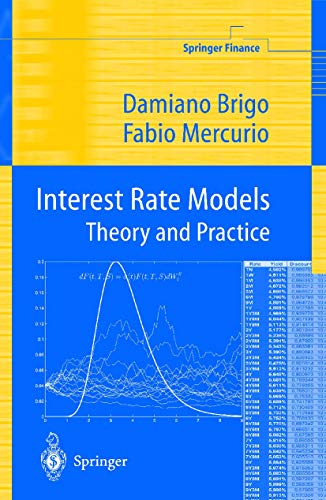
The 2nd edition of this successful book has several new features. The calibration discussion of the basic LIBOR market model has been enriched considerably, with an analysis of the impact of the swaptions interpolation technique and of the exogenous instantaneous correlation on the calibration outputs. A discussion of historical estimation of the instantaneous correlation matrix and of rank reduction has been added, and a LIBOR-model consistent swaption-volatility interpolation technique has been introduced. The old sections devoted to the smile issue in the LIBOR market model have been enlarged into a new chapter. New sections on local-volatility dynamics, and on stochastic volatility models have been added, with a thorough treatment of the recently developed uncertain-volatility approach. Examples of calibrations to real market data are now considered. The fast-growing interest for hybrid products has led to a new chapter. A special focus here is devoted to the pricing of inflation-linked derivatives. The three final new chapters of this second edition are devoted to credit. Since Credit Derivatives are increasingly fundamental, and since in the reduced-form modeling framework much of the technique involved is analogous to interest-rate modeling, Credit Derivatives -- mostly Credit Default Swaps (CDS), CDS Options and Constant Maturity CDS - are discussed, building on the basic short rate-models and market models introduced earlier for the default-free market. Counterparty risk in interest rate payoff valuation is also considered, motivated by the recent Basel II framework developments.
Les informations fournies dans la section « Synopsis » peuvent faire référence à une autre édition de ce titre.
Présentation de l'éditeur
In implementing mathematical models for pricing interest rate derivatives one has to address a number of practical issues such as the choice of a satisfactory model, the calibration to market data, the implementation of efficient routines, and so on. This book aims both at explaining rigorously how models work in theory and at suggesting how to implement them for concrete pricing. This is an area that is rarely covered by books on mathematical finance. The book is meant both to help quantitative analysts and advanced traders price and hedge with a sound theoretical apparatus, and to encourage academics to develop a feeling for the practical problems in the interest rate market that can be solved with the use of relatively advanced tools of mathematics and stochastic calculus in particular. Advanced undergraduate students, graduate students and researchers should benefit from seeing how mathematics can be used in concrete financial problems.
Les informations fournies dans la section « A propos du livre » peuvent faire référence à une autre édition de ce titre.
Autres éditions populaires du même titre

Résultats de recherche pour Interest Rate Models: Theory and Practice

Image d'archives
Interest Rate Models-Theory and Practice
Edité par
Springer, Berlin, Germany, 2001
ISBN 10 : 3540417729
ISBN 13 : 9783540417729
Ancien ou d'occasion
Couverture rigide
Vendeur : West With The Night, Tucson, AZ, Etats-Unis
Évaluation du vendeur 5 sur 5 étoiles

Hard cover. Sewn binding. Cloth over boards. 518 p. Lecture Notes in Computer Science. Audience: General/trade. Very good. light shelfwear, previous owner name on first page, N° de réf. du vendeur Alibris.0028288
Acheter D'occasion
EUR 45,23
Expédition à EUR 3,08
Expédition nationale : Etats-Unis
Expédition nationale : Etats-Unis
Quantité disponible : 1 disponible(s)
Image d'archives
Interest Rate Models
Vendeur : BennettBooksLtd, Los Angeles, CA, Etats-Unis
Évaluation du vendeur 5 sur 5 étoiles
hardcover. Etat : New. In shrink wrap. Looks like an interesting title! N° de réf. du vendeur Q-3540417729
Acheter neuf
EUR 84,13
Expédition à EUR 6,11
Expédition nationale : Etats-Unis
Expédition nationale : Etats-Unis
Quantité disponible : 1 disponible(s)
Image d'archives
Interest Rate Models - Theory and Practice (Springer Finance)
Edité par
Springer, 2001
ISBN 10 : 3540417729
ISBN 13 : 9783540417729
Ancien ou d'occasion
Couverture rigide
Vendeur : Brit Books, Milton Keynes, Royaume-Uni
Évaluation du vendeur 4 sur 5 étoiles

Hardcover. Etat : Used; Good. ***Simply Brit*** Welcome to our online used book store, where affordability meets great quality. Dive into a world of captivating reads without breaking the bank. We take pride in offering a wide selection of used books, from classics to hidden gems, ensuring there is something for every literary palate. All orders are shipped within 24 hours and our lightning fast-delivery within 48 hours coupled with our prompt customer service ensures a smooth journey from ordering to delivery. Discover the joy of reading with us, your trusted source for affordable books that do not compromise on quality. N° de réf. du vendeur 1664760
Acheter D'occasion
EUR 77,86
Expédition à EUR 18,72
Expédition depuis Royaume-Uni vers Etats-Unis
Expédition depuis Royaume-Uni vers Etats-Unis
Quantité disponible : 1 disponible(s)
Image d'archives
Interest Rate Models Theory and Practice (Springer Finance) Brigo, Damiano and Mercurio, Fabio
Edité par
Springer, 2001
ISBN 10 : 3540417729
ISBN 13 : 9783540417729
Ancien ou d'occasion
Couverture rigide
Vendeur : online-buch-de, Dozwil, Suisse
Évaluation du vendeur 5 sur 5 étoiles
Hardcover Jan 01, 2001. Etat : gebraucht; wie neu. N° de réf. du vendeur 343-4-1-5
Acheter D'occasion
EUR 74
Expédition à EUR 36
Expédition depuis Suisse vers Etats-Unis
Expédition depuis Suisse vers Etats-Unis
Quantité disponible : 1 disponible(s)
Image d'archives
Interest Rate Models Theory and Practice (Springer Finance) Brigo, Damiano and Mercurio, Fabio
Edité par
Springer Berlin, 2001
ISBN 10 : 3540417729
ISBN 13 : 9783540417729
Ancien ou d'occasion
Couverture rigide
Vendeur : BUCHSERVICE / ANTIQUARIAT Lars Lutzer, Wahlstedt, Allemagne
Évaluation du vendeur 5 sur 5 étoiles
Etat : gut. Interest Rate Models Theory and Practice (Springer Finance) In deutscher Sprache. pages. N° de réf. du vendeur BN373235
Acheter D'occasion
EUR 199,90
Expédition à EUR 39,95
Expédition depuis Allemagne vers Etats-Unis
Expédition depuis Allemagne vers Etats-Unis
Quantité disponible : 1 disponible(s)