
Articles liés à Gravitational Lensing: Strong, Weak and Micro: Saas-Fee...
Gravitational Lensing: Strong, Weak and Micro: Saas-Fee Advanced Course 33 - Couverture souple
Livre 13 sur 26: Saas-Fee Advanced Course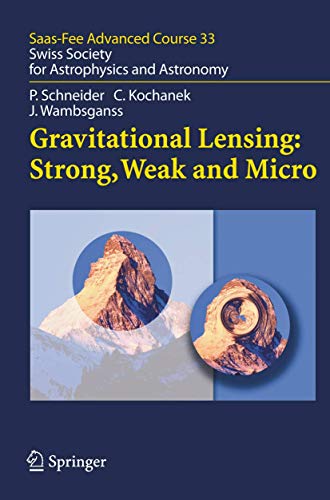
Synopsis
The observation, in 1919 by A.S. Eddington and collaborators, of the gra- tational de?ection of light by the Sun proved one of the many predictions of Einstein’s Theory of General Relativity: The Sun was the ?rst example of a gravitational lens. In 1936, Albert Einstein published an article in which he suggested - ing stars as gravitational lenses. A year later, Fritz Zwicky pointed out that galaxies would act as lenses much more likely than stars, and also gave a list of possible applications, as a means to determine the dark matter content of galaxies and clusters of galaxies. It was only in 1979 that the ?rst example of an extragalactic gravitational lens was provided by the observation of the distant quasar QSO 0957+0561, by D. Walsh, R.F. Carswell, and R.J. Weymann. A few years later, the ?rst lens showing images in the form of arcs was detected. The theory, observations, and applications of gravitational lensing cons- tute one of the most rapidly growing branches of astrophysics. The gravi- tional de?ection of light generated by mass concentrations along a light path producesmagni?cation,multiplicity,anddistortionofimages,anddelaysp- ton propagation from one line of sight relative to another. The huge amount of scienti?c work produced over the last decade on gravitational lensing has clearly revealed its already substantial and wide impact, and its potential for future astrophysical applications.
Les informations fournies dans la section « Synopsis » peuvent faire référence à une autre édition de ce titre.
Résultats de recherche pour Gravitational Lensing: Strong, Weak and Micro: Saas-Fee...

Image d'archives
Schneider:Gravitational Lensing: Strong (eng)
impression à la demandeVendeur : Brook Bookstore On Demand, Napoli, NA, Italie
Évaluation du vendeur 5 sur 5 étoiles

Etat : new. Questo è un articolo print on demand. N° de réf. du vendeur 04af0237ea211576cee4e008610c597f
Acheter neuf
EUR 94,25
Expédition à EUR 11
Expédition depuis Italie vers Etats-Unis
Expédition depuis Italie vers Etats-Unis
Quantité disponible : Plus de 20 disponibles
Image d'archives
Gravitational Lensing: Strong, Weak and Micro (Paperback)
Edité par
Springer-Verlag Berlin and Heidelberg GmbH & Co. KG, Berlin, 2010
ISBN 10 : 3642067778
ISBN 13 : 9783642067778
Neuf
Paperback
Edition originale
Vendeur : Grand Eagle Retail, Bensenville, IL, Etats-Unis
Évaluation du vendeur 5 sur 5 étoiles
Paperback. Etat : new. Paperback. The theory, observations, and applications of gravitational lensing constitute one of the most rapidly growing branches of astrophysics. The gravitational deflection of light generated by mass concentrations along a light path produces magnification, multiplicity, and distortion of images and delays photon propagation from one line of sight relative to another. The huge amount of scientific work produced over the last decade on gravitational lensing has clearly revealed its already substantial and wide impact and its potential for future astrophysical applications. The up-to-date contributions in this book are based on the lecture notes of the 33rd Saas--Fee Advanced Course of the Swiss Society of Astronomy and Astrophysics, entitled Gravitational Lensing: Strong, Weak, and Micro. The book comprises four complementary parts, written by leading experts in the field, constituting a genuine textbook about gravitational lensing. Students and researchers alike will benefit from this comprehensive presentation of the astrophysical and astronomical aspects of gravitational lensing. A year later, Fritz Zwicky pointed out that galaxies would act as lenses much more likely than stars, and also gave a list of possible applications, as a means to determine the dark matter content of galaxies and clusters of galaxies. Shipping may be from multiple locations in the US or from the UK, depending on stock availability. N° de réf. du vendeur 9783642067778
Acheter neuf
EUR 111,28
Livraison gratuite
Expédition nationale : Etats-Unis
Expédition nationale : Etats-Unis
Quantité disponible : 1 disponible(s)
Image d'archives
Gravitational Lensing: Strong, Weak and Micro: Saas-Fee Advanced Course 33
Vendeur : Ria Christie Collections, Uxbridge, Royaume-Uni
Évaluation du vendeur 5 sur 5 étoiles
Etat : New. In English. N° de réf. du vendeur ria9783642067778_new
Acheter neuf
EUR 116,40
Expédition à EUR 13,17
Expédition depuis Royaume-Uni vers Etats-Unis
Expédition depuis Royaume-Uni vers Etats-Unis
Quantité disponible : Plus de 20 disponibles
Image d'archives
Gravitational Lensing: Strong, Weak and Micro : Saas-fee Advanced Course 33
Vendeur : GreatBookPrices, Columbia, MD, Etats-Unis
Évaluation du vendeur 5 sur 5 étoiles
Etat : New. N° de réf. du vendeur 21686451-n
Acheter neuf
EUR 133,18
Expédition à EUR 2,30
Expédition nationale : Etats-Unis
Expédition nationale : Etats-Unis
Quantité disponible : Plus de 20 disponibles
Image d'archives
Gravitational Lensing: Strong, Weak and Micro: Saas-Fee Advanced Course 33
Vendeur : California Books, Miami, FL, Etats-Unis
Évaluation du vendeur 5 sur 5 étoiles
Etat : New. N° de réf. du vendeur I-9783642067778
Acheter neuf
EUR 137,29
Livraison gratuite
Expédition nationale : Etats-Unis
Expédition nationale : Etats-Unis
Quantité disponible : Plus de 20 disponibles
Image fournie par le vendeur
Gravitational Lensing: Strong, Weak and Micro
Edité par
Springer Berlin Heidelberg Nov 2010, 2010
ISBN 10 : 3642067778
ISBN 13 : 9783642067778
Neuf
Taschenbuch
Vendeur : BuchWeltWeit Ludwig Meier e.K., Bergisch Gladbach, Allemagne
Évaluation du vendeur 5 sur 5 étoiles
Taschenbuch. Etat : Neu. This item is printed on demand - it takes 3-4 days longer - Neuware -The observation, in 1919 by A.S. Eddington and collaborators, of the gra- tational de ection of light by the Sun proved one of the many predictions of Einstein's Theory of General Relativity: The Sun was the rst example of a gravitational lens. In 1936, Albert Einstein published an article in which he suggested - ing stars as gravitational lenses. A year later, Fritz Zwicky pointed out that galaxies would act as lenses much more likely than stars, and also gave a list of possible applications, as a means to determine the dark matter content of galaxies and clusters of galaxies. It was only in 1979 that the rst example of an extragalactic gravitational lens was provided by the observation of the distant quasar QSO 0957+0561, by D. Walsh, R.F. Carswell, and R.J. Weymann. A few years later, the rst lens showing images in the form of arcs was detected. The theory, observations, and applications of gravitational lensing cons- tute one of the most rapidly growing branches of astrophysics. The gravi- tional de ection of light generated by mass concentrations along a light path producesmagni cation,multiplicity,anddistortionofimages,anddelaysp- ton propagation from one line of sight relative to another. The huge amount of scienti c work produced over the last decade on gravitational lensing has clearly revealed its already substantial and wide impact, and its potential for future astrophysical applications. 572 pp. Englisch. N° de réf. du vendeur 9783642067778
Acheter neuf
EUR 117,69
Expédition à EUR 23
Expédition depuis Allemagne vers Etats-Unis
Expédition depuis Allemagne vers Etats-Unis
Quantité disponible : 2 disponible(s)
Image fournie par le vendeur
Gravitational Lensing: Strong, Weak and Micro
Edité par
Springer Berlin Heidelberg, 2010
ISBN 10 : 3642067778
ISBN 13 : 9783642067778
Neuf
Couverture souple
Vendeur : moluna, Greven, Allemagne
Évaluation du vendeur 5 sur 5 étoiles
Etat : New. N° de réf. du vendeur 5045867
Acheter neuf
EUR 101,04
Expédition à EUR 48,99
Expédition depuis Allemagne vers Etats-Unis
Expédition depuis Allemagne vers Etats-Unis
Quantité disponible : Plus de 20 disponibles
Image fournie par le vendeur
Gravitational Lensing: Strong, Weak and Micro | Saas-Fee Advanced Course 33
Vendeur : preigu, Osnabrück, Allemagne
Évaluation du vendeur 5 sur 5 étoiles
Taschenbuch. Etat : Neu. Gravitational Lensing: Strong, Weak and Micro | Saas-Fee Advanced Course 33 | Peter Schneider (u. a.) | Taschenbuch | Saas-Fee Advanced Course | xvi | Englisch | 2010 | Springer | EAN 9783642067778 | Verantwortliche Person für die EU: Springer Verlag GmbH, Tiergartenstr. 17, 69121 Heidelberg, juergen[dot]hartmann[at]springer[dot]com | Anbieter: preigu. N° de réf. du vendeur 107220545
Acheter neuf
EUR 104,25
Expédition à EUR 70
Expédition depuis Allemagne vers Etats-Unis
Expédition depuis Allemagne vers Etats-Unis
Quantité disponible : 5 disponible(s)
Image d'archives
Gravitational Lensing
Vendeur : Books Puddle, Woodside, NY, Etats-Unis
Évaluation du vendeur 4 sur 5 étoiles

Etat : New. pp. xvi + 552. N° de réf. du vendeur 263110844
Acheter neuf
EUR 171,02
Expédition à EUR 3,48
Expédition nationale : Etats-Unis
Expédition nationale : Etats-Unis
Quantité disponible : 4 disponible(s)
Image fournie par le vendeur
Gravitational Lensing: Strong, Weak and Micro
Edité par
Springer, Springer Spektrum Nov 2010, 2010
ISBN 10 : 3642067778
ISBN 13 : 9783642067778
Neuf
Taschenbuch
Vendeur : buchversandmimpf2000, Emtmannsberg, BAYE, Allemagne
Évaluation du vendeur 5 sur 5 étoiles
Taschenbuch. Etat : Neu. This item is printed on demand - Print on Demand Titel. Neuware -The observation, in 1919 by A.S. Eddington and collaborators, of the gra- tational de ection of light by the Sun proved one of the many predictions of Einstein¿s Theory of General Relativity: The Sun was the rst example of a gravitational lens. In 1936, Albert Einstein published an article in which he suggested - ing stars as gravitational lenses. A year later, Fritz Zwicky pointed out that galaxies would act as lenses much more likely than stars, and also gave a list of possible applications, as a means to determine the dark matter content of galaxies and clusters of galaxies. It was only in 1979 that the rst example of an extragalactic gravitational lens was provided by the observation of the distant quasar QSO 0957+0561, by D. Walsh, R.F. Carswell, and R.J. Weymann. A few years later, the rst lens showing images in the form of arcs was detected. The theory, observations, and applications of gravitational lensing cons- tute one of the most rapidly growing branches of astrophysics. The gravi- tional de ection of light generated by mass concentrations along a light path producesmagni cation,multiplicity,anddistortionofimages,anddelaysp- ton propagation from one line of sight relative to another. The huge amount of scienti c work produced over the last decade on gravitational lensing has clearly revealed its already substantial and wide impact, and its potential for future astrophysical applications.Springer-Verlag KG, Sachsenplatz 4-6, 1201 Wien 572 pp. Englisch. N° de réf. du vendeur 9783642067778
Acheter neuf
EUR 117,69
Expédition à EUR 60
Expédition depuis Allemagne vers Etats-Unis
Expédition depuis Allemagne vers Etats-Unis
Quantité disponible : 1 disponible(s)