
Articles liés à Python Scripting for Computational Science
Python Scripting for Computational Science - Couverture souple
Livre 4 sur 29: Texts in Computational Science and Engineering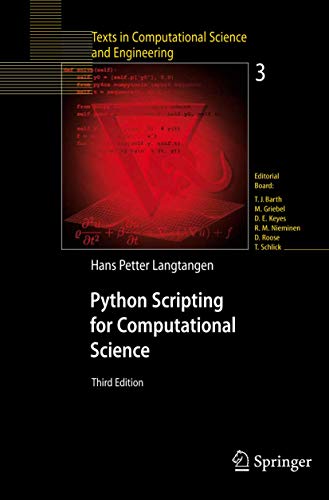
Synopsis
<p>With a primary focus on examples and applications of relevance to computational scientists, this brilliantly useful book shows computational scientists how to develop tailored, flexible, and human-efficient working environments built from small scripts written in the easy-to-learn, high-level Python language. All the tools and examples in this book are open source codes. This third edition features lots of new material. It is also released after a comprehensive reorganization of the text. The author has inserted improved examples and tools and updated information, as well as correcting any errors that crept in to the first imprint.</p>
Les informations fournies dans la section « Synopsis » peuvent faire référence à une autre édition de ce titre.
À propos de l'auteur
Hans Petter Langtangen (1962 - 2016) was a professor of computer science at the University of Oslo. He was formerly a professor of mechanics and was the Director of "Center for Biomedical Computing", a Norwegian Center of Excellence at the Simula Research Laboratory in Oslo. Langtangen has more than 100 scientific publications, including journal papers and many books, e.g., the bestseller TCSE 6 "A Primer on Scientific Programming with Python" (editions 1 - 5). He has also developed open source and commercial software systems for computational sciences."
Kent-Andre Mardal is a professor of mechanics at the University of Oslo and an adjunct research scientist at Simula Research Laboratory. He has published more than 80 scientific publications, including journal papers, one co-authored book and the co-edited the book about the FEniCS project, for which he was a core developer for many years.
À propos de la quatrième de couverture
Numerous readers of the second edition have noti?ed me about misprints and possible improvements of the text and the associated computer codes. The resulting modi?cations have been incorporated in this new edition and its accompanying software. The major change between the second and third editions, however, is caused by the new implementation of Numerical Python, now called numpy. The new numpy package encourages a slightly di?erent syntax compared to the old Numeric implementation, which was used in the previous editions. Since Numerical Python functionality appears in a lot of places in the book, there are hence a huge number of updates to the new suggested numpy syntax, especially in Chapters 4, 9, and 10. The second edition was based on Python version 2.3, while the third edition contains updates for version 2.5. Recent Python features, such as generator expressions (Chapter 8.9.4), Ctypes for interfacing shared libraries in C (Chapter 5.2.2), the with statement (Chapter 3.1.4), and the subprocess module for running external processes (Chapter 3.1.3) have been exempli?ed to make the reader aware of new tools. Chapter 4.4.4 is new and gives a taste of symbolic mathematics in Python.
Les informations fournies dans la section « A propos du livre » peuvent faire référence à une autre édition de ce titre.
Résultats de recherche pour Python Scripting for Computational Science

Image d'archives
Python Scripting for Computational Science (Texts in Computational Science and Engineering (3))
Edité par
Springer, 2010
ISBN 10 : 3642093159
ISBN 13 : 9783642093159
Ancien ou d'occasion
Paperback
Vendeur : HPB-Red, Dallas, TX, Etats-Unis
Évaluation du vendeur 5 sur 5 étoiles

Paperback. Etat : Good. Connecting readers with great books since 1972! Used textbooks may not include companion materials such as access codes, etc. May have some wear or writing/highlighting. We ship orders daily and Customer Service is our top priority! N° de réf. du vendeur S_392553726
Acheter D'occasion
EUR 48,70
Expédition à EUR 3,37
Expédition nationale : Etats-Unis
Expédition nationale : Etats-Unis
Quantité disponible : 1 disponible(s)
Image d'archives
Python Scripting for Computational Science (eng)
impression à la demandeVendeur : Brook Bookstore On Demand, Napoli, NA, Italie
Évaluation du vendeur 5 sur 5 étoiles
Etat : new. Questo è un articolo print on demand. N° de réf. du vendeur DWSKQ7QANC
Acheter neuf
EUR 54,23
Expédition à EUR 11
Expédition depuis Italie vers Etats-Unis
Expédition depuis Italie vers Etats-Unis
Quantité disponible : Plus de 20 disponibles
Image fournie par le vendeur
Python Scripting for Computational Science
Vendeur : GreatBookPrices, Columbia, MD, Etats-Unis
Évaluation du vendeur 5 sur 5 étoiles
Etat : New. N° de réf. du vendeur 11862924-n
Acheter neuf
EUR 66,83
Expédition à EUR 2,37
Expédition nationale : Etats-Unis
Expédition nationale : Etats-Unis
Quantité disponible : Plus de 20 disponibles
Image fournie par le vendeur
Python Scripting for Computational Science
Edité par
Springer, 2010
ISBN 10 : 3642093159
ISBN 13 : 9783642093159
Ancien ou d'occasion
Couverture souple
Vendeur : GreatBookPrices, Columbia, MD, Etats-Unis
Évaluation du vendeur 5 sur 5 étoiles
Etat : As New. Unread book in perfect condition. N° de réf. du vendeur 11862924
Acheter D'occasion
EUR 74,73
Expédition à EUR 2,37
Expédition nationale : Etats-Unis
Expédition nationale : Etats-Unis
Quantité disponible : Plus de 20 disponibles
Image fournie par le vendeur
Python Scripting for Computational Science
Edité par
Springer Berlin Heidelberg Nov 2010, 2010
ISBN 10 : 3642093159
ISBN 13 : 9783642093159
Neuf
Taschenbuch
Vendeur : BuchWeltWeit Ludwig Meier e.K., Bergisch Gladbach, Allemagne
Évaluation du vendeur 5 sur 5 étoiles
Taschenbuch. Etat : Neu. This item is printed on demand - it takes 3-4 days longer - Neuware -With a primary focus on examples and applications of relevance to computational scientists, this brilliantly useful book shows computational scientists how to develop tailored, flexible, and human-efficient working environments built from small scripts written in the easy-to-learn, high-level Python language. All the tools and examples in this book are open source codes. This third edition features lots of new material. It is also released after a comprehensive reorganization of the text. The author has inserted improved examples and tools and updated information, as well as correcting any errors that crept in to the first imprint. 780 pp. Englisch. N° de réf. du vendeur 9783642093159
Acheter neuf
EUR 64,19
Expédition à EUR 23
Expédition depuis Allemagne vers Etats-Unis
Expédition depuis Allemagne vers Etats-Unis
Quantité disponible : 2 disponible(s)
Image d'archives
Python Scripting for Computational Science
Vendeur : GreatBookPricesUK, Woodford Green, Royaume-Uni
Évaluation du vendeur 5 sur 5 étoiles
Etat : New. N° de réf. du vendeur 11862924-n
Acheter neuf
EUR 79,36
Expédition à EUR 17,98
Expédition depuis Royaume-Uni vers Etats-Unis
Expédition depuis Royaume-Uni vers Etats-Unis
Quantité disponible : Plus de 20 disponibles
Image fournie par le vendeur
Python Scripting for Computational Science
Edité par
Springer, 2010
ISBN 10 : 3642093159
ISBN 13 : 9783642093159
Ancien ou d'occasion
Couverture souple
Vendeur : GreatBookPricesUK, Woodford Green, Royaume-Uni
Évaluation du vendeur 5 sur 5 étoiles
Etat : As New. Unread book in perfect condition. N° de réf. du vendeur 11862924
Acheter D'occasion
EUR 82,72
Expédition à EUR 17,98
Expédition depuis Royaume-Uni vers Etats-Unis
Expédition depuis Royaume-Uni vers Etats-Unis
Quantité disponible : Plus de 20 disponibles
Image fournie par le vendeur
Python Scripting for Computational Science
Edité par
Springer Berlin Heidelberg, 2010
ISBN 10 : 3642093159
ISBN 13 : 9783642093159
Neuf
Couverture souple
Vendeur : moluna, Greven, Allemagne
Évaluation du vendeur 5 sur 5 étoiles
Etat : New. Dieser Artikel ist ein Print on Demand Artikel und wird nach Ihrer Bestellung fuer Sie gedruckt. Shows how to develop tailored, flexible, and human-efficient working environments using the easy-to-learn, high-level Python languageFocuses on examples and applications of practical use to computational scientistsCompatible with the new Nu. N° de réf. du vendeur 5048330
Acheter neuf
EUR 55,78
Expédition à EUR 48,99
Expédition depuis Allemagne vers Etats-Unis
Expédition depuis Allemagne vers Etats-Unis
Quantité disponible : Plus de 20 disponibles
Image d'archives
Python Scripting for Computational Science
Vendeur : Books Puddle, Woodside, NY, Etats-Unis
Évaluation du vendeur 4 sur 5 étoiles

Etat : New. pp. 782 3rd Edition. N° de réf. du vendeur 263078333
Acheter neuf
EUR 114,82
Expédition à EUR 3,58
Expédition nationale : Etats-Unis
Expédition nationale : Etats-Unis
Quantité disponible : 4 disponible(s)
Image fournie par le vendeur
Python Scripting for Computational Science
Vendeur : AHA-BUCH GmbH, Einbeck, Allemagne
Évaluation du vendeur 5 sur 5 étoiles
Taschenbuch. Etat : Neu. Druck auf Anfrage Neuware - Printed after ordering - Numerous readers of the second edition have noti ed me about misprints and possible improvements of the text and the associated computer codes. The resulting modi cations have been incorporated in this new edition and its accompanying software. The major change between the second and third editions, however, is caused by the new implementation of Numerical Python, now called numpy. The new numpy package encourages a slightly di erent syntax compared to the old Numeric implementation, which was used in the previous editions. Since Numerical Python functionality appears in a lot of places in the book, there are hence a huge number of updates to the new suggested numpy syntax, especially in Chapters 4, 9, and 10. The second edition was based on Python version 2.3, while the third edition contains updates for version 2.5. Recent Python features, such as generator expressions (Chapter 8.9.4), Ctypes for interfacing shared libraries in C (Chapter 5.2.2), the with statement (Chapter 3.1.4), and the subprocess module for running external processes (Chapter 3.1.3) have been exempli ed to make the reader aware of new tools. Chapter 4.4.4 is new and gives a taste of symbolic mathematics in Python. N° de réf. du vendeur 9783642093159
Acheter neuf
EUR 76,26
Expédition à EUR 43,11
Expédition depuis Allemagne vers Etats-Unis
Expédition depuis Allemagne vers Etats-Unis
Quantité disponible : 1 disponible(s)