
Articles liés à Symbiotic Multi-Robot Organisms: Reliability, Adaptability,...
Synopsis
It is our pleasure to contribute the forewordto this book on symbiotic mul- robot organisms, which is largely based on the scienti?c ?ndings and exp- rations of two major EU research projects, Symbrion and Replicator, funded under the Seventh Framework Programme for Research and Technological 1 development (FP7) . FP7 emphasises consortia of European partners, tra- national collaboration, open coordination, ?exibility and excellence of - search and plays a leading role in multidisciplinary research and cooperative activities in Europe and beyond. Its impact is major in terms of integrating and structuring research communities across national borders to achieve a critical mass, providing the leverage for high-potential ?elds to take o?, and encouraging healthy competition at European level while avoiding unn- essary duplication of research capacities. Research proposals are evaluated through a demanding peer-review process and only the best are selected to be funded bythe EuropeanCommission(EC). The InformationandCom- nication Technologies(ICT) theme has set out a number of challengeswithin this context, which cover topics such as cognitive systems, modular robotics, adaptive systems and societies of artefacts. - Symbrion was selected following the Call "Pervasive Adaptation" of the 2 "Future and Emerging Technologies (FET)" programme area. Itstarted on 1 February 2008 and will run for 5 years. FET Proactive addresses evolutionary and revolutionary approaches through multidisciplinary - operation and investigates new future technology options in response to emerging societal and industrial needs and identi?es new drivers for - search.
Les informations fournies dans la section « Synopsis » peuvent faire référence à une autre édition de ce titre.
Présentation de l'éditeur
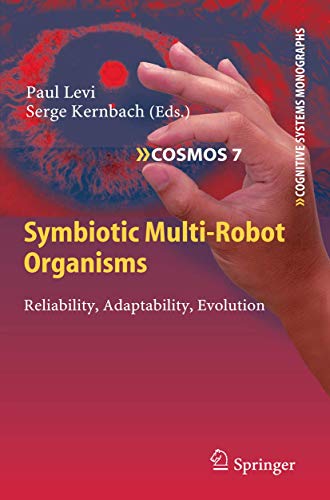
This book examines the evolution of self-organised multicellular structures, and the remarkable transition from unicellular to multicellular life. It shows the way forward in developing new robotic entities that are versatile, cooperative and self-configuring.
Les informations fournies dans la section « A propos du livre » peuvent faire référence à une autre édition de ce titre.
Résultats de recherche pour Symbiotic Multi-Robot Organisms: Reliability, Adaptability,...

Image d'archives
Symbiotic Multi-Robot Organisms (eng)
impression à la demandeVendeur : Brook Bookstore On Demand, Napoli, NA, Italie
Évaluation du vendeur 5 sur 5 étoiles

Etat : new. Questo è un articolo print on demand. N° de réf. du vendeur 872f77fd869067dcd51858bb9ac41215
Acheter neuf
EUR 126,26
Expédition à EUR 8
Expédition depuis Italie vers Etats-Unis
Expédition depuis Italie vers Etats-Unis
Quantité disponible : Plus de 20 disponibles
Image fournie par le vendeur
Symbiotic Multi-Robot Organisms : Reliability, Adaptability, Evolution
Vendeur : GreatBookPrices, Columbia, MD, Etats-Unis
Évaluation du vendeur 5 sur 5 étoiles
Etat : New. N° de réf. du vendeur 8815383-n
Acheter neuf
EUR 179,36
Expédition à EUR 2,31
Expédition nationale : Etats-Unis
Expédition nationale : Etats-Unis
Quantité disponible : Plus de 20 disponibles
Image d'archives
Symbiotic Multi-Robot Organisms: Reliability, Adaptability, Evolution (Cognitive Systems Monographs, 7)
Vendeur : California Books, Miami, FL, Etats-Unis
Évaluation du vendeur 4 sur 5 étoiles

Etat : New. N° de réf. du vendeur I-9783642116919
Acheter neuf
EUR 181,74
Livraison gratuite
Expédition nationale : Etats-Unis
Expédition nationale : Etats-Unis
Quantité disponible : Plus de 20 disponibles
Image fournie par le vendeur
Symbiotic Multi-Robot Organisms : Reliability, Adaptability, Evolution
Vendeur : GreatBookPricesUK, Woodford Green, Royaume-Uni
Évaluation du vendeur 5 sur 5 étoiles
Etat : New. N° de réf. du vendeur 8815383-n
Acheter neuf
EUR 165,47
Expédition à EUR 17,48
Expédition depuis Royaume-Uni vers Etats-Unis
Expédition depuis Royaume-Uni vers Etats-Unis
Quantité disponible : Plus de 20 disponibles
Image fournie par le vendeur
Symbiotic Multi-Robot Organisms
Edité par
Springer Berlin Heidelberg Jun 2010, 2010
ISBN 10 : 3642116914
ISBN 13 : 9783642116919
Neuf
Couverture rigide
Vendeur : BuchWeltWeit Ludwig Meier e.K., Bergisch Gladbach, Allemagne
Évaluation du vendeur 5 sur 5 étoiles
Buch. Etat : Neu. This item is printed on demand - it takes 3-4 days longer - Neuware -This book is devoted to the study of the evolution of self-organised multicellular structures and the remarkable transition from unicellular to multicellular life. Multicellular organisms provide the inspiration for the development of novel principles of adaptation and evolution for robotics and, in particular, for so-called multi-robot organisms. Multi-robot organisms are defined as large-scale swarms of robots that can physically dock with each other and symbiotically share energy and computational resources within a single 'artificial-life-form'. When it is advantageous to do so, these robots can dynamically aggregate and self-assemble into one or many symbiotic organisms in order to collectively interact with the physical world via a variety of sensors and actuators. Bio-inspired evolutionary paradigms, combined with robot embodiment and swarm-emergent phenomena, enable the organisms to autonomously manage their own hardware and software organisation. In this way, artificial robotic organisms become self-configuring from both hardware and software perspectives. This could lead to not only extremely adaptive, evolve-able and scalable robotic systems, but robot organisms also able to reprogram themselves without human supervision and new, previously unforeseen, functionality to emerge. This book introduces new concepts for symbiotic robot organisms and reports on experience of researching and developing such systems. In the long term it is intended to apply this experience in the construction and maintenance of real-world technical systems based on these concepts. 496 pp. Englisch. N° de réf. du vendeur 9783642116919
Acheter neuf
EUR 160,49
Expédition à EUR 23
Expédition depuis Allemagne vers Etats-Unis
Expédition depuis Allemagne vers Etats-Unis
Quantité disponible : 2 disponible(s)
Image fournie par le vendeur
Symbiotic Multi-Robot Organisms
Edité par
Springer Berlin Heidelberg, 2010
ISBN 10 : 3642116914
ISBN 13 : 9783642116919
Neuf
Couverture rigide
Vendeur : moluna, Greven, Allemagne
Évaluation du vendeur 5 sur 5 étoiles
Etat : New. Dieser Artikel ist ein Print on Demand Artikel und wird nach Ihrer Bestellung fuer Sie gedruckt. Recent research results in the emerging field of Symbiotic Robotics Written by experts in the fieldState of the art book on symbiotic multi-robot organismsConcepts of Symbiotic Robot Organisms.- Heterogeneous Multi-Robot Systems.- Cognitive Appro. N° de réf. du vendeur 5049630
Acheter neuf
EUR 136,16
Expédition à EUR 48,99
Expédition depuis Allemagne vers Etats-Unis
Expédition depuis Allemagne vers Etats-Unis
Quantité disponible : Plus de 20 disponibles
Image d'archives
Symbiotic Multi-Robot Organisms: Reliability, Adaptability, Evolution (Cognitive Systems Monographs, 7)
Vendeur : Ria Christie Collections, Uxbridge, Royaume-Uni
Évaluation du vendeur 5 sur 5 étoiles
Etat : New. In English. N° de réf. du vendeur ria9783642116919_new
Acheter neuf
EUR 182,28
Expédition à EUR 13,16
Expédition depuis Royaume-Uni vers Etats-Unis
Expédition depuis Royaume-Uni vers Etats-Unis
Quantité disponible : Plus de 20 disponibles
Image fournie par le vendeur
Symbiotic Multi-Robot Organisms
Edité par
Springer, Springer Spektrum Jun 2010, 2010
ISBN 10 : 3642116914
ISBN 13 : 9783642116919
Neuf
Couverture rigide
Vendeur : buchversandmimpf2000, Emtmannsberg, BAYE, Allemagne
Évaluation du vendeur 5 sur 5 étoiles
Buch. Etat : Neu. This item is printed on demand - Print on Demand Titel. Neuware -Concepts of Symbiotic Robot Organisms.- Heterogeneous Multi-Robot Systems.- Cognitive Approach in Artificial Organisms.- Adaptive Control Mechanisms.- Learning, Artificial Evolution and Cultural Aspects of Symbiotic Robotics.- Final Conclusions.Springer-Verlag KG, Sachsenplatz 4-6, 1201 Wien 496 pp. Englisch. N° de réf. du vendeur 9783642116919
Acheter neuf
EUR 160,49
Expédition à EUR 60
Expédition depuis Allemagne vers Etats-Unis
Expédition depuis Allemagne vers Etats-Unis
Quantité disponible : 1 disponible(s)
Image d'archives
Symbiotic Multi-robot Organisms: Reliability, Adaptability, Evolution
Vendeur : Revaluation Books, Exeter, Royaume-Uni
Évaluation du vendeur 5 sur 5 étoiles
Hardcover. Etat : Brand New. 1st edition. 466 pages. 9.25x6.25x1.25 inches. In Stock. N° de réf. du vendeur x-3642116914
Acheter neuf
EUR 240,32
Expédition à EUR 14,57
Expédition depuis Royaume-Uni vers Etats-Unis
Expédition depuis Royaume-Uni vers Etats-Unis
Quantité disponible : 2 disponible(s)
Image fournie par le vendeur
Symbiotic Multi-Robot Organisms : Reliability, Adaptability, Evolution
Vendeur : AHA-BUCH GmbH, Einbeck, Allemagne
Évaluation du vendeur 5 sur 5 étoiles
Buch. Etat : Neu. Druck auf Anfrage Neuware - Printed after ordering - This book is devoted to the study of the evolution of self-organised multicellular structures and the remarkable transition from unicellular to multicellular life. Multicellular organisms provide the inspiration for the development of novel principles of adaptation and evolution for robotics and, in particular, for so-called multi-robot organisms. Multi-robot organisms are defined as large-scale swarms of robots that can physically dock with each other and symbiotically share energy and computational resources within a single 'artificial-life-form'. When it is advantageous to do so, these robots can dynamically aggregate and self-assemble into one or many symbiotic organisms in order to collectively interact with the physical world via a variety of sensors and actuators. Bio-inspired evolutionary paradigms, combined with robot embodiment and swarm-emergent phenomena, enable the organisms to autonomously manage their own hardware and software organisation. In this way, artificial robotic organisms become self-configuring from both hardware and software perspectives. This could lead to not only extremely adaptive, evolve-able and scalable robotic systems, but robot organisms also able to reprogram themselves without human supervision and new, previously unforeseen, functionality to emerge. This book introduces new concepts for symbiotic robot organisms and reports on experience of researching and developing such systems. In the long term it is intended to apply this experience in the construction and maintenance of real-world technical systems based on these concepts. N° de réf. du vendeur 9783642116919
Acheter neuf
EUR 226,69
Expédition à EUR 30,50
Expédition depuis Allemagne vers Etats-Unis
Expédition depuis Allemagne vers Etats-Unis
Quantité disponible : 1 disponible(s)