
Articles liés à Protein-Nanoparticle Interactions: The Bio-Nano Interface
Protein-Nanoparticle Interactions: The Bio-Nano Interface - Couverture rigide
Livre 5 sur 11: Springer Series in Biophysics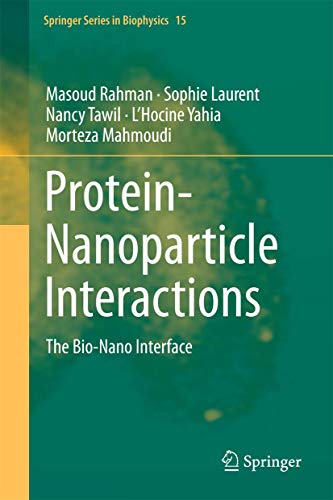
Synopsis
In recent years, the fabrication of nanomaterials and exploration of their properties have attracted the attention of various scientific disciplines such as biology, physics, chemistry, and engineering. Although nanoparticulate systems are of significant interest in various scientific and technological areas, there is little known about the safety of these nanoscale objects. It has now been established that the surfaces of nanoparticles are immediately covered by biomolecules (e.g. proteins, ions, and enzymes) upon their entrance into a biological medium. This interaction with the biological medium modulates the surface of the nanoparticles, conferring a "biological identity" to their surfaces (referred to as a "corona"), which determines the subsequent cellular/tissue responses. The new interface between the nanoparticles and the biological medium/proteins, called "bio-nano interface," has been very rarely studied in detail to date, though the interest in this topic is rapidly growing.
In this book, the importance of the physiochemical characteristics of nanoparticles for the properties of the protein corona is discussed in detail, followed by comprehensive descriptions of the methods for assessing the protein-nanoparticle interactions. The advantages and limitations of available corona evaluation methods (e.g. spectroscopy methods, mass spectrometry, nuclear magnetic resonance, electron microscopy, X-ray crystallography, and differential centrifugal sedimentation) are examined in detail, followed by a discussion of the possibilities for enhancing the current methods and a call for new techniques. Moreover, the advantages and disadvantages of protein-nanoparticle interaction phenomena are explored and discussed, with a focus on the biological impacts.
Les informations fournies dans la section « Synopsis » peuvent faire référence à une autre édition de ce titre.
Résultats de recherche pour Protein-Nanoparticle Interactions: The Bio-Nano Interface

Image fournie par le vendeur
Protein-Nanoparticle Interactions: The Bio-Nano Interface (Springer Series in Biophysics, 15, Band 15)
Edité par
Springer, 2013
ISBN 10 : 3642375545
ISBN 13 : 9783642375545
Ancien ou d'occasion
Couverture rigide
Vendeur : buchlando-buchankauf, Neumünster, SH, Allemagne
Évaluation du vendeur 5 sur 5 étoiles

Gebundene Ausgabe. Etat : Wie neu. 94 Seiten; Neuwertig und ungelesen, evtl. eingeschweisst. ZA 9900027 Sprache: Englisch Gewicht in Gramm: 319. N° de réf. du vendeur 17677
Acheter D'occasion
EUR 25
Expédition à EUR 45,10
Expédition depuis Allemagne vers Etats-Unis
Expédition depuis Allemagne vers Etats-Unis
Quantité disponible : 1 disponible(s)
Image d'archives
Protein-Nanoparticle Interactions (eng)
impression à la demandeVendeur : Brook Bookstore On Demand, Napoli, NA, Italie
Évaluation du vendeur 5 sur 5 étoiles
Etat : new. Questo è un articolo print on demand. N° de réf. du vendeur 40eea2685fdbe56a257d5713b4d92f19
Acheter neuf
EUR 86,24
Expédition à EUR 5,50
Expédition depuis Italie vers Etats-Unis
Expédition depuis Italie vers Etats-Unis
Quantité disponible : Plus de 20 disponibles
Image fournie par le vendeur
Protein-Nanoparticle Interactions
Edité par
Springer Berlin Heidelberg, Springer Berlin Heidelberg Jul 2013, 2013
ISBN 10 : 3642375545
ISBN 13 : 9783642375545
Neuf
Couverture rigide
Vendeur : BuchWeltWeit Ludwig Meier e.K., Bergisch Gladbach, Allemagne
Évaluation du vendeur 5 sur 5 étoiles
Buch. Etat : Neu. This item is printed on demand - it takes 3-4 days longer - Neuware -In recent years, the fabrication of nanomaterials and exploration of their properties have attracted the attention of various scientific disciplines such as biology, physics, chemistry, and engineering. Although nanoparticulate systems are of significant interest in various scientific and technological areas, there is little known about the safety of these nanoscale objects. It has now been established that the surfaces of nanoparticles are immediately covered by biomolecules (e.g. proteins, ions, and enzymes) upon their entrance into a biological medium. This interaction with the biological medium modulates the surface of the nanoparticles, conferring a 'biological identity' to their surfaces (referred to as a 'corona'), which determines the subsequent cellular/tissue responses. The new interface between the nanoparticles and the biological medium/proteins, called 'bio-nano interface,' has been very rarely studied in detail to date, though the interest in this topic is rapidly growing.In this book, the importance of the physiochemical characteristics of nanoparticles for the properties of the protein corona is discussed in detail, followed by comprehensive descriptions of the methods for assessing the protein-nanoparticle interactions. The advantages and limitations of available corona evaluation methods (e.g. spectroscopy methods, mass spectrometry, nuclear magnetic resonance, electron microscopy, X-ray crystallography, and differential centrifugal sedimentation) are examined in detail, followed by a discussion of the possibilities for enhancing the current methods and a call for new techniques. Moreover, the advantages and disadvantages of protein-nanoparticle interaction phenomena are explored and discussed, with a focus on the biological impacts. 96 pp. Englisch. N° de réf. du vendeur 9783642375545
Acheter neuf
EUR 106,99
Expédition à EUR 23
Expédition depuis Allemagne vers Etats-Unis
Expédition depuis Allemagne vers Etats-Unis
Quantité disponible : 2 disponible(s)
Image fournie par le vendeur
Protein-Nanoparticle Interactions
Edité par
Springer Berlin Heidelberg, 2013
ISBN 10 : 3642375545
ISBN 13 : 9783642375545
Neuf
Couverture rigide
Vendeur : moluna, Greven, Allemagne
Évaluation du vendeur 5 sur 5 étoiles
Gebunden. Etat : New. Dieser Artikel ist ein Print on Demand Artikel und wird nach Ihrer Bestellung fuer Sie gedruckt. The first book to investigate protein-nanoparticle interactions in detailGives an overview on the applications and safety issues resulting involvedWritten by international expertsIn recent years, the fabrication of nanomaterials . N° de réf. du vendeur 5058660
Acheter neuf
EUR 92,27
Expédition à EUR 48,99
Expédition depuis Allemagne vers Etats-Unis
Expédition depuis Allemagne vers Etats-Unis
Quantité disponible : Plus de 20 disponibles
Image fournie par le vendeur
Protein-Nanoparticle Interactions : The Bio-Nano Interface
Vendeur : AHA-BUCH GmbH, Einbeck, Allemagne
Évaluation du vendeur 5 sur 5 étoiles
Buch. Etat : Neu. Druck auf Anfrage Neuware - Printed after ordering - In recent years, the fabrication of nanomaterials and exploration of their properties have attracted the attention of various scientific disciplines such as biology, physics, chemistry, and engineering. Although nanoparticulate systems are of significant interest in various scientific and technological areas, there is little known about the safety of these nanoscale objects. It has now been established that the surfaces of nanoparticles are immediately covered by biomolecules (e.g. proteins, ions, and enzymes) upon their entrance into a biological medium. This interaction with the biological medium modulates the surface of the nanoparticles, conferring a 'biological identity' to their surfaces (referred to as a 'corona'), which determines the subsequent cellular/tissue responses. The new interface between the nanoparticles and the biological medium/proteins, called 'bio-nano interface,' has been very rarely studied in detail to date, though the interest in this topic is rapidly growing.In this book, the importance of the physiochemical characteristics of nanoparticles for the properties of the protein corona is discussed in detail, followed by comprehensive descriptions of the methods for assessing the protein-nanoparticle interactions. The advantages and limitations of available corona evaluation methods (e.g. spectroscopy methods, mass spectrometry, nuclear magnetic resonance, electron microscopy, X-ray crystallography, and differential centrifugal sedimentation) are examined in detail, followed by a discussion of the possibilities for enhancing the current methods and a call for new techniques. Moreover, the advantages and disadvantages of protein-nanoparticle interaction phenomena are explored and discussed, with a focus on the biological impacts. N° de réf. du vendeur 9783642375545
Acheter neuf
EUR 114
Expédition à EUR 35
Expédition depuis Allemagne vers Etats-Unis
Expédition depuis Allemagne vers Etats-Unis
Quantité disponible : 1 disponible(s)
Image d'archives
Protein-Nanoparticle Interactions
Vendeur : Books Puddle, Woodside, NY, Etats-Unis
Évaluation du vendeur 4 sur 5 étoiles

Etat : New. pp. 96. N° de réf. du vendeur 2698368149
Acheter neuf
EUR 155,43
Expédition à EUR 3,56
Expédition nationale : Etats-Unis
Expédition nationale : Etats-Unis
Quantité disponible : 4 disponible(s)
Image fournie par le vendeur
Protein-Nanoparticle Interactions
Edité par
Springer, Springer Jul 2013, 2013
ISBN 10 : 3642375545
ISBN 13 : 9783642375545
Neuf
Couverture rigide
Vendeur : buchversandmimpf2000, Emtmannsberg, BAYE, Allemagne
Évaluation du vendeur 5 sur 5 étoiles
Buch. Etat : Neu. This item is printed on demand - Print on Demand Titel. Neuware -In recent years, the fabrication of nanomaterials and exploration of their properties have attracted the attention of various scientific disciplines such as biology, physics, chemistry, and engineering. Although nanoparticulate systems are of significant interest in various scientific and technological areas, there is little known about the safety of these nanoscale objects. It has now been established that the surfaces of nanoparticles are immediately covered by biomolecules (e.g. proteins, ions, and enzymes) upon their entrance into a biological medium. This interaction with the biological medium modulates the surface of the nanoparticles, conferring a ¿biological identity¿ to their surfaces (referred to as a ¿coronä), which determines the subsequent cellular/tissue responses. The new interface between the nanoparticles and the biological medium/proteins, called ¿bio-nano interface,¿ has been very rarely studied in detail to date, though the interest in this topic is rapidly growing.In this book, the importance of the physiochemical characteristics of nanoparticles for the properties of the protein corona is discussed in detail, followed by comprehensive descriptions of the methods for assessing the protein-nanoparticle interactions. The advantages and limitations of available corona evaluation methods (e.g. spectroscopy methods, mass spectrometry, nuclear magnetic resonance, electron microscopy, X-ray crystallography, and differential centrifugal sedimentation) are examined in detail, followed by a discussion of the possibilities for enhancing the current methods and a call for new techniques. Moreover, the advantages and disadvantages of protein-nanoparticle interaction phenomena are explored and discussed, with a focus on the biological impacts.Springer-Verlag KG, Sachsenplatz 4-6, 1201 Wien 96 pp. Englisch. N° de réf. du vendeur 9783642375545
Acheter neuf
EUR 106,99
Expédition à EUR 60
Expédition depuis Allemagne vers Etats-Unis
Expédition depuis Allemagne vers Etats-Unis
Quantité disponible : 1 disponible(s)
Image d'archives
Protein-Nanoparticle Interactions
impression à la demandeVendeur : Majestic Books, Hounslow, Royaume-Uni
Évaluation du vendeur 4 sur 5 étoiles
Etat : New. Print on Demand pp. 96. N° de réf. du vendeur 95110474
Acheter neuf
EUR 162,55
Expédition à EUR 7,66
Expédition depuis Royaume-Uni vers Etats-Unis
Expédition depuis Royaume-Uni vers Etats-Unis
Quantité disponible : 4 disponible(s)
Image d'archives
Protein-Nanoparticle Interactions
impression à la demandeVendeur : Biblios, Frankfurt am main, HESSE, Allemagne
Évaluation du vendeur 4 sur 5 étoiles
Etat : New. PRINT ON DEMAND pp. 96. N° de réf. du vendeur 1898368159
Acheter neuf
EUR 160,85
Expédition à EUR 9,95
Expédition depuis Allemagne vers Etats-Unis
Expédition depuis Allemagne vers Etats-Unis
Quantité disponible : 4 disponible(s)
Image d'archives
Protein-Nanoparticle Interactions: The Bio-Nano Interface (Springer Series in Biophysics (15))
Edité par
Springer, 2013
ISBN 10 : 3642375545
ISBN 13 : 9783642375545
Ancien ou d'occasion
Couverture rigide
Vendeur : Mispah books, Redhill, SURRE, Royaume-Uni
Évaluation du vendeur 4 sur 5 étoiles
Hardcover. Etat : Like New. LIKE NEW. SHIPS FROM MULTIPLE LOCATIONS. book. N° de réf. du vendeur ERICA79036423755456
Acheter D'occasion
EUR 184,49
Expédition à EUR 29,46
Expédition depuis Royaume-Uni vers Etats-Unis
Expédition depuis Royaume-Uni vers Etats-Unis
Quantité disponible : 1 disponible(s)