
Articles liés à New Trends of Research in Ontologies and Lexical Resources:...
New Trends of Research in Ontologies and Lexical Resources: Ideas, Projects, Systems - Couverture souple
Livre 6 sur 16: Theory and Applications of Natural Language Processing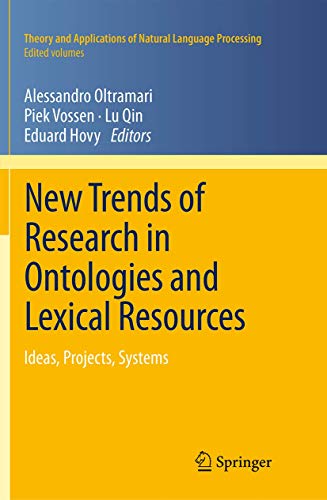
Synopsis
In order to exchange knowledge, humans need to share a common lexicon of words as well as
to access the world models underlying that lexicon. What is a natural process for a human turns out to be an extremely hard task for a machine: computers can’t represent knowledge as effectively as humans do, which hampers, for example, meaning disambiguation and communication. Applied ontologies and NLP have been developed to face these challenges. Integrating ontologies with (possibly multilingual) lexical resources is an essential requirement to make human language understandable by machines, and also to enable interoperability and computability across information systems and, ultimately, in the Web.
This book explores recent advances in the integration of ontologies and lexical resources, including questions such as building the required infrastructure (e.g., the Semantic Web) and different formalisms, methods and platforms for eliciting, analyzing and encoding knowledge contents (e.g., multimedia, emotions, events, etc.). The contributors look towards next-generation technologies, shifting the focus from the state of the art to the future of Ontologies and Lexical Resources. This work will be of interest to research scientists, graduate students, and professionals in the fields of knowledge engineering, computational linguistics, and semantic technologies.
Les informations fournies dans la section « Synopsis » peuvent faire référence à une autre édition de ce titre.
À propos de la quatrième de couverture
In order to exchange knowledge, humans need to share a common lexicon of words as well as
to access the world models underlying that lexicon. What is a natural process for a human turns out to be an extremely hard task for a machine: computers can t represent knowledge as effectively as humans do, which hampers, for example, meaning disambiguation and communication. Applied ontologies and NLP have been developed to face these challenges. Integrating ontologies with (possibly multilingual) lexical resources is an essential requirement to make human language understandable by machines, and also to enable interoperability and computability across information systems and, ultimately, in the Web.
This book explores recent advances in the integration of ontologies and lexical resources, including questions such as building the required infrastructure (e.g., the Semantic Web) and different formalisms, methods and platforms for eliciting, analyzing and encoding knowledge contents (e.g., multimedia, emotions, events, etc.). The contributors look towards next-generation technologies, shifting the focus from the state of the art to the future of Ontologies and Lexical Resources. This work will be of interest to research scientists, graduate students, and professionals in the fields of knowledge engineering, computational linguistics, and semantic technologies.
Les informations fournies dans la section « A propos du livre » peuvent faire référence à une autre édition de ce titre.
Résultats de recherche pour New Trends of Research in Ontologies and Lexical Resources:...

Image d'archives
New Trends of Research in Ontologies and Lexical Resources (eng)
impression à la demandeVendeur : Brook Bookstore On Demand, Napoli, NA, Italie
Évaluation du vendeur 5 sur 5 étoiles

Etat : new. Questo è un articolo print on demand. N° de réf. du vendeur 14dac143bfcb2e3fd07de9d68e8f3949
Acheter neuf
EUR 46,22
Expédition à EUR 30
Expédition depuis Italie vers Etats-Unis
Expédition depuis Italie vers Etats-Unis
Quantité disponible : Plus de 20 disponibles
Image fournie par le vendeur
New Trends of Research in Ontologies and Lexical Resources
Edité par
Springer Berlin Heidelberg Mrz 2015, 2015
ISBN 10 : 3642437788
ISBN 13 : 9783642437786
Neuf
Taschenbuch
Vendeur : BuchWeltWeit Ludwig Meier e.K., Bergisch Gladbach, Allemagne
Évaluation du vendeur 5 sur 5 étoiles
Taschenbuch. Etat : Neu. This item is printed on demand - it takes 3-4 days longer - Neuware -In order to exchange knowledge, humans need to share a common lexicon of words as well as to access the world models underlying that lexicon. What is a natural process for a human turns out to be an extremely hard task for a machine: computers can't represent knowledge as effectively as humans do, which hampers, for example, meaning disambiguation and communication. Applied ontologies and NLP have been developed to face these challenges. Integrating ontologies with (possibly multilingual) lexical resources is an essential requirement to make human language understandable by machines, and also to enable interoperability and computability across information systems and, ultimately, in the Web. This book explores recent advances in the integration of ontologies and lexical resources, including questions such as building the required infrastructure (e.g., the Semantic Web) and different formalisms, methods and platforms for eliciting, analyzing and encoding knowledge contents (e.g., multimedia, emotions, events, etc.). The contributors look towards next-generation technologies, shifting the focus from the state of the art to the future of Ontologies and Lexical Resources. This work will be of interest to research scientists, graduate students, and professionals in the fields of knowledge engineering, computational linguistics, and semantic technologies. 300 pp. Englisch. N° de réf. du vendeur 9783642437786
Acheter neuf
EUR 53,49
Expédition à EUR 23
Expédition depuis Allemagne vers Etats-Unis
Expédition depuis Allemagne vers Etats-Unis
Quantité disponible : 2 disponible(s)
Image fournie par le vendeur
New Trends of Research in Ontologies and Lexical Resources : Ideas, Projects, Systems
Vendeur : GreatBookPrices, Columbia, MD, Etats-Unis
Évaluation du vendeur 5 sur 5 étoiles
Etat : New. N° de réf. du vendeur 23722216-n
Acheter neuf
EUR 77,40
Expédition à EUR 2,36
Expédition nationale : Etats-Unis
Expédition nationale : Etats-Unis
Quantité disponible : Plus de 20 disponibles
Image fournie par le vendeur
New Trends of Research in Ontologies and Lexical Resources : Ideas, Projects, Systems
Vendeur : GreatBookPricesUK, Woodford Green, Royaume-Uni
Évaluation du vendeur 5 sur 5 étoiles
Etat : New. N° de réf. du vendeur 23722216-n
Acheter neuf
EUR 68,08
Expédition à EUR 17,98
Expédition depuis Royaume-Uni vers Etats-Unis
Expédition depuis Royaume-Uni vers Etats-Unis
Quantité disponible : Plus de 20 disponibles
Image fournie par le vendeur
New Trends of Research in Ontologies and Lexical Resources
Edité par
Springer Berlin Heidelberg, 2015
ISBN 10 : 3642437788
ISBN 13 : 9783642437786
Neuf
Couverture souple
Vendeur : moluna, Greven, Allemagne
Évaluation du vendeur 5 sur 5 étoiles
Etat : New. Dieser Artikel ist ein Print on Demand Artikel und wird nach Ihrer Bestellung fuer Sie gedruckt. Focusing on new trends of research instead of state of the artBased on an original top event in the field (OntoLex 2010 workshop at COLING 2010) Explores sinergies with new application domains (Augmented Reality, Social Networking, Interne. N° de réf. du vendeur 449056705
Acheter neuf
EUR 48,37
Expédition à EUR 48,99
Expédition depuis Allemagne vers Etats-Unis
Expédition depuis Allemagne vers Etats-Unis
Quantité disponible : Plus de 20 disponibles
Image fournie par le vendeur
New Trends of Research in Ontologies and Lexical Resources : Ideas, Projects, Systems
Vendeur : AHA-BUCH GmbH, Einbeck, Allemagne
Évaluation du vendeur 5 sur 5 étoiles
Taschenbuch. Etat : Neu. Druck auf Anfrage Neuware - Printed after ordering - In order to exchange knowledge, humans need to share a common lexicon of words as well as to access the world models underlying that lexicon. What is a natural process for a human turns out to be an extremely hard task for a machine: computers can't represent knowledge as effectively as humans do, which hampers, for example, meaning disambiguation and communication. Applied ontologies and NLP have been developed to face these challenges. Integrating ontologies with (possibly multilingual) lexical resources is an essential requirement to make human language understandable by machines, and also to enable interoperability and computability across information systems and, ultimately, in the Web. This book explores recent advances in the integration of ontologies and lexical resources, including questions such as building the required infrastructure (e.g., the Semantic Web) and different formalisms, methods and platforms for eliciting, analyzing and encoding knowledge contents (e.g., multimedia, emotions, events, etc.). The contributors look towards next-generation technologies, shifting the focus from the state of the art to the future of Ontologies and Lexical Resources. This work will be of interest to research scientists, graduate students, and professionals in the fields of knowledge engineering, computational linguistics, and semantic technologies. N° de réf. du vendeur 9783642437786
Acheter neuf
EUR 66,40
Expédition à EUR 35
Expédition depuis Allemagne vers Etats-Unis
Expédition depuis Allemagne vers Etats-Unis
Quantité disponible : 1 disponible(s)
Image fournie par le vendeur
New Trends of Research in Ontologies and Lexical Resources
Edité par
Springer, Springer Mär 2015, 2015
ISBN 10 : 3642437788
ISBN 13 : 9783642437786
Neuf
Taschenbuch
Vendeur : buchversandmimpf2000, Emtmannsberg, BAYE, Allemagne
Évaluation du vendeur 5 sur 5 étoiles
Taschenbuch. Etat : Neu. This item is printed on demand - Print on Demand Titel. Neuware -In order to exchange knowledge, humans need to share a common lexicon of words as well asto access the world models underlying that lexicon. What is a natural process for a human turns out to be an extremely hard task for a machine: computers can¿t represent knowledge as effectively as humans do, which hampers, for example, meaning disambiguation and communication. Applied ontologies and NLP have been developed to face these challenges. Integrating ontologies with (possibly multilingual) lexical resources is an essential requirement to make human language understandable by machines, and also to enable interoperability and computability across information systems and, ultimately, in the Web.This book explores recent advances in the integration of ontologies and lexical resources, including questions such as building the required infrastructure (e.g., the Semantic Web) and different formalisms, methods and platforms for eliciting, analyzing and encoding knowledge contents (e.g., multimedia, emotions, events, etc.). The contributors look towards next-generation technologies, shifting the focus from the state of the art to the future of Ontologies and Lexical Resources. This work will be of interest to research scientists, graduate students, and professionals in the fields of knowledge engineering, computational linguistics, and semantic technologies.Springer-Verlag GmbH, Tiergartenstr. 17, 69121 Heidelberg 300 pp. Englisch. N° de réf. du vendeur 9783642437786
Acheter neuf
EUR 53,49
Expédition à EUR 60
Expédition depuis Allemagne vers Etats-Unis
Expédition depuis Allemagne vers Etats-Unis
Quantité disponible : 1 disponible(s)
Image fournie par le vendeur
New Trends of Research in Ontologies and Lexical Resources | Ideas, Projects, Systems
Vendeur : preigu, Osnabrück, Allemagne
Évaluation du vendeur 5 sur 5 étoiles
Taschenbuch. Etat : Neu. New Trends of Research in Ontologies and Lexical Resources | Ideas, Projects, Systems | Alessandro Oltramari (u. a.) | Taschenbuch | Theory and Applications of Natural Language Processing | xv | Englisch | 2015 | Springer | EAN 9783642437786 | Verantwortliche Person für die EU: Springer Verlag GmbH, Tiergartenstr. 17, 69121 Heidelberg, juergen[dot]hartmann[at]springer[dot]com | Anbieter: preigu. N° de réf. du vendeur 109581469
Acheter neuf
EUR 50,65
Expédition à EUR 70
Expédition depuis Allemagne vers Etats-Unis
Expédition depuis Allemagne vers Etats-Unis
Quantité disponible : 5 disponible(s)
Image d'archives
New Trends of Research in Ontologies and Lexical Resources
impression à la demandeVendeur : Majestic Books, Hounslow, Royaume-Uni
Évaluation du vendeur 4 sur 5 étoiles

Etat : New. Print on Demand pp. 300. N° de réf. du vendeur 372014731
Acheter neuf
EUR 153,76
Expédition à EUR 7,79
Expédition depuis Royaume-Uni vers Etats-Unis
Expédition depuis Royaume-Uni vers Etats-Unis
Quantité disponible : 4 disponible(s)
Image d'archives
New Trends of Research in Ontologies and Lexical Resources
Vendeur : Books Puddle, Woodside, NY, Etats-Unis
Évaluation du vendeur 4 sur 5 étoiles
Etat : New. pp. 300. N° de réf. du vendeur 26375112020
Acheter neuf
EUR 163,57
Expédition à EUR 3,56
Expédition nationale : Etats-Unis
Expédition nationale : Etats-Unis
Quantité disponible : 4 disponible(s)