
Articles liés à AN INTRODUCTION TO FLORAL DYES: Extraction and Application
Synopsis
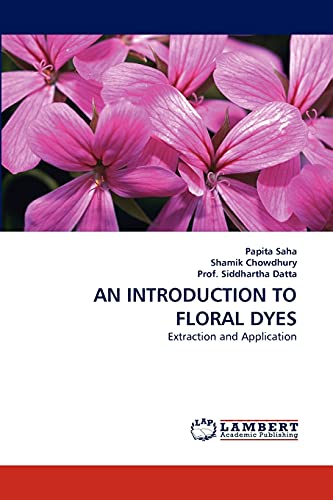
India is the home to more than 500 flowering plants that can yield dyes. Though there is a large plant resource base, little has been exploited so far. ?An Introduction to FLORAL DYES? provides a precise technical knowledge about some of these flowering plants along with the basic principles of extraction and application of the floral dye in Textile Industry and in Powder - Gulal Industry. These floral dyes are non toxic, non allergic to human skin, easily available and more economical. Some natural dye sources produce truly exquisite shades and are more economical to purchase than synthetic dyes. The process of extraction of dye is economically viable as the raw materials are available at low cost. This technology can be used in small scale Industry as well as in large scale Industry.
Les informations fournies dans la section « Synopsis » peuvent faire référence à une autre édition de ce titre.
Présentation de l'éditeur
India is the home to more than 500 flowering plants that can yield dyes. Though there is a large plant resource base, little has been exploited so far. ?An Introduction to FLORAL DYES? provides a precise technical knowledge about some of these flowering plants along with the basic principles of extraction and application of the floral dye in Textile Industry and in Powder - Gulal Industry. These floral dyes are non toxic, non allergic to human skin, easily available and more economical. Some natural dye sources produce truly exquisite shades and are more economical to purchase than synthetic dyes. The process of extraction of dye is economically viable as the raw materials are available at low cost. This technology can be used in small scale Industry as well as in large scale Industry.
Biographie de l'auteur
PAPITA SAHA Assistant Professor; Biotechnology Department, National Institute of Technology-Durgapur, Durgapur,India SHAMIK CHOWDHURY Biotechnology Department, National Institute of Technology-Durgapur,India Prof. SIDDHARTHA DATTA Pro Vice-Chancellor Jadavpur University, Kolkata, India
Les informations fournies dans la section « A propos du livre » peuvent faire référence à une autre édition de ce titre.
Résultats de recherche pour AN INTRODUCTION TO FLORAL DYES: Extraction and Application

Image d'archives
An Introduction to Floral Dyes
Edité par
VDM Verlag Dr. Mueller Aktiengesellschaft & Co. KG, 2010
ISBN 10 : 3843370257
ISBN 13 : 9783843370257
Neuf
Couverture souple
Vendeur : Books Puddle, Woodside, NY, Etats-Unis
Évaluation du vendeur 4 sur 5 étoiles

Etat : New. pp. 88. N° de réf. du vendeur 26128845973
Acheter neuf
EUR 80,03
Expédition à EUR 3,56
Expédition nationale : Etats-Unis
Expédition nationale : Etats-Unis
Quantité disponible : 4 disponible(s)
Image d'archives
An Introduction to Floral Dyes
Edité par
VDM Verlag Dr. Mueller Aktiengesellschaft & Co. KG, 2010
ISBN 10 : 3843370257
ISBN 13 : 9783843370257
Neuf
Couverture souple
Vendeur : Majestic Books, Hounslow, Royaume-Uni
Évaluation du vendeur 4 sur 5 étoiles
Etat : New. Print on Demand pp. 88 2:B&W 6 x 9 in or 229 x 152 mm Perfect Bound on Creme w/Gloss Lam. N° de réf. du vendeur 131708746
Acheter neuf
EUR 80,08
Expédition à EUR 7,68
Expédition depuis Royaume-Uni vers Etats-Unis
Expédition depuis Royaume-Uni vers Etats-Unis
Quantité disponible : 4 disponible(s)
Image d'archives
An Introduction to Floral Dyes
Edité par
VDM Verlag Dr. Mueller Aktiengesellschaft & Co. KG, 2010
ISBN 10 : 3843370257
ISBN 13 : 9783843370257
Neuf
Couverture souple
Vendeur : Biblios, Frankfurt am main, HESSE, Allemagne
Évaluation du vendeur 4 sur 5 étoiles
Etat : New. PRINT ON DEMAND pp. 88. N° de réf. du vendeur 18128845983
Acheter neuf
EUR 79,52
Expédition à EUR 9,95
Expédition depuis Allemagne vers Etats-Unis
Expédition depuis Allemagne vers Etats-Unis
Quantité disponible : 4 disponible(s)
Image fournie par le vendeur
AN INTRODUCTION TO FLORAL DYES : Extraction and Application
Edité par
LAP Lambert Academic Publishing, 2010
ISBN 10 : 3843370257
ISBN 13 : 9783843370257
Neuf
Taschenbuch
Vendeur : AHA-BUCH GmbH, Einbeck, Allemagne
Évaluation du vendeur 5 sur 5 étoiles

Taschenbuch. Etat : Neu. nach der Bestellung gedruckt Neuware - Printed after ordering - India is the home to more than 500 flowering plants that can yield dyes. Though there is a large plant resource base, little has been exploited so far. An Introduction to FLORAL DYES provides a precise technical knowledge about some of these flowering plants along with the basic principles of extraction and application of the floral dye in Textile Industry and in Powder - Gulal Industry. These floral dyes are non toxic, non allergic to human skin, easily available and more economical. Some natural dye sources produce truly exquisite shades and are more economical to purchase than synthetic dyes. The process of extraction of dye is economically viable as the raw materials are available at low cost. This technology can be used in small scale Industry as well as in large scale Industry. N° de réf. du vendeur 9783843370257
Acheter neuf
EUR 54,70
Expédition à EUR 35
Expédition depuis Allemagne vers Etats-Unis
Expédition depuis Allemagne vers Etats-Unis
Quantité disponible : 2 disponible(s)
Image fournie par le vendeur
AN INTRODUCTION TO FLORAL DYES
Edité par
LAP LAMBERT Academic Publishing, 2010
ISBN 10 : 3843370257
ISBN 13 : 9783843370257
Neuf
Couverture souple
Vendeur : moluna, Greven, Allemagne
Évaluation du vendeur 5 sur 5 étoiles
Etat : New. Dieser Artikel ist ein Print on Demand Artikel und wird nach Ihrer Bestellung fuer Sie gedruckt. Autor/Autorin: Saha PapitaPAPITA SAHA Assistant Professor Biotechnology Department, National Institute of Technology-Durgapur, Durgapur,India SHAMIK CHOWDHURY Biotechnology Department, National Institute of Technology-Durgapur,India Prof. SIDD. N° de réf. du vendeur 5466945
Acheter neuf
EUR 41,67
Expédition à EUR 48,99
Expédition depuis Allemagne vers Etats-Unis
Expédition depuis Allemagne vers Etats-Unis
Quantité disponible : Plus de 20 disponibles
Image fournie par le vendeur
AN INTRODUCTION TO FLORAL DYES | Extraction and Application
Edité par
LAP Lambert Academic Publishing, 2010
ISBN 10 : 3843370257
ISBN 13 : 9783843370257
Neuf
Taschenbuch
Vendeur : preigu, Osnabrück, Allemagne
Évaluation du vendeur 5 sur 5 étoiles
Taschenbuch. Etat : Neu. AN INTRODUCTION TO FLORAL DYES | Extraction and Application | Papita Saha (u. a.) | Taschenbuch | Englisch | LAP Lambert Academic Publishing | EAN 9783843370257 | Verantwortliche Person für die EU: LAP Lambert Academic Publishing, Brivibas Gatve 197, 1039 RIGA, LETTLAND, customerservice[at]vdm-vsg[dot]de | Anbieter: preigu. N° de réf. du vendeur 107234460
Acheter neuf
EUR 43,40
Expédition à EUR 70
Expédition depuis Allemagne vers Etats-Unis
Expédition depuis Allemagne vers Etats-Unis
Quantité disponible : 5 disponible(s)
Image d'archives
AN INTRODUCTION TO FLORAL DYES: Extraction and Application
Edité par
LAP LAMBERT Academic Publishing, 2010
ISBN 10 : 3843370257
ISBN 13 : 9783843370257
Ancien ou d'occasion
Paperback
Vendeur : Mispah books, Redhill, SURRE, Royaume-Uni
Évaluation du vendeur 4 sur 5 étoiles
Paperback. Etat : Like New. LIKE NEW. SHIPS FROM MULTIPLE LOCATIONS. book. N° de réf. du vendeur ERICA75838433702576
Acheter D'occasion
EUR 122,90
Expédition à EUR 29,54
Expédition depuis Royaume-Uni vers Etats-Unis
Expédition depuis Royaume-Uni vers Etats-Unis
Quantité disponible : 1 disponible(s)