
Articles liés à Return to the Postcolony: Specters of Colonialism in...
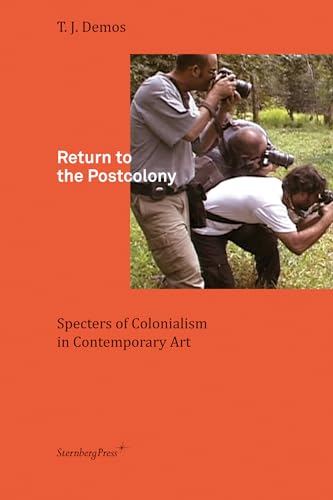
Synopsis
Dans le sillage des États défaillants, des inégalités économiques et politiques croissantes, et des guerres en cours menées par les États-Unis et l'OTAN pour les ressources, la sécurité et la domination économique dans le monde entier, les artistes contemporains revisitent les anciennes colonies européennes, considérant les injustices passées car ils hantent les vivants tout en restant réprimés dans la conscience européenne. Avec une grande rapidité, les projets de Sven Augustijnen, Vincent Meessen, Zarina Bhimji, Renzo Martens et Pieter Hugo ont émergé lors du cinquantième anniversaire de l'indépendance pour de nombreux pays africains, inspirant une sorte de « migration inversée » — un retour à la postcolonie, qui conduit un ensemble d'impératifs éthico-politiques et esthétiques : apprendre à vivre avec gg hôtes, et de le faire plus justement.
Les informations fournies dans la section « Synopsis » peuvent faire référence à une autre édition de ce titre.
Présentation de l'éditeur
In the wake of failed states, growing economic and political inequality, and the ongoing US- and NATO-led wars for resources, security, and economic dominance worldwide, contemporary artists are revisiting former European colonies, considering past injustices as they haunt the living yet remain repressed in European consciousness. With great timeliness, projects by Sven Augustijnen, Vincent Meessen, Zarina Bhimji, Renzo Martens, and Pieter Hugo have emerged during the fiftieth anniversary of independence for many African countries, inspiring a ''reverse migration''--a return to the postcolony, which drives an ethico-political as well as aesthetic set of imperatives: to learn to live with ghosts, and to do so more justly. ----------------- T. J. Demos places contemporary art within the context of neoliberal globalization and what scholars have referred to as the ''colonial present.'' The analysis is complex and provocative, both for an understanding of the historical material as well as for the contemporary theoretical discourse. ''Return to the Postcolony'' is one of the most ambitious, intelligent, and readable texts on contemporary art related to the African context that I have read. --Alexander Alberro, author of ''Conceptual Art and the Politics of Publicity'' ----------------- The specters of colonialism continue to haunt the current global order. Far removed from universalist and ultimately empty demands for a ''global art history,'' T. J. Demos uses particular cases to explore the false universality of ''globalization'' as we know it. This is art writing at its best: determinate and determined. --Sven Lütticken, author of ''Idols of the Market: Modern Iconoclasm and the Fundamentalist Spectacle'' ---------------- Design by Kummer & Herrman
Revue de presse
T. J. Demos places contemporary art within the context of neoliberal globalization and what scholars have referred to as the »colonial present.« The analysis is complex and provocative, both for an understanding of the historical material as well as for the contemporary theoretical discourse. »Return to the Postcolony« is one of the most ambitious, intelligent, and readable texts on contemporary art related to the African context that I have read. (Alexander Alberro, author of »Conceptual Art and the Politics of Publicity«)
The specters of colonialism continue to haunt the current global order. Far removed from universalist and ultimately empty demands for a »global art history,« T. J. Demos uses particular cases to explore the false universality of »globalization« as we know it. This is art writing at its best: determinate and determined. (Sven Lütticken, author of »Idols of the Market: Modern Iconoclasm and the Fundamentalist Spectacle«)
Les informations fournies dans la section « A propos du livre » peuvent faire référence à une autre édition de ce titre.
Résultats de recherche pour Return to the Postcolony: Specters of Colonialism in...

Image d'archives
Return to the Postcolony
Vendeur : PBShop.store UK, Fairford, GLOS, Royaume-Uni
Évaluation du vendeur 5 sur 5 étoiles

PAP. Etat : New. New Book. Shipped from UK. Established seller since 2000. N° de réf. du vendeur GB-9783943365429
Acheter neuf
EUR 24,96
Expédition à EUR 4,84
Expédition depuis Royaume-Uni vers Etats-Unis
Expédition depuis Royaume-Uni vers Etats-Unis
Quantité disponible : 2 disponible(s)
Image d'archives
Return to the Postcolony (Paperback)
Edité par
Sternberg Press, New York, 2013
ISBN 10 : 3943365425
ISBN 13 : 9783943365429
Neuf
Paperback
Vendeur : Grand Eagle Retail, Bensenville, IL, Etats-Unis
Évaluation du vendeur 5 sur 5 étoiles
Paperback. Etat : new. Paperback. In the wake of failed states, growing economic and political inequality, and the ongoing US- and NATO-led wars for resources, security, and economic dominance worldwide, contemporary artists are revisiting former European colonies, considering past injustices as they haunt the living yet remain repressed in European consciousness. With great timeliness, projects by Sven Augustijnen, Vincent Meessen, Zarina Bhimji, Renzo Martens, and Pieter Hugo have emerged during the fiftieth anniversary of independence for many African countries, inspiring a kind of "reverse migration"-a return to the postcolony, which drives an ethico-political as well as aesthetic set of imperatives- to learn to live with ghosts, and to do so more justly. Shipping may be from multiple locations in the US or from the UK, depending on stock availability. N° de réf. du vendeur 9783943365429
Acheter neuf
EUR 30,61
Livraison gratuite
Expédition nationale : Etats-Unis
Expédition nationale : Etats-Unis
Quantité disponible : 1 disponible(s)
Image fournie par le vendeur
Return to the Postcolony
Vendeur : Rarewaves.com USA, London, LONDO, Royaume-Uni
Évaluation du vendeur 5 sur 5 étoiles
Paperback. Etat : New. N° de réf. du vendeur LU-9783943365429
Acheter neuf
EUR 31,16
Livraison gratuite
Expédition depuis Royaume-Uni vers Etats-Unis
Expédition depuis Royaume-Uni vers Etats-Unis
Quantité disponible : 1 disponible(s)
Image d'archives
Return to the Postcolony: Specters of Colonialism in Contemporary Art
Edité par
Sternberg Press, 2013
ISBN 10 : 3943365425
ISBN 13 : 9783943365429
Ancien ou d'occasion
Couverture souple
Vendeur : Anybook.com, Lincoln, Royaume-Uni
Évaluation du vendeur 5 sur 5 étoiles
Etat : Good. This is an ex-library book and may have the usual library/used-book markings inside.This book has soft covers. In good all round condition. Please note the Image in this listing is a stock photo and may not match the covers of the actual item,450grams, ISBN:9783943365429. N° de réf. du vendeur 4142822
Acheter D'occasion
EUR 18,73
Expédition à EUR 15,81
Expédition depuis Royaume-Uni vers Etats-Unis
Expédition depuis Royaume-Uni vers Etats-Unis
Quantité disponible : 1 disponible(s)
Image d'archives
Return to the Postcolony : Specters of Colonialism in.
Vendeur : Majestic Books, Hounslow, Royaume-Uni
Évaluation du vendeur 4 sur 5 étoiles

Etat : New. pp. 176. N° de réf. du vendeur 141869871
Acheter neuf
EUR 29,01
Expédition à EUR 7,56
Expédition depuis Royaume-Uni vers Etats-Unis
Expédition depuis Royaume-Uni vers Etats-Unis
Quantité disponible : 1 disponible(s)
Image d'archives
Return to the Postcolony : Specters of Colonialism in.
Vendeur : Books Puddle, Woodside, NY, Etats-Unis
Évaluation du vendeur 4 sur 5 étoiles
Etat : New. pp. 176. N° de réf. du vendeur 26134446320
Acheter neuf
EUR 33,28
Expédition à EUR 3,50
Expédition nationale : Etats-Unis
Expédition nationale : Etats-Unis
Quantité disponible : 1 disponible(s)
Image d'archives
Return to the Postcolony: Specters of Colonialism in Contemporary Art
Edité par
Sternberg Press, 2013
ISBN 10 : 3943365425
ISBN 13 : 9783943365429
Ancien ou d'occasion
Soft cover
Vendeur : Amnesty Bookshop - Brighton, Brighton, Royaume-Uni
Évaluation du vendeur 5 sur 5 étoiles
Soft cover. Etat : Very Good. Please note that, depending on size and destination, we may request a payment to cover any extra shipping & postage charges. Proceeds to Amnesty International. Abe2638. N° de réf. du vendeur ABE-1790432662585
Acheter D'occasion
EUR 15,57
Expédition à EUR 23,26
Expédition depuis Royaume-Uni vers Etats-Unis
Expédition depuis Royaume-Uni vers Etats-Unis
Quantité disponible : 1 disponible(s)
Image d'archives
Return To The Postcolony - Specters Of Colonialism In Contemporary Art
Vendeur : Revaluation Books, Exeter, Royaume-Uni
Évaluation du vendeur 5 sur 5 étoiles
Paperback. Etat : Brand New. 176 pages. 8.50x6.50x0.25 inches. In Stock. N° de réf. du vendeur __3943365425
Acheter neuf
EUR 27,39
Expédition à EUR 11,63
Expédition depuis Royaume-Uni vers Etats-Unis
Expédition depuis Royaume-Uni vers Etats-Unis
Quantité disponible : 2 disponible(s)
Image d'archives
Return to the Postcolony: Specters of Colonialism in Contemporary Art
Vendeur : Kennys Bookshop and Art Galleries Ltd., Galway, GY, Irlande
Évaluation du vendeur 5 sur 5 étoiles
Etat : New. Num Pages: 176 pages. BIC Classification: ABA. Category: (G) General (US: Trade). Dimension: 213 x 147 x 15. Weight in Grams: 322. . 2013. Paperback. . . . . N° de réf. du vendeur V9783943365429
Acheter neuf
EUR 29,99
Expédition à EUR 9,50
Expédition depuis Irlande vers Etats-Unis
Expédition depuis Irlande vers Etats-Unis
Quantité disponible : 2 disponible(s)
Image d'archives
Return To The Postcolony - Specters Of Colonialism In Contemporary Art (Sternberg Press)
Edité par
Sternberg Press 2013-03-19, 2013
ISBN 10 : 3943365425
ISBN 13 : 9783943365429
Neuf
Paperback
Vendeur : Chiron Media, Wallingford, Royaume-Uni
Évaluation du vendeur 5 sur 5 étoiles
Paperback. Etat : New. N° de réf. du vendeur 6666-GRD-9783943365429
Acheter neuf
EUR 22,57
Expédition à EUR 18,01
Expédition depuis Royaume-Uni vers Etats-Unis
Expédition depuis Royaume-Uni vers Etats-Unis
Quantité disponible : 2 disponible(s)