
Articles liés à Japanese For Busy People II: An All New Edition of...
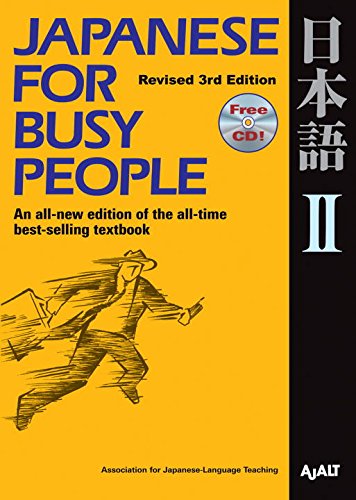
Japanese For Busy People II: An All New Edition of All-Time Best- Selling Textbook Revised 3rd Edition with Free CD - Couverture souple
Synopsis
Book by Association for JapaneseLanguage Teaching
Les informations fournies dans la section « Synopsis » peuvent faire référence à une autre édition de ce titre.
Présentation de l'éditeur
Volume I dealt with "survival Japanese" for tourists and other short-term travelers and newcomers to Japan. Volume II, meanwhile, turns to the basics of Japanese syntax. The book is by no means only about grammar, however. Rather, it is designed to help learners consolidate their understanding of syntactical structure through lessons that focus on how to talk about topics relevant to daily life. In addition to serving learners continuing from Volume I, Volume II will benefit those who have already studied beginning Japanese to some extent but wish to brush up on syntax.
Major Features of Japanese for Busy People II, Revised 3rd EditionJapanese for Busy People II, Revised 3rd Edition will enable learners to progress smoothly through the equivalent of the latter half of a typical first-year Japanese course while gradually building speaking and listening skills.
Learners approaching mid-beginner status often find themselves suddenly faced with syntax and vocabulary much more complex than what they have studied before. Such grammar and vocabulary do not appear as frequently in everyday conversation as those words and structures they have learned up to this point, necessitating that they spend ample time on review. Moreover, learners at this stage are expected to become familiar with verb tense and aspect, time expressions, conditional clauses, and other topics that require them to have a solid grasp of context and speaker intent if they are to fully understand the differences in meaning conveyed by each. Such points cannot be mastered by reading through grammatical explanations alone. In short, the mid-beginner level is a difficult one for many adult learners who, unlike students in school, have neither time nor opportunities to take repeated tests or to otherwise gauge their progress.
Japanese for Busy People II, Revised 3rd Edition helps overcome the above obstacles through grammar and content topics carefully selected to be appropriate to learners at this level of Japanese proficiency. The book is designed so that by practicing talking about each topic, learners will gradually and effectively acquire sentence patterns and vocabulary related to that topic. Like Volume I, Volume II is organized into several large units, each covering topics grouped under a particular theme. In this way, the book enables learners to achieve a well-balanced understanding of grammar, sentence structure, and context.
Themes and lesson objectives of the five units in Volume II are as follows.
Unit 1: Souvenir Shopping
Following up on Volume I, Unit 1 presents survival Japanese related to shopping, thus providing learners with a thorough review of simple clauses. The unit also goes beyond what was covered in Volume I by showing ways of asking someone’s opinion while shopping, making comparisons between items, and describing an item’s characteristics. The overall theme is "picking souvenirs," a subject that should be relevant to learners both in Japan and abroad. The verbal skills and dialogue patterns studied here may be applied not only to shopping but also more broadly to any situation that involves choosing between options.
Unit 2: Building Rapport with Colleagues
This unit introduces the plain forms of verbs — a crucial component of Japanese compound sentences — along with several sentence-final elements that make use of these forms. Topics are selected from among those that typically come up when interacting with people from work. Covered are constructions for indicating interest in another’s actions, inviting someone to do something outside of work, asking for help or offering advice, and otherwise interacting with people in ways that help build relationships of trust and understanding.
Unit 3: Returning to Japan for Work
This unit explains how to build sentences using temporal clauses, direct and indirect quotation, and attributive modifiers. Through talking about factual events in one’s life history or in that of a particular neighborhood, learners will study how to relate an event in chronological sequence, compare the way something is now to how it was in the past, and describe facilities and other things around them.
Unit 4: Planning a Vacation
Along with sentences with clauses for stating reasons or reporting questions, this unit covers sentence-final elements used to express indefiniteness, for example wish or probability. Topics deal with verbal skills necessary for planning and carrying out activities in cooperation with others, including explaining reasons or circumstances, expressing probability, and indicating desire. The overall theme is that of planning and going on a trip to a unique place in Japan.
Unit 5: Solving Problems
The focus of this unit is on forming conditional clauses. Topics include preparing for earthquakes or other disasters, discussing dreams for the future, solving problems, helping someone who is lost, and other situations that call on learners to talk about what might happen in the future, discuss options for solving problems, and give instructions or explain steps for doing something.
Présentation de l'éditeur
Japanese for Busy People is, as the title suggests, a concise course for 'busy' students who want to learn natural spoken Japanese as effectively as possible in a limited amount of time. This worldwide bestselling series was prepared by a working group of experienced Japanese language instructors who reviewed and tested the material in an authentic classroom environment. Includes a free CD.
Les informations fournies dans la section « A propos du livre » peuvent faire référence à une autre édition de ce titre.
Résultats de recherche pour Japanese For Busy People II: An All New Edition of...

Image d'archives
Japanese for Busy People: Bk. 2
Edité par
Kodansha America, Inc, 2007
ISBN 10 : 477003010X
ISBN 13 : 9784770030108
Ancien ou d'occasion
Paperback
Vendeur : World of Books (was SecondSale), Montgomery, IL, Etats-Unis
Évaluation du vendeur 5 sur 5 étoiles

Paperback. Etat : Good. Volume I dealt with survival Japanese for tourists and other short-term travelers and newcomers to Japan. Volume II, meanwhile, turns to the basics of Japanese syntax. The book is by no means only about grammar, however. Rather, it is designed to help learners consolidate their understanding of syntactical structure through lessons that focus on how to talk about topics relevant to daily life. In addition to serving learners continuing from Volume I, Volume II will benefit those who have already studied beginning Japanese to some extent but wish to brush up on syntax. Major Features of Japanese for Busy People II, Revised 3rd EditionJapanese for Busy People II, Revised 3rd Edition will enable learners to progress smoothly through the equivalent of the latter half of a typical first-year Japanese course while gradually building speaking and listening skills. Learners approaching mid-beginner status often find themselves suddenly faced with syntax and vocabulary much more complex than what they have studied before. Such grammar and vocabulary do not appear as frequently in everyday conversation as those words and structures they have learned up to this point, necessitating that they spend ample time on review. Moreover, learners at this stage are expected to become familiar with verb tense and aspect, time expressions, conditional clauses, and other topics that require them to have a solid grasp of context and speaker intent if they are to fully understand the differences in meaning conveyed by each. Such points cannot be mastered by reading through grammatical explanations alone. In short, the mid-beginner level is a difficult one for many adult learners who, unlike students in school, have neither time nor opportunities to take repeated tests or to otherwise gauge their progress. Japanese for Busy People II, Revised 3rd Edition helps overcome the above obstacles through grammar and content topics carefully selected to be appropriate to learners at this level of Japanese proficiency. The book is designed so that by practicing talking about each topic, learners will gradually and effectively acquire sentence patterns and vocabulary related to that topic. Like Volume I, Volume II is organized into several large units, each covering topics grouped under a particular theme. In this way, the book enables learners to achieve a well-balanced understanding of grammar, sentence structure, and context. Themes and lesson objectives of the five units in Volume II are as follows. Unit 1: Souvenir ShoppingFollowing up on Volume I, Unit 1 presents survival Japanese related to shopping, thus providing learners with a thorough review of simple clauses. The unit also goes beyond what was covered in Volume I by showing ways of asking someone's opinion while shopping, making comparisons between items, and describing an item's characteristics. The overall theme is picking souvenirs, a subject that should be relevant to learners both in Japan and abroad. The verbal skills and dialogue patterns studied here may be applied not only to shopping but also more broadly to any situation that involves choosing between options. Unit 2: Building Rapport with ColleaguesThis unit introduces the plain forms of verbs-a crucial component of Japanese compound sentences-along with several sentence-final elements that make use of these forms. Topics are selected from among those that typically come up when interacting with people from work. Covered are constructions for indicating interest in another's actions, inviting someone to do something outside of work, asking for help or offering advice, and otherwise interacting with people in ways that help build relationships of trust and understanding. Unit 3: Returning to Japan for WorkThis unit explains how to build sentences using temporal clauses, direct and indirect quotation, and attributive modifiers. Through talking about factual events in one's life history or in that of a particular neighborhood, learners will study how to relate an event in chronological sequence, compare the way something is now to how it was in the past, and describe facilities and other things around them. Unit 4: Planning a VacationAlong with sentences with clauses for stating reasons or reporting questions, this unit covers sentence-final elements used to express indefiniteness, for example wish or probability. Topics deal with verbal skills necessary for planning and carrying out activities in cooperation with others, including explaining reasons or circumstances, expressing probability, and indicating desire. The overall theme is that of planning and going on a trip to a unique place in Japan. Unit 5: Solving ProblemsThe focus of this unit is on forming conditional clauses. Topics include preparing for earthquakes or other disasters, discussing dreams for the future, solving problems, helping someone who is lost, and other situations that call on learners to talk about what might happen in the future, discuss options for solving problems, and give instructions or explain steps for doing something. N° de réf. du vendeur 00110133372
Acheter D'occasion
EUR 8,84
Livraison gratuite
Expédition nationale : Etats-Unis
Expédition nationale : Etats-Unis
Quantité disponible : 1 disponible(s)
Image d'archives
Japanese for Busy People II : Third Revised Editionincl. 1 CD
Edité par
Kodansha America, Incorporated, 2007
ISBN 10 : 477003010X
ISBN 13 : 9784770030108
Ancien ou d'occasion
Couverture souple
Vendeur : Better World Books, Mishawaka, IN, Etats-Unis
Évaluation du vendeur 5 sur 5 étoiles
Etat : Very Good. Pages intact with possible writing/highlighting. Binding strong with minor wear. Dust jackets/supplements may not be included. Stock photo provided. Product includes identifying sticker. Better World Books: Buy Books. Do Good. N° de réf. du vendeur 15048589-6
Acheter D'occasion
EUR 9,07
Livraison gratuite
Expédition nationale : Etats-Unis
Expédition nationale : Etats-Unis
Quantité disponible : 1 disponible(s)
Image d'archives
Japanese for Busy People: Bk. 2
Edité par
Kodansha America, Inc, 2007
ISBN 10 : 477003010X
ISBN 13 : 9784770030108
Ancien ou d'occasion
Paperback
Vendeur : World of Books Inc, Montgomery, IL, Etats-Unis
Évaluation du vendeur 4 sur 5 étoiles

Paperback. Etat : Good. Volume I dealt with survival Japanese for tourists and other short-term travelers and newcomers to Japan. Volume II, meanwhile, turns to the basics of Japanese syntax. The book is by no means only about grammar, however. Rather, it is designed to help learners consolidate their understanding of syntactical structure through lessons that focus on how to talk about topics relevant to daily life. In addition to serving learners continuing from Volume I, Volume II will benefit those who have already studied beginning Japanese to some extent but wish to brush up on syntax. Major Features of Japanese for Busy People II, Revised 3rd EditionJapanese for Busy People II, Revised 3rd Edition will enable learners to progress smoothly through the equivalent of the latter half of a typical first-year Japanese course while gradually building speaking and listening skills. Learners approaching mid-beginner status often find themselves suddenly faced with syntax and vocabulary much more complex than what they have studied before. Such grammar and vocabulary do not appear as frequently in everyday conversation as those words and structures they have learned up to this point, necessitating that they spend ample time on review. Moreover, learners at this stage are expected to become familiar with verb tense and aspect, time expressions, conditional clauses, and other topics that require them to have a solid grasp of context and speaker intent if they are to fully understand the differences in meaning conveyed by each. Such points cannot be mastered by reading through grammatical explanations alone. In short, the mid-beginner level is a difficult one for many adult learners who, unlike students in school, have neither time nor opportunities to take repeated tests or to otherwise gauge their progress. Japanese for Busy People II, Revised 3rd Edition helps overcome the above obstacles through grammar and content topics carefully selected to be appropriate to learners at this level of Japanese proficiency. The book is designed so that by practicing talking about each topic, learners will gradually and effectively acquire sentence patterns and vocabulary related to that topic. Like Volume I, Volume II is organized into several large units, each covering topics grouped under a particular theme. In this way, the book enables learners to achieve a well-balanced understanding of grammar, sentence structure, and context. Themes and lesson objectives of the five units in Volume II are as follows. Unit 1: Souvenir ShoppingFollowing up on Volume I, Unit 1 presents survival Japanese related to shopping, thus providing learners with a thorough review of simple clauses. The unit also goes beyond what was covered in Volume I by showing ways of asking someone's opinion while shopping, making comparisons between items, and describing an item's characteristics. The overall theme is picking souvenirs, a subject that should be relevant to learners both in Japan and abroad. The verbal skills and dialogue patterns studied here may be applied not only to shopping but also more broadly to any situation that involves choosing between options. Unit 2: Building Rapport with ColleaguesThis unit introduces the plain forms of verbs-a crucial component of Japanese compound sentences-along with several sentence-final elements that make use of these forms. Topics are selected from among those that typically come up when interacting with people from work. Covered are constructions for indicating interest in another's actions, inviting someone to do something outside of work, asking for help or offering advice, and otherwise interacting with people in ways that help build relationships of trust and understanding. Unit 3: Returning to Japan for WorkThis unit explains how to build sentences using temporal clauses, direct and indirect quotation, and attributive modifiers. Through talking about factual events in one's life history or in that of a particular neighborhood, learners will study how to relate an event in chronological sequence, compare the way something is now to how it was in the past, and describe facilities and other things around them. Unit 4: Planning a VacationAlong with sentences with clauses for stating reasons or reporting questions, this unit covers sentence-final elements used to express indefiniteness, for example wish or probability. Topics deal with verbal skills necessary for planning and carrying out activities in cooperation with others, including explaining reasons or circumstances, expressing probability, and indicating desire. The overall theme is that of planning and going on a trip to a unique place in Japan. Unit 5: Solving ProblemsThe focus of this unit is on forming conditional clauses. Topics include preparing for earthquakes or other disasters, discussing dreams for the future, solving problems, helping someone who is lost, and other situations that call on learners to talk about what might happen in the future, discuss options for solving problems, and give instructions or explain steps for doing something. N° de réf. du vendeur CIN477003010XG
Acheter D'occasion
EUR 10,68
Livraison gratuite
Expédition nationale : Etats-Unis
Expédition nationale : Etats-Unis
Quantité disponible : 1 disponible(s)
Image d'archives
Japanese for Busy People II, Revised 3rd Edition w/CD
Edité par
Kodansha USA, 2007
ISBN 10 : 477003010X
ISBN 13 : 9784770030108
Ancien ou d'occasion
Paperback
Vendeur : HPB-Red, Dallas, TX, Etats-Unis
Évaluation du vendeur 5 sur 5 étoiles
Paperback. Etat : Acceptable. Connecting readers with great books since 1972. Used textbooks may not include companion materials such as access codes, etc. May have condition issues including wear and notes/highlighting. We ship orders daily and Customer Service is our top priority! N° de réf. du vendeur S_433977840
Acheter D'occasion
EUR 9,01
Expédition à EUR 3,36
Expédition nationale : Etats-Unis
Expédition nationale : Etats-Unis
Quantité disponible : 1 disponible(s)
Image d'archives
Japanese for Busy People II, Revised 3rd Edition w/CD
Edité par
Kodansha USA, 2007
ISBN 10 : 477003010X
ISBN 13 : 9784770030108
Ancien ou d'occasion
Paperback
Vendeur : ThriftBooks-Atlanta, AUSTELL, GA, Etats-Unis
Évaluation du vendeur 5 sur 5 étoiles
Paperback. Etat : Fair. No Jacket. Readable copy. Pages may have considerable notes/highlighting. ~ ThriftBooks: Read More, Spend Less. N° de réf. du vendeur G477003010XI5N00
Acheter D'occasion
EUR 12,50
Livraison gratuite
Expédition nationale : Etats-Unis
Expédition nationale : Etats-Unis
Quantité disponible : 1 disponible(s)
Image d'archives
Japanese for Busy People II, Revised 3rd Edition w/CD
Edité par
Kodansha USA, 2007
ISBN 10 : 477003010X
ISBN 13 : 9784770030108
Ancien ou d'occasion
Paperback
Vendeur : Half Price Books Inc., Dallas, TX, Etats-Unis
Évaluation du vendeur 5 sur 5 étoiles
Paperback. Etat : Very Good. Connecting readers with great books since 1972! Used books may not include companion materials, and may have some shelf wear or limited writing. We ship orders daily and Customer Service is our top priority! N° de réf. du vendeur S_487710865
Acheter D'occasion
EUR 9,22
Expédition à EUR 3,36
Expédition nationale : Etats-Unis
Expédition nationale : Etats-Unis
Quantité disponible : 1 disponible(s)
Image fournie par le vendeur
Japanese for Busy People: Bk. 2: An All New Edition of All-Time Best- Selling Textbook Revised 3rd Edition with Free CD
Edité par
Kodansha International Ltd, 2007
ISBN 10 : 477003010X
ISBN 13 : 9784770030108
Ancien ou d'occasion
paperback
Vendeur : WeBuyBooks, Rossendale, LANCS, Royaume-Uni
Évaluation du vendeur 5 sur 5 étoiles
paperback. Etat : Very Good. Most items will be dispatched the same or the next working day. A copy that has been read, but is in excellent condition. Pages are intact and not marred by notes or highlighting. The spine remains undamaged. N° de réf. du vendeur rev4355070886
Acheter D'occasion
EUR 2,90
Expédition à EUR 9,69
Expédition depuis Royaume-Uni vers Etats-Unis
Expédition depuis Royaume-Uni vers Etats-Unis
Quantité disponible : 1 disponible(s)
Image fournie par le vendeur
Japanese for Busy People: Bk. 2: An All New Edition of All-Time Best- Selling Textbook Revised 3rd Edition with Free CD
Edité par
Kodansha International Ltd, 2007
ISBN 10 : 477003010X
ISBN 13 : 9784770030108
Ancien ou d'occasion
paperback
Vendeur : WeBuyBooks, Rossendale, LANCS, Royaume-Uni
Évaluation du vendeur 5 sur 5 étoiles
paperback. Etat : Like New. Most items will be dispatched the same or the next working day. An apparently unread copy in perfect condition. Dust cover is intact with no nicks or tears. Spine has no signs of creasing. Pages are clean and not marred by notes or folds of any kind. N° de réf. du vendeur rev4255116997
Acheter D'occasion
EUR 2,90
Expédition à EUR 9,69
Expédition depuis Royaume-Uni vers Etats-Unis
Expédition depuis Royaume-Uni vers Etats-Unis
Quantité disponible : 1 disponible(s)
Image d'archives
Japanese for Busy People: Bk. 2: An All New Edition of All-Time Best- Selling Textbook Revised 3rd Edition with Free CD
Edité par
Kodansha International Ltd, 2007
ISBN 10 : 477003010X
ISBN 13 : 9784770030108
Ancien ou d'occasion
paperback
Vendeur : Sell Books, Elland, YORKS, Royaume-Uni
Évaluation du vendeur 5 sur 5 étoiles
paperback. Etat : Good. Our good condition books are generally good for reading but not for gifting or collecting. They could have imperfections such as creasing, fanning, inscriptions, margin notes, yellowing, staining on edge or cover or pages, bumps, scuffs, etc etc (sometimes multiple of these). It's a wide category that encompasses anything that isn't almost-new down to anything that is slightly better than poor. We would NOT recommend gifting Good books - these should be considered reading copies. Our books are dispatched from a Yorkshire former cotton mill. We list via barcode/ISBN so please note that the images are stock images and may not be the exact copy you receive, furthermore the details about edition and year might not be accurate as many publishers reuse the same ISBN for multiple editions and as we simply scan a barcode or enter an ISBN we do not check the validity of the edition data when listing. If you're looking for an exact edition please don't order (at least not without checking with us first, although we don't always have time to check). We aim to dispatch prompty, the service used will depend on order value and book size. We can ship to most countries, see our shipping policies. Payment is via Abe only. N° de réf. du vendeur SBAB-mon0000140822
Acheter D'occasion
EUR 2,18
Expédition à EUR 13,51
Expédition depuis Royaume-Uni vers Etats-Unis
Expédition depuis Royaume-Uni vers Etats-Unis
Quantité disponible : 1 disponible(s)
Image fournie par le vendeur
Japanese for Busy People II, Revised 3rd Edition w/CD
Edité par
Kodansha USA, 2007
ISBN 10 : 477003010X
ISBN 13 : 9784770030108
Ancien ou d'occasion
Couverture souple
Vendeur : Goodwill of Silicon Valley, SAN JOSE, CA, Etats-Unis
Évaluation du vendeur 4 sur 5 étoiles
Etat : good. Supports Goodwill of Silicon Valley job training programs. The cover and pages are in Good condition! Any other included accessories are also in Good condition showing use. Use can include some highlighting and writing, page and cover creases as well as other types visible wear. N° de réf. du vendeur GWSVV.477003010X.G
Acheter D'occasion
EUR 12,55
Expédition à EUR 3,58
Expédition nationale : Etats-Unis
Expédition nationale : Etats-Unis
Quantité disponible : 2 disponible(s)