
Articles liés à Composing under the skin : The Music-making Body at...
Synopsis
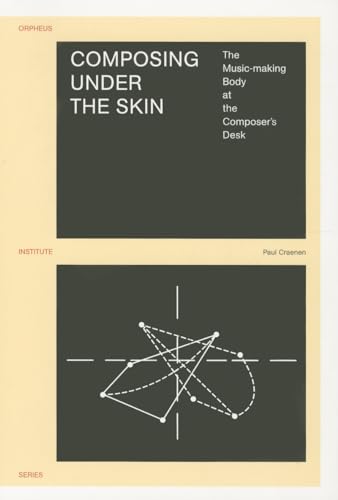
Fingers slipping over guitar strings, the tap of a bow against the body of a cello, a pianist humming along to the music : contemporary composers often work with parasitic, non-conventional sounds such as these. Are they to be perceived as musical elements or do they shift attention to the physical effort of music-making, contact between a body and an instrument ? Composer Paul Craenen explores ways in which the musician's body is revealed in musical performance. He leads us from Cage, Lachenmann, Kagel and their contemporaries to a discussion of how today's generation of young composers is writing a body paradigm into composition itself. Micro-temporal physical gestures and instrumental timbre provide the key to unveiling the physical presence of both a musician and a "composing body". The author's concept of "intercorporeality", along with the idea of an alternating linear and non-linear relationship of the composing body to time, casts new light on the relationship between musicians, composers, and music consumers.
Les informations fournies dans la section « Synopsis » peuvent faire référence à une autre édition de ce titre.
À propos de l'auteur
Paul Craenen is director of Musica, Impulse Centre for Music.
À propos de la quatrième de couverture
A revealing study of the physical presence of the musician in musical performance. Fingers slipping over guitar strings, the tap of a bow against the body of a cello, a pianist humming along to the music: contemporary composers often work with parasitic, non-conventional sounds such as these. Are they to be perceived as musical elements or do they shift attention to the physical effort of music-making, contact between a body and an instrument? Composer Paul Craenen explores ways in which the musician’s body is revealed in musical performance. He leads us from Cage, Lachenmann, Kagel and their contemporaries to a discussion of how today's generation of young composers is writing a body paradigm into composition itself. Micro-temporal physical gestures and instrumental timbre provide the key to unveiling the physical presence of both a musician and a ‘composing body’. The author's concept of ‘intercorporeality’, along with the idea of an alternating linear and non-linear relationship of the composing body to time, casts new light on the relationship between musicians, composers, and music consumers.
Les informations fournies dans la section « A propos du livre » peuvent faire référence à une autre édition de ce titre.
Résultats de recherche pour Composing under the skin : The Music-making Body at...

Image d'archives
Composing under the Skin: The Music-making Body at the Composer's Desk (Orpheus Institute Series)
Edité par
Leuven University Press, 2014
ISBN 10 : 9058679748
ISBN 13 : 9789058679741
Ancien ou d'occasion
Paperback
Vendeur : Midtown Scholar Bookstore, Harrisburg, PA, Etats-Unis
Évaluation du vendeur 5 sur 5 étoiles

Paperback. Etat : Good. Stamped non-returnable. Good - Bumped and creased book with tears to the extremities, but not affecting the text block, may have remainder mark or previous owner's name - GOOD Standard-sized. N° de réf. du vendeur M9058679748Z3
Acheter D'occasion
EUR 38,47
Expédition à EUR 5,13
Expédition nationale : Etats-Unis
Expédition nationale : Etats-Unis
Quantité disponible : 2 disponible(s)
Image fournie par le vendeur
Composing under the Skin: The Music-making Body at the Composer's Desk.
Edité par
Leuven University Press, 2014
ISBN 10 : 9058679748
ISBN 13 : 9789058679741
Ancien ou d'occasion
Couverture souple
Vendeur : Antiquariat An der Vikarie, Grafschaft-Leimersdorf, Allemagne
Évaluation du vendeur 5 sur 5 étoiles
284 pp., very good and clean, text in English, Sprache: Englisch Gewicht in Gramm: 1100 original softcover (no dust jacket), N° de réf. du vendeur 12199
Acheter D'occasion
EUR 42,30
Expédition à EUR 60
Expédition depuis Allemagne vers Etats-Unis
Expédition depuis Allemagne vers Etats-Unis
Quantité disponible : 1 disponible(s)