
Articles liés à What does it mean to be human in the aftermath of historical...
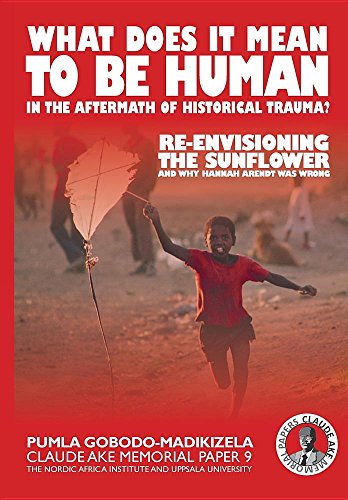
What does it mean to be human in the aftermath of historical trauma?: Re-envisioning The Sunflower and why Hannah Arendt was wrong - Couverture souple
Synopsis
What does it mean to be human in the aftermath of mass trauma and violence? When victims and perpetrators of gross human rights violations live in the same country, and sometimes as neighbours, what strategies can help individuals and communities deal with trauma in a way that restores dignity to victims and enables perpetrators to be accountable for their crimes? This essay explores these questions. Examples that illustrate attempts to create sites for listening, for moral reflection and for initiating the difficult process of dialogue at community and individual levels after mass trauma and violence are discussed. It is argued that in the aftermath of historical trauma, restoring human bonds requires a new vocabulary of re-humanization. This new mode of being human calls for a "reparative humanism" that opens towards a horizon of an ethics of care for the sake of a transformed society.
Examples drawn from two sources are discussed to explore the idea of an "ethics of care." First, insights from the Truth and Reconciliation Commission (TRC) of South Africa are discussed to show how the work of the TRC enabled dialogic spaces in which new subjectivities emerged in the encounter between victims/survivors and perpetrators. Second, the essay engages in a reinterpretation of Simon Wiesenthal's book The Sunflower as a story that continues to pose a challenge about how to reclaim a sense of being human in the aftermath of unspeakable crimes against humanity. The essay concludes with a critical reflection on Emmanuel Levinas' ethics of responsibility as an important vision in societies dealing with a violent and traumatic past.
Les informations fournies dans la section « Synopsis » peuvent faire référence à une autre édition de ce titre.
Résultats de recherche pour What does it mean to be human in the aftermath of historical...

Image fournie par le vendeur
What Does It Mean to Be Human in the Aftermath of Historical Trauma? : Re-envisioning the Sunflower and Why Hannah Arendt Was Wrong
Edité par
Nordic Africa Institute, 2016
ISBN 10 : 9171067884
ISBN 13 : 9789171067883
Ancien ou d'occasion
Couverture souple
Vendeur : GreatBookPrices, Columbia, MD, Etats-Unis
Évaluation du vendeur 5 sur 5 étoiles

Etat : As New. Unread book in perfect condition. N° de réf. du vendeur 28166301
Acheter D'occasion
EUR 9,03
Expédition à EUR 2,35
Expédition nationale : Etats-Unis
Expédition nationale : Etats-Unis
Quantité disponible : Plus de 20 disponibles
Image fournie par le vendeur
What Does It Mean to Be Human in the Aftermath of Historical Trauma? : Re-envisioning the Sunflower and Why Hannah Arendt Was Wrong
Edité par
Nordic Africa Institute, 2016
ISBN 10 : 9171067884
ISBN 13 : 9789171067883
Neuf
Couverture souple
Vendeur : GreatBookPrices, Columbia, MD, Etats-Unis
Évaluation du vendeur 5 sur 5 étoiles
Etat : New. N° de réf. du vendeur 28166301-n
Acheter neuf
EUR 9,18
Expédition à EUR 2,35
Expédition nationale : Etats-Unis
Expédition nationale : Etats-Unis
Quantité disponible : Plus de 20 disponibles
Image fournie par le vendeur
What Does It Mean to Be Human in the Aftermath of Historical Trauma?: Re-Envisioning the Sunflower and Why Hannah Arendt Was Wrong (Paperback or Softback)
Edité par
Nordic Africa Institute 10/21/2016, 2016
ISBN 10 : 9171067884
ISBN 13 : 9789171067883
Neuf
Paperback or Softback
Vendeur : BargainBookStores, Grand Rapids, MI, Etats-Unis
Évaluation du vendeur 5 sur 5 étoiles
Paperback or Softback. Etat : New. What Does It Mean to Be Human in the Aftermath of Historical Trauma?: Re-Envisioning the Sunflower and Why Hannah Arendt Was Wrong. Book. N° de réf. du vendeur BBS-9789171067883
Acheter neuf
EUR 11,61
Livraison gratuite
Expédition nationale : Etats-Unis
Expédition nationale : Etats-Unis
Quantité disponible : 5 disponible(s)
Image fournie par le vendeur
What does it mean to be human in the aftermath of historical trauma?
Vendeur : Rarewaves.com USA, London, LONDO, Royaume-Uni
Évaluation du vendeur 5 sur 5 étoiles
Paperback. Etat : New. N° de réf. du vendeur LU-9789171067883
Acheter neuf
EUR 12,11
Livraison gratuite
Expédition depuis Royaume-Uni vers Etats-Unis
Expédition depuis Royaume-Uni vers Etats-Unis
Quantité disponible : Plus de 20 disponibles
Image d'archives
What does it mean to be human in the aftermath of historical trauma?
impression à la demandeVendeur : PBShop.store US, Wood Dale, IL, Etats-Unis
Évaluation du vendeur 5 sur 5 étoiles
PAP. Etat : New. New Book. Shipped from UK. THIS BOOK IS PRINTED ON DEMAND. Established seller since 2000. N° de réf. du vendeur L0-9789171067883
Acheter neuf
EUR 12,93
Livraison gratuite
Expédition nationale : Etats-Unis
Expédition nationale : Etats-Unis
Quantité disponible : Plus de 20 disponibles
Image d'archives
What does it mean to be human in the aftermath of historical trauma?: Re-envisioning The Sunflower and why Hannah Arendt was wrong
Edité par
The Nordic Africa Institute 2016-10, 2016
ISBN 10 : 9171067884
ISBN 13 : 9789171067883
Neuf
PF
Vendeur : Chiron Media, Wallingford, Royaume-Uni
Évaluation du vendeur 5 sur 5 étoiles
PF. Etat : New. This item is printed on demand. Brand new book, sourced directly from publisher. Dispatch time is 6-7 days from our warehouse. Book will be sent in robust, secure packaging to ensure it reaches you securely. N° de réf. du vendeur 6666-IUK-9789171067883
Acheter neuf
EUR 8,35
Expédition à EUR 5,39
Expédition depuis Royaume-Uni vers Etats-Unis
Expédition depuis Royaume-Uni vers Etats-Unis
Quantité disponible : 20 disponible(s)
Image d'archives
What does it mean to be human in the aftermath of historical trauma?: Re-envisioning The Sunflower and why Hannah Arendt was wrong (Claude Ake Memorial Papers)
Edité par
Nordic Africa Institute, 2016
ISBN 10 : 9171067884
ISBN 13 : 9789171067883
Neuf
Couverture souple
Vendeur : California Books, Miami, FL, Etats-Unis
Évaluation du vendeur 5 sur 5 étoiles
Etat : New. N° de réf. du vendeur I-9789171067883
Acheter neuf
EUR 13,75
Expédition à EUR 2,67
Expédition nationale : Etats-Unis
Expédition nationale : Etats-Unis
Quantité disponible : Plus de 20 disponibles
Image d'archives
What does it mean to be human in the aftermath of historical trauma?
impression à la demandeVendeur : PBShop.store UK, Fairford, GLOS, Royaume-Uni
Évaluation du vendeur 5 sur 5 étoiles
PAP. Etat : New. New Book. Delivered from our UK warehouse in 4 to 14 business days. THIS BOOK IS PRINTED ON DEMAND. Established seller since 2000. N° de réf. du vendeur L0-9789171067883
Acheter neuf
EUR 12,73
Expédition à EUR 3,95
Expédition depuis Royaume-Uni vers Etats-Unis
Expédition depuis Royaume-Uni vers Etats-Unis
Quantité disponible : Plus de 20 disponibles
Image fournie par le vendeur
What Does It Mean to Be Human in the Aftermath of Historical Trauma? : Re-envisioning the Sunflower and Why Hannah Arendt Was Wrong
Edité par
Nordic Africa Institute, 2016
ISBN 10 : 9171067884
ISBN 13 : 9789171067883
Neuf
Couverture souple
Vendeur : GreatBookPricesUK, Woodford Green, Royaume-Uni
Évaluation du vendeur 5 sur 5 étoiles
Etat : New. N° de réf. du vendeur 28166301-n
Acheter neuf
EUR 11,42
Expédition à EUR 17,99
Expédition depuis Royaume-Uni vers Etats-Unis
Expédition depuis Royaume-Uni vers Etats-Unis
Quantité disponible : Plus de 20 disponibles
Image fournie par le vendeur
What Does It Mean to Be Human in the Aftermath of Historical Trauma? : Re-envisioning the Sunflower and Why Hannah Arendt Was Wrong
Edité par
Nordic Africa Institute, 2016
ISBN 10 : 9171067884
ISBN 13 : 9789171067883
Ancien ou d'occasion
Couverture souple
Vendeur : GreatBookPricesUK, Woodford Green, Royaume-Uni
Évaluation du vendeur 5 sur 5 étoiles
Etat : As New. Unread book in perfect condition. N° de réf. du vendeur 28166301
Acheter D'occasion
EUR 13,48
Expédition à EUR 17,99
Expédition depuis Royaume-Uni vers Etats-Unis
Expédition depuis Royaume-Uni vers Etats-Unis
Quantité disponible : Plus de 20 disponibles