
Articles liés à Competence Development and Assessment in Tvet Comet:...
Competence Development and Assessment in Tvet Comet: Theoretical Framework and Empirical Results - Couverture rigide
Livre 16 sur 36: Technical and Vocational Education and Training: Issues, Concerns and Prospects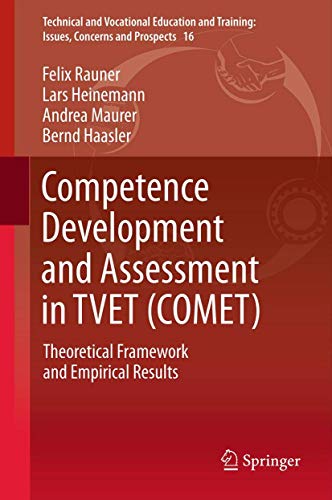
Synopsis
The transferability of vocational education and training qualifications across international borders is a live issue in this heterogeneous field. Key to this goal is defining a common methodology for measuring vocational competences. This publication sets out a proposal for just that, based on the results of a pilot project known as ‘COMET’ on competence diagnostics in the field of electrical engineering. The study deploys longitudinal analysis to explore issues of competence development, the development of vocational identity, and occupational commitment. It focuses on two discrete occupational profiles in electrical engineering in an ambitious test of a model currently applied to other professions as well.
The model’s success in its first phase is detailed in the second part of the volume, where the authors show that the transfer of the competence framework into an empirical model was successful. They also demonstrate that the methodology can be applied to designing and evaluating vocational education and training processes, making the material relevant to VET teachers and trainers as well as academics. With its first section comprising a full description of the theoretical framework, this book is a significant step forward in an urgent task facing administrations, labor forces and employers around the world. The achievement is in proportion to the notorious complexities of a field whose diversity makes tough demands on large-scale methods of assessment.
Les informations fournies dans la section « Synopsis » peuvent faire référence à une autre édition de ce titre.
À propos de l'auteur
Prof. Dr.phil Dr. h.c. Felix Rauner ist Gründer des Instituts Technik und Bildung (itb) an der Universität Bremen sowie Gründer der dortigen Forschungsgruppe Berufsbildungsforschung I:BB. Er ist nunmehr Lehrbeauftragter und leitender Forscher für Kompetenzmessung mittels COMET am Lehrstuhl für Technikdidaktik am Berufskolleg (TVD) der Universität Siegen. Univ.-Prof. Dr.phil. Ralph Dreher war Berufsschullehrer für Fahrzeugtechnik und wissenschaftlicher Mitarbeiter am Institut Technik und Bildung (itb) der Universität Bremen. Er hat das Lehrgebiet Technikdidaktik am Berufskolleg (TVD) an der Universität Siegen gegründet und ist dort Lehrstuhlinhaber. Sein Forschungsbereich ist die gestaltungsorientierte berufliche Bildung sowie die Evaluation beruflicher Bildungsprozesse mittels des Kompetenzmessverfahrens COMET. Dr. Jürgen Lehberger war Gastwissenschaftler der Forschungsgruppe Berufsbildungsforschung (I:BB) der Universität Bremen und ist Lehrbeauftragter am Lehrstuhl für Technikdidaktik am Berufskolleg (TVD) der Universität Siegen. Als Forscher entwickelt und betreut er das Ratertraining für das Kompetenzmessverfahren COMET.
À propos de la quatrième de couverture
The transferability of vocational education and training qualifications across international borders is a live issue in this heterogeneous field. Key to this goal is defining a common methodology for measuring vocational competences. This publication sets out a proposal for just that, based on the results of a pilot project known as COMET on competence diagnostics in the field of electrical engineering. The study deploys longitudinal analysis to explore issues of competence development, the development of vocational identity, and occupational commitment. It focuses on two discrete occupational profiles in electrical engineering in an ambitious test of a model currently applied to other professions as well.
The model s success in its first phase is detailed in the second part of the volume, where the authors show that the transfer of the competence framework into an empirical model was successful. They also demonstrate that the methodology can be applied to designing and evaluating vocational education and training processes, making the material relevant to VET teachers and trainers as well as academics. With its first section comprising a full description of the theoretical framework, this book is a significant step forward in an urgent task facing administrations, labor forces and employers around the world. The achievement is in proportion to the notorious complexities of a field whose diversity makes tough demands on large-scale methods of assessment.
Les informations fournies dans la section « A propos du livre » peuvent faire référence à une autre édition de ce titre.
Résultats de recherche pour Competence Development and Assessment in Tvet Comet:...

Image d'archives
Competence Development and Assessment in TVET (COMET) (eng)
impression à la demandeVendeur : Brook Bookstore On Demand, Napoli, NA, Italie
Évaluation du vendeur 5 sur 5 étoiles

Etat : new. Questo è un articolo print on demand. N° de réf. du vendeur 8DTR6KROJE
Acheter neuf
EUR 86,24
Expédition à EUR 5,50
Expédition depuis Italie vers Etats-Unis
Expédition depuis Italie vers Etats-Unis
Quantité disponible : Plus de 20 disponibles
Image fournie par le vendeur
Competence Development and Assessment in TVET (COMET)
Edité par
Springer Netherlands Jul 2012, 2012
ISBN 10 : 9400747241
ISBN 13 : 9789400747241
Neuf
Couverture rigide
Vendeur : BuchWeltWeit Ludwig Meier e.K., Bergisch Gladbach, Allemagne
Évaluation du vendeur 5 sur 5 étoiles
Buch. Etat : Neu. This item is printed on demand - it takes 3-4 days longer - Neuware -The transferability of vocational education and training qualifications across international borders is a live issue in this heterogeneous field. Key to this goal is defining a common methodology for measuring vocational competences. This publication sets out a proposal for just that, based on the results of a pilot project known as 'COMET' on competence diagnostics in the field of electrical engineering. The study deploys longitudinal analysis to explore issues of competence development, the development of vocational identity, and occupational commitment. It focuses on two discrete occupational profiles in electrical engineering in an ambitious test of a model currently applied to other professions as well. The model's success in its first phase is detailed in the second part of the volume, where the authors show that the transfer of the competence framework into an empirical model was successful. They also demonstrate that the methodology can be applied to designing and evaluating vocational education and training processes, making the material relevant to VET teachers and trainers as well as academics. With its first section comprising a full description of the theoretical framework, this book is a significant step forward in an urgent task facing administrations, labor forces and employers around the world. The achievement is in proportion to the notorious complexities of a field whose diversity makes tough demands on large-scale methods of assessment. 188 pp. Englisch. N° de réf. du vendeur 9789400747241
Acheter neuf
EUR 106,99
Expédition à EUR 23
Expédition depuis Allemagne vers Etats-Unis
Expédition depuis Allemagne vers Etats-Unis
Quantité disponible : 2 disponible(s)
Image fournie par le vendeur
Competence Development and Assessment in TVET (COMET)
Edité par
Springer Netherlands, 2012
ISBN 10 : 9400747241
ISBN 13 : 9789400747241
Neuf
Couverture rigide
Vendeur : moluna, Greven, Allemagne
Évaluation du vendeur 5 sur 5 étoiles
Gebunden. Etat : New. Dieser Artikel ist ein Print on Demand Artikel und wird nach Ihrer Bestellung fuer Sie gedruckt. Presents and ambitious case-study to test a methodology for competence assessment in vocational education and trainingAllows to measure not only professional competence, but also the development of professional identityCOMET toolbox can also be u. N° de réf. du vendeur 5827137
Acheter neuf
EUR 92,27
Expédition à EUR 48,99
Expédition depuis Allemagne vers Etats-Unis
Expédition depuis Allemagne vers Etats-Unis
Quantité disponible : Plus de 20 disponibles
Image fournie par le vendeur
Competence Development and Assessment in TVET (COMET) : Theoretical Framework and Empirical Results
Vendeur : AHA-BUCH GmbH, Einbeck, Allemagne
Évaluation du vendeur 5 sur 5 étoiles
Buch. Etat : Neu. Druck auf Anfrage Neuware - Printed after ordering - The transferability of vocational education and training qualifications across international borders is a live issue in this heterogeneous field. Key to this goal is defining a common methodology for measuring vocational competences. This publication sets out a proposal for just that, based on the results of a pilot project known as 'COMET' on competence diagnostics in the field of electrical engineering. The study deploys longitudinal analysis to explore issues of competence development, the development of vocational identity, and occupational commitment. It focuses on two discrete occupational profiles in electrical engineering in an ambitious test of a model currently applied to other professions as well. The model's success in its first phase is detailed in the second part of the volume, where the authors show that the transfer of the competence framework into an empirical model was successful. They also demonstrate that the methodology can be applied to designing and evaluating vocational education and training processes, making the material relevant to VET teachers and trainers as well as academics. With its first section comprising a full description of the theoretical framework, this book is a significant step forward in an urgent task facing administrations, labor forces and employers around the world. The achievement is in proportion to the notorious complexities of a field whose diversity makes tough demands on large-scale methods of assessment. N° de réf. du vendeur 9789400747241
Acheter neuf
EUR 124,85
Expédition à EUR 35
Expédition depuis Allemagne vers Etats-Unis
Expédition depuis Allemagne vers Etats-Unis
Quantité disponible : 1 disponible(s)
Image d'archives
Competence Development and Assessment in Tvet (Comet)
Vendeur : Books Puddle, Woodside, NY, Etats-Unis
Évaluation du vendeur 4 sur 5 étoiles

Etat : New. pp. 188. N° de réf. du vendeur 2651416608
Acheter neuf
EUR 159,05
Expédition à EUR 3,57
Expédition nationale : Etats-Unis
Expédition nationale : Etats-Unis
Quantité disponible : 4 disponible(s)
Image fournie par le vendeur
Competence Development and Assessment in TVET (COMET)
Edité par
Springer, Springer Jul 2012, 2012
ISBN 10 : 9400747241
ISBN 13 : 9789400747241
Neuf
Couverture rigide
Vendeur : buchversandmimpf2000, Emtmannsberg, BAYE, Allemagne
Évaluation du vendeur 5 sur 5 étoiles
Buch. Etat : Neu. This item is printed on demand - Print on Demand Titel. Neuware -The transferability of vocational education and training qualifications across international borders is a live issue in this heterogeneous field. Key to this goal is defining a common methodology for measuring vocational competences. This publication sets out a proposal for just that, based on the results of a pilot project known as ¿COMET¿ on competence diagnostics in the field of electrical engineering. The study deploys longitudinal analysis to explore issues of competence development, the development of vocational identity, and occupational commitment. It focuses on two discrete occupational profiles in electrical engineering in an ambitious test of a model currently applied to other professions as well.The model¿s success in its first phase is detailed in the second part of the volume, where the authors show that the transfer of the competence framework into an empirical model was successful. They also demonstrate that the methodology can be applied to designing and evaluating vocational education and training processes, making the material relevant to VET teachers and trainers as well as academics. With its first section comprising a full description of the theoretical framework, this book is a significant step forward in an urgent task facing administrations, labor forces and employers around the world. The achievement is in proportion to the notorious complexities of a field whose diversity makes tough demands on large-scale methods of assessment.Springer-Verlag KG, Sachsenplatz 4-6, 1201 Wien 188 pp. Englisch. N° de réf. du vendeur 9789400747241
Acheter neuf
EUR 106,99
Expédition à EUR 60
Expédition depuis Allemagne vers Etats-Unis
Expédition depuis Allemagne vers Etats-Unis
Quantité disponible : 1 disponible(s)
Image d'archives
Competence Development and Assessment in Tvet (Comet)
impression à la demandeVendeur : Majestic Books, Hounslow, Royaume-Uni
Évaluation du vendeur 4 sur 5 étoiles
Etat : New. Print on Demand pp. 188. N° de réf. du vendeur 57094655
Acheter neuf
EUR 166,40
Expédition à EUR 7,79
Expédition depuis Royaume-Uni vers Etats-Unis
Expédition depuis Royaume-Uni vers Etats-Unis
Quantité disponible : 4 disponible(s)
Image d'archives
Competence Development and Assessment in Tvet (Comet)
impression à la demandeVendeur : Biblios, Frankfurt am main, HESSE, Allemagne
Évaluation du vendeur 4 sur 5 étoiles
Etat : New. PRINT ON DEMAND pp. 188. N° de réf. du vendeur 1851416618
Acheter neuf
EUR 166,72
Expédition à EUR 9,95
Expédition depuis Allemagne vers Etats-Unis
Expédition depuis Allemagne vers Etats-Unis
Quantité disponible : 4 disponible(s)
Image d'archives
Competence Development and Assessment in TVET (COMET) : Theoretical Framework and Empirical Results
Edité par
Springer Netherlands, 2012
ISBN 10 : 9400747241
ISBN 13 : 9789400747241
Ancien ou d'occasion
Couverture rigide
Vendeur : Buchpark, Trebbin, Allemagne
Évaluation du vendeur 5 sur 5 étoiles
Etat : Sehr gut. Zustand: Sehr gut | Sprache: Englisch | Produktart: Bücher | The transferability of vocational education and training qualifications across international borders is a live issue in this heterogeneous field. Key to this goal is defining a common methodology for measuring vocational competences. This publication sets out a proposal for just that, based on the results of a pilot project known as ¿COMET¿ on competence diagnostics in the field of electrical engineering. The study deploys longitudinal analysis to explore issues of competence development, the development of vocational identity, and occupational commitment. It focuses on two discrete occupational profiles in electrical engineering in an ambitious test of a model currently applied to other professions as well. The model¿s success in its first phase is detailed in the second part of the volume, where the authors show that the transfer of the competence framework into an empirical model was successful. They also demonstrate that the methodology can be applied to designing and evaluating vocational education and training processes, making the material relevant to VET teachers and trainers as well as academics. With its first section comprising a full description of the theoretical framework, this book is a significant step forward in an urgent task facing administrations, labor forces and employers around the world. The achievement is in proportion to the notorious complexities of a field whose diversity makes tough demands on large-scale methods of assessment. N° de réf. du vendeur 12309279/12
Acheter D'occasion
EUR 80,25
Expédition à EUR 105
Expédition depuis Allemagne vers Etats-Unis
Expédition depuis Allemagne vers Etats-Unis
Quantité disponible : 1 disponible(s)
Image d'archives
Competence Development and Assessment in TVET (COMET): Theoretical Framework and Empirical Results (Technical and Vocational Education and Training: Issues, Concerns and Prospects, 16)
Edité par
Springer, 2012
ISBN 10 : 9400747241
ISBN 13 : 9789400747241
Ancien ou d'occasion
Couverture rigide
Vendeur : Mispah books, Redhill, SURRE, Royaume-Uni
Évaluation du vendeur 4 sur 5 étoiles
Hardcover. Etat : Like New. LIKE NEW. SHIPS FROM MULTIPLE LOCATIONS. book. N° de réf. du vendeur ERICA77394007472416
Acheter D'occasion
EUR 234,47
Expédition à EUR 29,95
Expédition depuis Royaume-Uni vers Etats-Unis
Expédition depuis Royaume-Uni vers Etats-Unis
Quantité disponible : 1 disponible(s)