
Articles liés à Plant Physiological Ecology: Field methods and instrumentati...
Synopsis
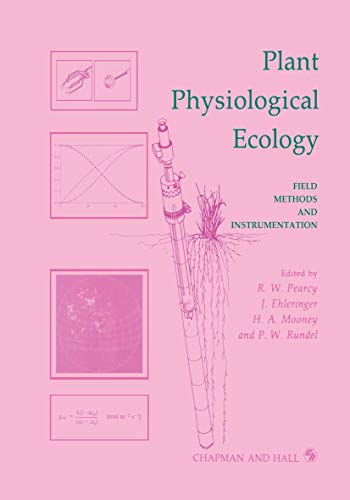
Physiological plant ecology is primarily concerned with the function and performance of plants in their environment. Within this broad focus, attempts are made on one hand to understand the underlying physiological, biochemical and molecular attributes of plants with respect to performance under the constraints imposed by the environment. On the other hand physiological ecology is also concerned with a more synthetic view which attempts to under- stand the distribution and success of plants measured in terms of the factors that promote long-term survival and reproduction in the environment. These concerns are not mutually exclusive but rather represent a continuum of research approaches. Osmond et al. (1980) have elegantly pointed this out in a space-time scale showing that the concerns of physiological ecology range from biochemical and organelle-scale events with time constants of a second or minutes to succession and evolutionary-scale events involving communities and ecosystems and thousands, if not millions, of years. The focus of physiological ecology is typically at the single leaf or root system level extending up to the whole plant. The time scale is on the order of minutes to a year. The activities of individual physiological ecologists extend in one direction or the other, but few if any are directly concerned with the whole space-time scale. In their work, however, they must be cognizant both of the underlying mechanisms as well as the consequences to ecological and evolutionary processes.
Les informations fournies dans la section « Synopsis » peuvent faire référence à une autre édition de ce titre.
Présentation de l'éditeur
Providing the researcher with the methodology appropriate to field experiments and useful analytical techniques this book includes measurements both of the environment itself and of the physiological and morphological responses of plants to it. In some cases, for example stable isotope measurements, investigations are performed in the laboratory on samples collected under field conditions, while other chapters cover analytical techniques for use in the field. Many techniques reviewed are based on the central theme of the acquisition of resources such as carbon, light, water and nutrients, and the use of these resources for plant growth. Methods for estimating some of the costs of allocation of these resources to particular functions are also covered. A methodological framework is provided for extending from organ level measurements to whole plants on root system and canopy structure, and to ecosystem level processes.
Les informations fournies dans la section « A propos du livre » peuvent faire référence à une autre édition de ce titre.
Résultats de recherche pour Plant Physiological Ecology: Field methods and instrumentati...

Image d'archives
Plant Physiological Ecology (eng)
impression à la demandeVendeur : Brook Bookstore On Demand, Napoli, NA, Italie
Évaluation du vendeur 5 sur 5 étoiles

Etat : new. Questo è un articolo print on demand. N° de réf. du vendeur IV12MKIDVM
Acheter neuf
EUR 166,29
Expédition à EUR 8
Expédition depuis Italie vers Etats-Unis
Expédition depuis Italie vers Etats-Unis
Quantité disponible : Plus de 20 disponibles
Image fournie par le vendeur
Plant Physiological Ecology
Edité par
Springer Netherlands, 2011
ISBN 10 : 9401074968
ISBN 13 : 9789401074964
Neuf
Couverture souple
Vendeur : moluna, Greven, Allemagne
Évaluation du vendeur 5 sur 5 étoiles
Etat : New. Dieser Artikel ist ein Print on Demand Artikel und wird nach Ihrer Bestellung fuer Sie gedruckt. Physiological plant ecology is primarily concerned with the function and performance of plants in their environment. Within this broad focus, attempts are made on one hand to understand the underlying physiological, biochemical and molecular attributes of p. N° de réf. du vendeur 5834095
Acheter neuf
EUR 180,07
Expédition à EUR 48,99
Expédition depuis Allemagne vers Etats-Unis
Expédition depuis Allemagne vers Etats-Unis
Quantité disponible : Plus de 20 disponibles
Image fournie par le vendeur
Plant Physiological Ecology : Field Methods and Instrumentation
Vendeur : GreatBookPrices, Columbia, MD, Etats-Unis
Évaluation du vendeur 5 sur 5 étoiles
Etat : New. N° de réf. du vendeur 20193155-n
Acheter neuf
EUR 239,06
Expédition à EUR 2,36
Expédition nationale : Etats-Unis
Expédition nationale : Etats-Unis
Quantité disponible : 15 disponible(s)
Image d'archives
Plant Physiological Ecology: Field methods and instrumentation
Vendeur : Ria Christie Collections, Uxbridge, Royaume-Uni
Évaluation du vendeur 5 sur 5 étoiles
Etat : New. In English. N° de réf. du vendeur ria9789401074964_new
Acheter neuf
EUR 253,33
Expédition à EUR 13,34
Expédition depuis Royaume-Uni vers Etats-Unis
Expédition depuis Royaume-Uni vers Etats-Unis
Quantité disponible : Plus de 20 disponibles
Image fournie par le vendeur
Plant Physiological Ecology
Edité par
Springer Netherlands Sep 2011, 2011
ISBN 10 : 9401074968
ISBN 13 : 9789401074964
Neuf
Taschenbuch
Vendeur : BuchWeltWeit Ludwig Meier e.K., Bergisch Gladbach, Allemagne
Évaluation du vendeur 5 sur 5 étoiles
Taschenbuch. Etat : Neu. This item is printed on demand - it takes 3-4 days longer - Neuware -Physiological plant ecology is primarily concerned with the function and performance of plants in their environment. Within this broad focus, attempts are made on one hand to understand the underlying physiological, biochemical and molecular attributes of plants with respect to performance under the constraints imposed by the environment. On the other hand physiological ecology is also concerned with a more synthetic view which attempts to under stand the distribution and success of plants measured in terms of the factors that promote long-term survival and reproduction in the environment. These concerns are not mutually exclusive but rather represent a continuum of research approaches. Osmond et al. (1980) have elegantly pointed this out in a space-time scale showing that the concerns of physiological ecology range from biochemical and organelle-scale events with time constants of a second or minutes to succession and evolutionary-scale events involving communities and ecosystems and thousands, if not millions, of years. The focus of physiological ecology is typically at the single leaf or root system level extending up to the whole plant. The time scale is on the order of minutes to a year. The activities of individual physiological ecologists extend in one direction or the other, but few if any are directly concerned with the whole space-time scale. In their work, however, they must be cognizant both of the underlying mechanisms as well as the consequences to ecological and evolutionary processes. 480 pp. Englisch. N° de réf. du vendeur 9789401074964
Acheter neuf
EUR 245,03
Expédition à EUR 23
Expédition depuis Allemagne vers Etats-Unis
Expédition depuis Allemagne vers Etats-Unis
Quantité disponible : 2 disponible(s)
Image fournie par le vendeur
Plant Physiological Ecology
Edité par
Springer, Springer Sep 2011, 2011
ISBN 10 : 9401074968
ISBN 13 : 9789401074964
Neuf
Taschenbuch
Vendeur : buchversandmimpf2000, Emtmannsberg, BAYE, Allemagne
Évaluation du vendeur 5 sur 5 étoiles
Taschenbuch. Etat : Neu. This item is printed on demand - Print on Demand Titel. Neuware -Physiological plant ecology is primarily concerned with the function and performance of plants in their environment. Within this broad focus, attempts are made on one hand to understand the underlying physiological, biochemical and molecular attributes of plants with respect to performance under the constraints imposed by the environment. On the other hand physiological ecology is also concerned with a more synthetic view which attempts to under stand the distribution and success of plants measured in terms of the factors that promote long-term survival and reproduction in the environment. These concerns are not mutually exclusive but rather represent a continuum of research approaches. Osmond et al. (1980) have elegantly pointed this out in a space-time scale showing that the concerns of physiological ecology range from biochemical and organelle-scale events with time constants of a second or minutes to succession and evolutionary-scale events involving communities and ecosystems and thousands, if not millions, of years. The focus of physiological ecology is typically at the single leaf or root system level extending up to the whole plant. The time scale is on the order of minutes to a year. The activities of individual physiological ecologists extend in one direction or the other, but few if any are directly concerned with the whole space-time scale. In their work, however, they must be cognizant both of the underlying mechanisms as well as the consequences to ecological and evolutionary processes.Springer-Verlag KG, Sachsenplatz 4-6, 1201 Wien 480 pp. Englisch. N° de réf. du vendeur 9789401074964
Acheter neuf
EUR 213,99
Expédition à EUR 60
Expédition depuis Allemagne vers Etats-Unis
Expédition depuis Allemagne vers Etats-Unis
Quantité disponible : 1 disponible(s)
Image fournie par le vendeur
Plant Physiological Ecology : Field methods and instrumentation
Vendeur : AHA-BUCH GmbH, Einbeck, Allemagne
Évaluation du vendeur 5 sur 5 étoiles
Taschenbuch. Etat : Neu. Druck auf Anfrage Neuware - Printed after ordering - Physiological plant ecology is primarily concerned with the function and performance of plants in their environment. Within this broad focus, attempts are made on one hand to understand the underlying physiological, biochemical and molecular attributes of plants with respect to performance under the constraints imposed by the environment. On the other hand physiological ecology is also concerned with a more synthetic view which attempts to under stand the distribution and success of plants measured in terms of the factors that promote long-term survival and reproduction in the environment. These concerns are not mutually exclusive but rather represent a continuum of research approaches. Osmond et al. (1980) have elegantly pointed this out in a space-time scale showing that the concerns of physiological ecology range from biochemical and organelle-scale events with time constants of a second or minutes to succession and evolutionary-scale events involving communities and ecosystems and thousands, if not millions, of years. The focus of physiological ecology is typically at the single leaf or root system level extending up to the whole plant. The time scale is on the order of minutes to a year. The activities of individual physiological ecologists extend in one direction or the other, but few if any are directly concerned with the whole space-time scale. In their work, however, they must be cognizant both of the underlying mechanisms as well as the consequences to ecological and evolutionary processes. N° de réf. du vendeur 9789401074964
Acheter neuf
EUR 239,84
Expédition à EUR 35
Expédition depuis Allemagne vers Etats-Unis
Expédition depuis Allemagne vers Etats-Unis
Quantité disponible : 1 disponible(s)
Image d'archives
Plant Physiological Ecology
Vendeur : Books Puddle, Woodside, NY, Etats-Unis
Évaluation du vendeur 4 sur 5 étoiles

Etat : New. pp. 480. N° de réf. du vendeur 26128224170
Acheter neuf
EUR 308,70
Expédition à EUR 3,56
Expédition nationale : Etats-Unis
Expédition nationale : Etats-Unis
Quantité disponible : 4 disponible(s)
Image d'archives
Plant Physiological Ecology
impression à la demandeVendeur : Majestic Books, Hounslow, Royaume-Uni
Évaluation du vendeur 4 sur 5 étoiles
Etat : New. Print on Demand pp. 480 66:B&W 7 x 10 in or 254 x 178 mm Perfect Bound on White w/Gloss Lam. N° de réf. du vendeur 131282037
Acheter neuf
EUR 328,63
Expédition à EUR 7,68
Expédition depuis Royaume-Uni vers Etats-Unis
Expédition depuis Royaume-Uni vers Etats-Unis
Quantité disponible : 4 disponible(s)
Image d'archives
Plant Physiological Ecology
impression à la demandeVendeur : Biblios, Frankfurt am main, HESSE, Allemagne
Évaluation du vendeur 4 sur 5 étoiles
Etat : New. PRINT ON DEMAND pp. 480. N° de réf. du vendeur 18128224160
Acheter neuf
EUR 327,05
Expédition à EUR 9,95
Expédition depuis Allemagne vers Etats-Unis
Expédition depuis Allemagne vers Etats-Unis
Quantité disponible : 4 disponible(s)