
Articles liés à Pulsation and Mass Loss in Stars: Proceedings of a...
Pulsation and Mass Loss in Stars: Proceedings of a Workshop Held in Trieste, Italy, September 14–18, 1987 - Couverture souple
Synopsis
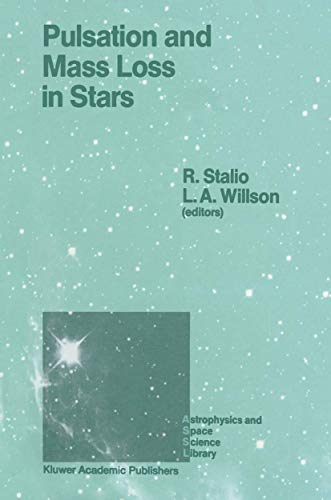
Stellar mass loss is an essential part of the cycling of material from the interstellar medium into stars and back, and must be understood if we are to model processes on galactic to cosmological scales. The study of stellar winds and the effects of stellar mass loss has reached a particularly exciting stage where observational capabilities are increasingly able to provide interesting constraints on models and theories. Recent resu1ts from theoretical and observational work for both hot and cool stars with substantial winds have led to the suggestion that a combination of pulsation with other mechanisms makes for particularly efficient mass loss from stars. This provided the original motivation for the organization of this workshop. The conference was organized along relatively conventional lines according to the types of objects being scrutinized. However the true unity of the proceedings comes from the interplay of the mechanisms involved. For example, for the cool, luminous Mira variables, pulsation leads to shock waves that extend the atmosphere, enhancing dust formation; radiation pressure on dust drives the wind, cooling the atmosphere and in some cases suppressing the shocks. Similarly for the Be stars, both pulsation (in this case, non-radial) and radiation pressure (due to UV resonance lines) are expected to be important, and this expectation is at least qualitatively borne out by the observations.
Les informations fournies dans la section « Synopsis » peuvent faire référence à une autre édition de ce titre.
Résultats de recherche pour Pulsation and Mass Loss in Stars: Proceedings of a...

Image d'archives
Pulsation and Mass Loss in Stars (eng)
impression à la demandeVendeur : Brook Bookstore On Demand, Napoli, NA, Italie
Évaluation du vendeur 5 sur 5 étoiles

Etat : new. Questo è un articolo print on demand. N° de réf. du vendeur HAT74TPKCF
Acheter neuf
EUR 126,26
Expédition à EUR 6,80
Expédition depuis Italie vers Etats-Unis
Expédition depuis Italie vers Etats-Unis
Quantité disponible : Plus de 20 disponibles
Image d'archives
Pulsation and Mass Loss in Stars: Proceedings of a Workshop Held in Trieste, Italy, September 14-18, 1987 (Astrophysics and Space Science Library, 148)
Vendeur : Ria Christie Collections, Uxbridge, Royaume-Uni
Évaluation du vendeur 5 sur 5 étoiles
Etat : New. In. N° de réf. du vendeur ria9789401078610_new
Acheter neuf
EUR 165,99
Expédition à EUR 13,20
Expédition depuis Royaume-Uni vers Etats-Unis
Expédition depuis Royaume-Uni vers Etats-Unis
Quantité disponible : Plus de 20 disponibles
Image fournie par le vendeur
Pulsation and Mass Loss in Stars
Edité par
Springer Netherlands, 2011
ISBN 10 : 9401078610
ISBN 13 : 9789401078610
Neuf
Couverture souple
Vendeur : moluna, Greven, Allemagne
Évaluation du vendeur 5 sur 5 étoiles
Etat : New. Dieser Artikel ist ein Print on Demand Artikel und wird nach Ihrer Bestellung fuer Sie gedruckt. Proceedings of a Workshop held in Trieste, Italy, September 14-18, 1987 Stellar mass loss is an essential part of the cycling of material from the interstellar medium into stars and back, and must be understood if we are to model processes on galactic . N° de réf. du vendeur 5834443
Acheter neuf
EUR 136,16
Expédition à EUR 48,99
Expédition depuis Allemagne vers Etats-Unis
Expédition depuis Allemagne vers Etats-Unis
Quantité disponible : Plus de 20 disponibles
Image fournie par le vendeur
Pulsation and Mass Loss in Stars
Edité par
Springer, Springer Okt 2011, 2011
ISBN 10 : 9401078610
ISBN 13 : 9789401078610
Neuf
Taschenbuch
Vendeur : buchversandmimpf2000, Emtmannsberg, BAYE, Allemagne
Évaluation du vendeur 5 sur 5 étoiles
Taschenbuch. Etat : Neu. This item is printed on demand - Print on Demand Titel. Neuware -Stellar mass loss is an essential part of the cycling of material from the interstellar medium into stars and back, and must be understood if we are to model processes on galactic to cosmological scales. The study of stellar winds and the effects of stellar mass loss has reached a particularly exciting stage where observational capabilities are increasingly able to provide interesting constraints on models and theories. Recent resu1ts from theoretical and observational work for both hot and cool stars with substantial winds have led to the suggestion that a combination of pulsation with other mechanisms makes for particularly efficient mass loss from stars. This provided the original motivation for the organization of this workshop. The conference was organized along relatively conventional lines according to the types of objects being scrutinized. However the true unity of the proceedings comes from the interplay of the mechanisms involved. For example, for the cool, luminous Mira variables, pulsation leads to shock waves that extend the atmosphere, enhancing dust formation; radiation pressure on dust drives the wind, cooling the atmosphere and in some cases suppressing the shocks. Similarly for the Be stars, both pulsation (in this case, non-radial) and radiation pressure (due to UV resonance lines) are expected to be important, and this expectation is at least qualitatively borne out by the observations.Springer-Verlag KG, Sachsenplatz 4-6, 1201 Wien 352 pp. Englisch. N° de réf. du vendeur 9789401078610
Acheter neuf
EUR 160,49
Expédition à EUR 60
Expédition depuis Allemagne vers Etats-Unis
Expédition depuis Allemagne vers Etats-Unis
Quantité disponible : 1 disponible(s)
Image fournie par le vendeur
Pulsation and Mass Loss in Stars
Edité par
Springer Netherlands Okt 2011, 2011
ISBN 10 : 9401078610
ISBN 13 : 9789401078610
Neuf
Taschenbuch
Vendeur : BuchWeltWeit Ludwig Meier e.K., Bergisch Gladbach, Allemagne
Évaluation du vendeur 5 sur 5 étoiles
Taschenbuch. Etat : Neu. This item is printed on demand - it takes 3-4 days longer - Neuware -Stellar mass loss is an essential part of the cycling of material from the interstellar medium into stars and back, and must be understood if we are to model processes on galactic to cosmological scales. The study of stellar winds and the effects of stellar mass loss has reached a particularly exciting stage where observational capabilities are increasingly able to provide interesting constraints on models and theories. Recent resu1ts from theoretical and observational work for both hot and cool stars with substantial winds have led to the suggestion that a combination of pulsation with other mechanisms makes for particularly efficient mass loss from stars. This provided the original motivation for the organization of this workshop. The conference was organized along relatively conventional lines according to the types of objects being scrutinized. However the true unity of the proceedings comes from the interplay of the mechanisms involved. For example, for the cool, luminous Mira variables, pulsation leads to shock waves that extend the atmosphere, enhancing dust formation; radiation pressure on dust drives the wind, cooling the atmosphere and in some cases suppressing the shocks. Similarly for the Be stars, both pulsation (in this case, non-radial) and radiation pressure (due to UV resonance lines) are expected to be important, and this expectation is at least qualitatively borne out by the observations. 352 pp. Englisch. N° de réf. du vendeur 9789401078610
Acheter neuf
EUR 213,95
Expédition à EUR 23
Expédition depuis Allemagne vers Etats-Unis
Expédition depuis Allemagne vers Etats-Unis
Quantité disponible : 2 disponible(s)
Image d'archives
Pulsation and Mass Loss in Stars: Proceedings of a Workshop Held in Trieste, Italy, September 14-18, 1987
Vendeur : Revaluation Books, Exeter, Royaume-Uni
Évaluation du vendeur 5 sur 5 étoiles
Paperback. Etat : Brand New. 352 pages. 9.25x6.10x0.80 inches. In Stock. N° de réf. du vendeur x-9401078610
Acheter neuf
EUR 234,56
Expédition à EUR 14,61
Expédition depuis Royaume-Uni vers Etats-Unis
Expédition depuis Royaume-Uni vers Etats-Unis
Quantité disponible : 2 disponible(s)
Image fournie par le vendeur
Pulsation and Mass Loss in Stars : Proceedings of a Workshop Held in Trieste, Italy, September 14-18, 1987
Vendeur : AHA-BUCH GmbH, Einbeck, Allemagne
Évaluation du vendeur 5 sur 5 étoiles
Taschenbuch. Etat : Neu. Druck auf Anfrage Neuware - Printed after ordering - Stellar mass loss is an essential part of the cycling of material from the interstellar medium into stars and back, and must be understood if we are to model processes on galactic to cosmological scales. The study of stellar winds and the effects of stellar mass loss has reached a particularly exciting stage where observational capabilities are increasingly able to provide interesting constraints on models and theories. Recent resu1ts from theoretical and observational work for both hot and cool stars with substantial winds have led to the suggestion that a combination of pulsation with other mechanisms makes for particularly efficient mass loss from stars. This provided the original motivation for the organization of this workshop. The conference was organized along relatively conventional lines according to the types of objects being scrutinized. However the true unity of the proceedings comes from the interplay of the mechanisms involved. For example, for the cool, luminous Mira variables, pulsation leads to shock waves that extend the atmosphere, enhancing dust formation; radiation pressure on dust drives the wind, cooling the atmosphere and in some cases suppressing the shocks. Similarly for the Be stars, both pulsation (in this case, non-radial) and radiation pressure (due to UV resonance lines) are expected to be important, and this expectation is at least qualitatively borne out by the observations. N° de réf. du vendeur 9789401078610
Acheter neuf
EUR 224,71
Expédition à EUR 30,50
Expédition depuis Allemagne vers Etats-Unis
Expédition depuis Allemagne vers Etats-Unis
Quantité disponible : 1 disponible(s)
Image d'archives
Pulsation and Mass Loss in Stars: Proceedings of a Workshop Held in Trieste, Italy, September 1418, 1987 (Astrophysics and Space Science Library)
Edité par
Springer, 2011
ISBN 10 : 9401078610
ISBN 13 : 9789401078610
Ancien ou d'occasion
Paperback
Vendeur : Mispah books, Redhill, SURRE, Royaume-Uni
Évaluation du vendeur 4 sur 5 étoiles

Paperback. Etat : Like New. LIKE NEW. SHIPS FROM MULTIPLE LOCATIONS. book. N° de réf. du vendeur ERICA79794010786106
Acheter D'occasion
EUR 260,10
Expédition à EUR 29,23
Expédition depuis Royaume-Uni vers Etats-Unis
Expédition depuis Royaume-Uni vers Etats-Unis
Quantité disponible : 1 disponible(s)