
Articles liés à Hypergraph Computation
Hypergraph Computation - Couverture rigide
Livre 15 sur 15: Artificial Intelligence: Foundations, Theory, and Algorithms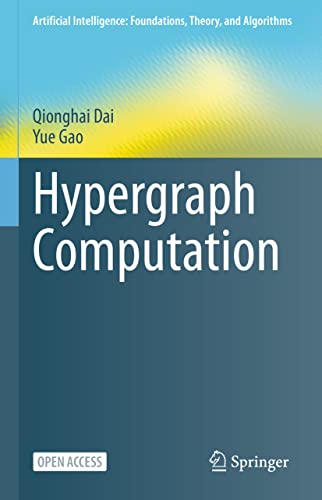
Synopsis
This open access book discusses the theory and methods of hypergraph computation.
Many underlying relationships among data can be represented using graphs, for example in the areas including computer vision, molecular chemistry, molecular biology, etc. In the last decade, methods like graph-based learning and neural network methods have been developed to process such data, they are particularly suitable for handling relational learning tasks. In many real-world problems, however, relationships among the objects of our interest are more complexthan pair-wise. Naively squeezing the complex relationships into pairwise ones will inevitably lead to loss of information which can be expected valuable for learning tasks.
Hypergraph, as a generation of graph, has shown superior performance on modelling complex correlations compared with graph. Recent years have witnessed a great popularity of researches on hypergraph-related AI methods, which have been used in computer vision, social media analysis, etc. We summarize these attempts as a new computing paradigm, called hypergraph computation, which is to formulate thehigh-order correlations underneath the data using hypergraph, and then conduct semantic computing on the hypergraph for different applications. The content of this book consists of hypergraph computation paradigms, hypergraph modelling, hypergraph structure evolution, hypergraph neural networks, and applications of hypergraph computation in different fields. We further summarize recent achievements and future directions on hypergraph computation in this book.
Les informations fournies dans la section « Synopsis » peuvent faire référence à une autre édition de ce titre.
À propos de l'auteur
Yue Gao is an Associate Professor of School of Software at Tsinghua University. His main research interests focus on Artificial Intelligence, Computer Vision and Brain Science. He has published over 200 papers in the areas of Artificial Intelligence, 3D Vision, Multimedia, and Medical Image Analysis. Prof. Gao has authored the books " View-based 3-D Object Retrieval" (2014) and " Learning-Based Local Visual Representation and Indexing" (2015). He has been an associate editor for prestigious journals such as IEEE Transactions on Signal and Information Processing over Networks, Journal of Visual Communication and Image Representation, and IEEE Signal Processing Letters. He is a Senior Member of IEEE. He was listed as the Web of Science Highly Cited Researcher and Elsevier Highly Cited Chinese Researchers.
Qionghai Dai is a Professor and the Dean of School of Information at Tsinghua University. He is the member of Chinese Academy of Engineering. His main research interests focus on Artificial Intelligence, Computational Imaging and Brain Science. He has published over 400 papers at Cell, Nature Photonics, Nature Biotechnology, IEEE TPAMI, etc. Prof. Dai has authored the books " View-based 3-D Object Retrieval" (2014), " Learning-Based Local Visual Representation and Indexing" (2015), "3D Video Processing and Communication" (in Chinese, 2016), "Multidimensional Signal Processing: Fast Transform, Sparse Representation and Low-Rank Analysis" (in Chinese, 2016), and "Computational photography: Computational Capture of Plenoptic Visual Information" (in Chinese, 2016). He has been an associate editor for prestigious journals such as IEEE Transactions on Image Processing and IEEE Transactions on Neural Networks and Learning Systems. He is the President of Chinese Association for Artificial Intelligence, a Fellow of CAAI and CAA, and recipient of numerous awards, including the National Natural Science Award of China (three times). He was listed as the Web of Science Highly Cited Researcher.
Les informations fournies dans la section « A propos du livre » peuvent faire référence à une autre édition de ce titre.
Résultats de recherche pour Hypergraph Computation

Image d'archives
Hypergraph Computation (eng)
impression à la demandeVendeur : Brook Bookstore On Demand, Napoli, NA, Italie
Évaluation du vendeur 5 sur 5 étoiles

Etat : new. Questo è un articolo print on demand. N° de réf. du vendeur 3C6EJWN6QP
Acheter neuf
EUR 46,22
Expédition à EUR 6,80
Expédition depuis Italie vers Etats-Unis
Expédition depuis Italie vers Etats-Unis
Quantité disponible : Plus de 20 disponibles
Image d'archives
Hypergraph Computation (Hardcover)
Edité par
Springer Verlag, Singapore, Singapore, 2023
ISBN 10 : 9819901847
ISBN 13 : 9789819901845
Neuf
Couverture rigide
Edition originale
Vendeur : Grand Eagle Retail, Bensenville, IL, Etats-Unis
Évaluation du vendeur 5 sur 5 étoiles
Hardcover. Etat : new. Hardcover. This open access book discusses the theory and methods of hypergraph computation. Many underlying relationships among data can be represented using graphs, for example in the areas including computer vision, molecular chemistry, molecular biology, etc. In the last decade, methods like graph-based learning and neural network methods have been developed to process such data, they are particularly suitable for handling relational learning tasks. In many real-world problems, however, relationships among the objects of our interest are more complexthan pair-wise. Naively squeezing the complex relationships into pairwise ones will inevitably lead to loss of information which can be expected valuable for learning tasks. Hypergraph, as a generation of graph, has shown superior performance on modelling complex correlations compared with graph. Recent years have witnessed a great popularity of researches on hypergraph-related AI methods, which have been used in computer vision, social media analysis, etc. We summarize these attempts as a new computing paradigm, called hypergraph computation, which is to formulate thehigh-order correlations underneath the data using hypergraph, and then conduct semantic computing on the hypergraph for different applications. The content of this book consists of hypergraph computation paradigms, hypergraph modelling, hypergraph structure evolution, hypergraph neural networks, and applications of hypergraph computation in different fields. We further summarize recent achievements and future directions on hypergraph computation in this book. The content of this book consists of hypergraph computation paradigms, hypergraph modelling, hypergraph structure evolution, hypergraph neural networks, and applications of hypergraph computation in different fields. Shipping may be from multiple locations in the US or from the UK, depending on stock availability. N° de réf. du vendeur 9789819901845
Acheter neuf
EUR 55,97
Livraison gratuite
Expédition nationale : Etats-Unis
Expédition nationale : Etats-Unis
Quantité disponible : 1 disponible(s)
Image d'archives
Hypergraph Computation
Edité par
Springer, 2023
ISBN 10 : 9819901847
ISBN 13 : 9789819901845
Ancien ou d'occasion
Couverture rigide
Vendeur : GreatBookPrices, Columbia, MD, Etats-Unis
Évaluation du vendeur 5 sur 5 étoiles
Etat : As New. Unread book in perfect condition. N° de réf. du vendeur 46003592
Acheter D'occasion
EUR 67,88
Expédition à EUR 2,35
Expédition nationale : Etats-Unis
Expédition nationale : Etats-Unis
Quantité disponible : Plus de 20 disponibles
Image d'archives
Hypergraph Computation
Vendeur : GreatBookPrices, Columbia, MD, Etats-Unis
Évaluation du vendeur 5 sur 5 étoiles
Etat : New. N° de réf. du vendeur 46003592-n
Acheter neuf
EUR 68,27
Expédition à EUR 2,35
Expédition nationale : Etats-Unis
Expédition nationale : Etats-Unis
Quantité disponible : Plus de 20 disponibles
Image d'archives
Hypergraph Computation (Artificial Intelligence: Foundations, Theory, and Algorithms)
Vendeur : California Books, Miami, FL, Etats-Unis
Évaluation du vendeur 5 sur 5 étoiles
Etat : New. N° de réf. du vendeur I-9789819901845
Acheter neuf
EUR 67,95
Expédition à EUR 2,67
Expédition nationale : Etats-Unis
Expédition nationale : Etats-Unis
Quantité disponible : Plus de 20 disponibles
Image fournie par le vendeur
Hypergraph Computation
Edité par
Springer Nature Singapore Mai 2023, 2023
ISBN 10 : 9819901847
ISBN 13 : 9789819901845
Neuf
Couverture rigide
Vendeur : BuchWeltWeit Ludwig Meier e.K., Bergisch Gladbach, Allemagne
Évaluation du vendeur 5 sur 5 étoiles
Buch. Etat : Neu. This item is printed on demand - it takes 3-4 days longer - Neuware -This open access book discusses the theory and methods of hypergraph computation. Many underlying relationships among data can be represented using graphs, for example in the areas including computer vision, molecular chemistry, molecular biology, etc. In the last decade, methods like graph-based learning and neural network methods have been developed to process such data, they are particularly suitable for handling relationallearningtasks. In many real-world problems, however, relationships among the objects of our interest are more complex than pair-wise. Naively squeezing the complex relationships into pairwise ones will inevitably lead to loss of information which can be expected valuable for learningtasks.Hypergraph, as a generation of graph, has shown superior performance on modelling complex correlations compared with graph. Recent years have witnessed a great popularity of researches on hypergraph-related AI methods, which have been used in computer vision, social media analysis,etc. We summarize these attempts as a new computing paradigm, called hypergraph computation, which is to formulate the high-order correlations underneath the data using hypergraph, and then conduct semantic computing on the hypergraph for different applications. The content of this book consists of hypergraph computation paradigms, hypergraph modelling, hypergraph structure evolution, hypergraph neural networks, and applications of hypergraph computation in different fields. We further summarize recent achievements and future directions on hypergraph computation in this book. 260 pp. Englisch. N° de réf. du vendeur 9789819901845
Acheter neuf
EUR 53,49
Expédition à EUR 23
Expédition depuis Allemagne vers Etats-Unis
Expédition depuis Allemagne vers Etats-Unis
Quantité disponible : 2 disponible(s)
Image d'archives
Hypergraph Computation (Artificial Intelligence: Foundations, Theory, and Algorithms)
Vendeur : Ria Christie Collections, Uxbridge, Royaume-Uni
Évaluation du vendeur 5 sur 5 étoiles
Etat : New. In English. N° de réf. du vendeur ria9789819901845_new
Acheter neuf
EUR 68,67
Expédition à EUR 13,46
Expédition depuis Royaume-Uni vers Etats-Unis
Expédition depuis Royaume-Uni vers Etats-Unis
Quantité disponible : Plus de 20 disponibles
Image d'archives
Hypergraph Computation
Vendeur : GreatBookPricesUK, Woodford Green, Royaume-Uni
Évaluation du vendeur 5 sur 5 étoiles
Etat : New. N° de réf. du vendeur 46003592-n
Acheter neuf
EUR 67,98
Expédition à EUR 17,89
Expédition depuis Royaume-Uni vers Etats-Unis
Expédition depuis Royaume-Uni vers Etats-Unis
Quantité disponible : Plus de 20 disponibles
Image d'archives
Hypergraph Computation
Edité par
Springer, 2023
ISBN 10 : 9819901847
ISBN 13 : 9789819901845
Ancien ou d'occasion
Couverture rigide
Vendeur : GreatBookPricesUK, Woodford Green, Royaume-Uni
Évaluation du vendeur 5 sur 5 étoiles
Etat : As New. Unread book in perfect condition. N° de réf. du vendeur 46003592
Acheter D'occasion
EUR 68,69
Expédition à EUR 17,89
Expédition depuis Royaume-Uni vers Etats-Unis
Expédition depuis Royaume-Uni vers Etats-Unis
Quantité disponible : Plus de 20 disponibles
Image d'archives
Hypergraph Computation (Artificial Intelligence: Foundations, Theory, and Algorithms)
Vendeur : Books Puddle, Woodside, NY, Etats-Unis
Évaluation du vendeur 4 sur 5 étoiles

Etat : New. 1st ed. 2023 edition. N° de réf. du vendeur 26396348988
Acheter neuf
EUR 89,67
Expédition à EUR 3,56
Expédition nationale : Etats-Unis
Expédition nationale : Etats-Unis
Quantité disponible : 4 disponible(s)