
Articles liés à Chinese Politics (Part 7)- From Poverty to Powerhouse,...
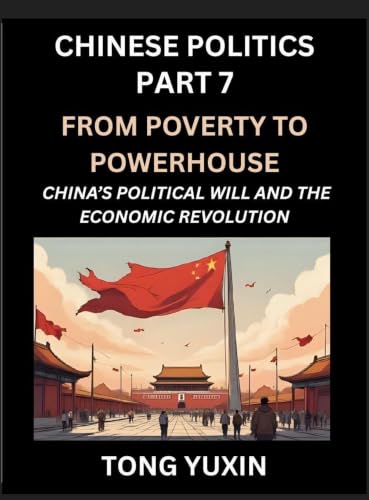
Chinese Politics (Part 7)- From Poverty to Powerhouse, China's Political Will and the Economic Revolution, How China's Decisions Drove Its Economic ... Rural Revitalization: Principles and Progress - Couverture rigide
Synopsis
Over the past forty years, China's story has been nothing short of extraordinary. Once a nation struggling with widespread poverty and economic stagnation, it has risen to become the world's second-largest economy-a transformation many deemed impossible. But this economic revolution was no accident. It was the result of deliberate, far-sighted political decisions that reshaped not just markets, but the very fabric of Chinese society.
At the core of this metamorphosis was political will-a steadfast commitment from China's leaders to pursue reform even when risks loomed large. Unlike Western economies, which often rely on incremental adjustments, China's approach combined centralized vision with localized innovation. Policies like "reform and opening-up" (改革开放 gǎigé kāifàng) created space for experimentation, allowing provinces and cities to adapt national strategies to their unique circumstances.Take, for example, the dismantling of agricultural collectivization (人民公社 rénmín gōngshè) in the late 1970s. By breaking up inefficient communes and allowing farmers to keep surplus crops, productivity soared. Rural incomes doubled within a decade, laying the foundation for a consumer-driven economy. Similarly, the gradual opening of sectors to foreign investment (外资 wàizī) transformed coastal cities into manufacturing hubs, while SOE reforms turned sluggish state-owned enterprises into agile competitors.But growth was never uniform. Rural revitalization (乡村振兴 xiāngcūn zhènxīng) programs became essential to bridge the widening urban-rural divide (城乡差距 chéngxiāng chājù), ensuring that prosperity reached inland provinces. Meanwhile, China's leaders navigated global crises-from the 1997 Asian Financial Crisis to the 2008 Global Recession-by turning challenges into opportunities for reform.What emerges is a portrait of institutional flexibility: a government willing to pivot when necessary, yet unwavering in its long-term goals. This book delves into the policy choices, debates, and compromises that defined China's rise. It asks not just how China grew, but why its leaders made the decisions they did-and what those choices reveal about the nature of governance in a rapidly changing world.As China faces new uncertainties-from demographic shifts to technological disruption-its past offers critical lessons. This is more than an economic success story; it is a testament to how visionary governance can transform a nation. By examining the interplay of politics and economics, we uncover the secrets behind China's ascent-and the challenges that lie ahead.Les informations fournies dans la section « Synopsis » peuvent faire référence à une autre édition de ce titre.
Résultats de recherche pour Chinese Politics (Part 7)- From Poverty to Powerhouse,...

Image d'archives
Chinese Politics (Part 7)- From Poverty to Powerhouse, China's Political Will and the Economic Revolution, How China's Decisions Drove Its Economic Miracle, Prosperity through Market and Rural Revitalization (Hardcover)
impression à la demandeVendeur : Grand Eagle Retail, Bensenville, IL, Etats-Unis
Évaluation du vendeur 5 sur 5 étoiles

Hardcover. Etat : new. Hardcover. Over the past forty years, China's story has been nothing short of extraordinary. Once a nation struggling with widespread poverty and economic stagnation, it has risen to become the world's second-largest economy-a transformation many deemed impossible. But this economic revolution was no accident. It was the result of deliberate, far-sighted political decisions that reshaped not just markets, but the very fabric of Chinese society.At the core of this metamorphosis was political will-a steadfast commitment from China's leaders to pursue reform even when risks loomed large. Unlike Western economies, which often rely on incremental adjustments, China's approach combined centralized vision with localized innovation. Policies like "reform and opening-up" ( gaige kaifang) created space for experimentation, allowing provinces and cities to adapt national strategies to their unique circumstances.Take, for example, the dismantling of agricultural collectivization ( renmin gongshe) in the late 1970s. By breaking up inefficient communes and allowing farmers to keep surplus crops, productivity soared. Rural incomes doubled within a decade, laying the foundation for a consumer-driven economy. Similarly, the gradual opening of sectors to foreign investment ( waizi) transformed coastal cities into manufacturing hubs, while SOE reforms turned sluggish state-owned enterprises into agile competitors.But growth was never uniform. Rural revitalization ( xiangcun zhenxing) programs became essential to bridge the widening urban-rural divide ( chengxiang chaju), ensuring that prosperity reached inland provinces. Meanwhile, China's leaders navigated global crises-from the 1997 Asian Financial Crisis to the 2008 Global Recession-by turning challenges into opportunities for reform.What emerges is a portrait of institutional flexibility: a government willing to pivot when necessary, yet unwavering in its long-term goals. This book delves into the policy choices, debates, and compromises that defined China's rise. It asks not just how China grew, but why its leaders made the decisions they did-and what those choices reveal about the nature of governance in a rapidly changing world.As China faces new uncertainties-from demographic shifts to technological disruption-its past offers critical lessons. This is more than an economic success story; it is a testament to how visionary governance can transform a nation. By examining the interplay of politics and economics, we uncover the secrets behind China's ascent-and the challenges that lie ahead. This item is printed on demand. Shipping may be from multiple locations in the US or from the UK, depending on stock availability. N° de réf. du vendeur 9798895846292
Acheter neuf
EUR 64,14
Livraison gratuite
Expédition nationale : Etats-Unis
Expédition nationale : Etats-Unis
Quantité disponible : 1 disponible(s)
Image d'archives
Chinese Politics (Part 7)- From Poverty to Powerhouse, China's Political Will and the Economic Revolution, How China's Decisions Drove Its Economic ... Rural Revitalization: Principles and Progress
Vendeur : California Books, Miami, FL, Etats-Unis
Évaluation du vendeur 5 sur 5 étoiles
Etat : New. N° de réf. du vendeur I-9798895846292
Acheter neuf
EUR 64,15
Livraison gratuite
Expédition nationale : Etats-Unis
Expédition nationale : Etats-Unis
Quantité disponible : Plus de 20 disponibles
Image d'archives
Chinese Politics (Part 7)- From Poverty to Powerhouse, China's Political Will and the Economic Revolution, How China's Decisions Drove Its Economic Miracle, Prosperity through Market and Rural Revitalization
impression à la demandeVendeur : PBShop.store US, Wood Dale, IL, Etats-Unis
Évaluation du vendeur 5 sur 5 étoiles
HRD. Etat : New. New Book. Shipped from UK. THIS BOOK IS PRINTED ON DEMAND. Established seller since 2000. N° de réf. du vendeur L1-9798895846292
Acheter neuf
EUR 86,40
Livraison gratuite
Expédition nationale : Etats-Unis
Expédition nationale : Etats-Unis
Quantité disponible : Plus de 20 disponibles
Image d'archives
Chinese Politics (Part 7)- From Poverty to Powerhouse, China's Political Will and the Economic Revolution, How China's Decisions Drove Its Economic Miracle, Prosperity through Market and Rural Revitalization
impression à la demandeVendeur : PBShop.store UK, Fairford, GLOS, Royaume-Uni
Évaluation du vendeur 5 sur 5 étoiles
HRD. Etat : New. New Book. Delivered from our UK warehouse in 4 to 14 business days. THIS BOOK IS PRINTED ON DEMAND. Established seller since 2000. N° de réf. du vendeur L1-9798895846292
Acheter neuf
EUR 81,55
Expédition à EUR 5,95
Expédition depuis Royaume-Uni vers Etats-Unis
Expédition depuis Royaume-Uni vers Etats-Unis
Quantité disponible : Plus de 20 disponibles
Image d'archives
Chinese Politics (Part 7)- From Poverty to Powerhouse, China's Political Will and the Economic Revolution, How China's Decisions Drove Its Economic Miracle, Prosperity through Market and Rural Revitalization (Hardcover)
impression à la demandeVendeur : AussieBookSeller, Truganina, VIC, Australie
Évaluation du vendeur 5 sur 5 étoiles
Hardcover. Etat : new. Hardcover. Over the past forty years, China's story has been nothing short of extraordinary. Once a nation struggling with widespread poverty and economic stagnation, it has risen to become the world's second-largest economy-a transformation many deemed impossible. But this economic revolution was no accident. It was the result of deliberate, far-sighted political decisions that reshaped not just markets, but the very fabric of Chinese society.At the core of this metamorphosis was political will-a steadfast commitment from China's leaders to pursue reform even when risks loomed large. Unlike Western economies, which often rely on incremental adjustments, China's approach combined centralized vision with localized innovation. Policies like "reform and opening-up" ( gaige kaifang) created space for experimentation, allowing provinces and cities to adapt national strategies to their unique circumstances.Take, for example, the dismantling of agricultural collectivization ( renmin gongshe) in the late 1970s. By breaking up inefficient communes and allowing farmers to keep surplus crops, productivity soared. Rural incomes doubled within a decade, laying the foundation for a consumer-driven economy. Similarly, the gradual opening of sectors to foreign investment ( waizi) transformed coastal cities into manufacturing hubs, while SOE reforms turned sluggish state-owned enterprises into agile competitors.But growth was never uniform. Rural revitalization ( xiangcun zhenxing) programs became essential to bridge the widening urban-rural divide ( chengxiang chaju), ensuring that prosperity reached inland provinces. Meanwhile, China's leaders navigated global crises-from the 1997 Asian Financial Crisis to the 2008 Global Recession-by turning challenges into opportunities for reform.What emerges is a portrait of institutional flexibility: a government willing to pivot when necessary, yet unwavering in its long-term goals. This book delves into the policy choices, debates, and compromises that defined China's rise. It asks not just how China grew, but why its leaders made the decisions they did-and what those choices reveal about the nature of governance in a rapidly changing world.As China faces new uncertainties-from demographic shifts to technological disruption-its past offers critical lessons. This is more than an economic success story; it is a testament to how visionary governance can transform a nation. By examining the interplay of politics and economics, we uncover the secrets behind China's ascent-and the challenges that lie ahead. This item is printed on demand. Shipping may be from our Sydney, NSW warehouse or from our UK or US warehouse, depending on stock availability. N° de réf. du vendeur 9798895846292
Acheter neuf
EUR 68,33
Expédition à EUR 32,92
Expédition depuis Australie vers Etats-Unis
Expédition depuis Australie vers Etats-Unis
Quantité disponible : 1 disponible(s)
Image d'archives
Chinese Politics (Part 7)- From Poverty to Powerhouse, China's Political Will and the Economic Revolution, How China's Decisions Drove Its Economic Miracle, Prosperity through Market and Rural Revitalization (Hardcover)
impression à la demandeVendeur : CitiRetail, Stevenage, Royaume-Uni
Évaluation du vendeur 5 sur 5 étoiles
Hardcover. Etat : new. Hardcover. Over the past forty years, China's story has been nothing short of extraordinary. Once a nation struggling with widespread poverty and economic stagnation, it has risen to become the world's second-largest economy-a transformation many deemed impossible. But this economic revolution was no accident. It was the result of deliberate, far-sighted political decisions that reshaped not just markets, but the very fabric of Chinese society.At the core of this metamorphosis was political will-a steadfast commitment from China's leaders to pursue reform even when risks loomed large. Unlike Western economies, which often rely on incremental adjustments, China's approach combined centralized vision with localized innovation. Policies like "reform and opening-up" ( gaige kaifang) created space for experimentation, allowing provinces and cities to adapt national strategies to their unique circumstances.Take, for example, the dismantling of agricultural collectivization ( renmin gongshe) in the late 1970s. By breaking up inefficient communes and allowing farmers to keep surplus crops, productivity soared. Rural incomes doubled within a decade, laying the foundation for a consumer-driven economy. Similarly, the gradual opening of sectors to foreign investment ( waizi) transformed coastal cities into manufacturing hubs, while SOE reforms turned sluggish state-owned enterprises into agile competitors.But growth was never uniform. Rural revitalization ( xiangcun zhenxing) programs became essential to bridge the widening urban-rural divide ( chengxiang chaju), ensuring that prosperity reached inland provinces. Meanwhile, China's leaders navigated global crises-from the 1997 Asian Financial Crisis to the 2008 Global Recession-by turning challenges into opportunities for reform.What emerges is a portrait of institutional flexibility: a government willing to pivot when necessary, yet unwavering in its long-term goals. This book delves into the policy choices, debates, and compromises that defined China's rise. It asks not just how China grew, but why its leaders made the decisions they did-and what those choices reveal about the nature of governance in a rapidly changing world.As China faces new uncertainties-from demographic shifts to technological disruption-its past offers critical lessons. This is more than an economic success story; it is a testament to how visionary governance can transform a nation. By examining the interplay of politics and economics, we uncover the secrets behind China's ascent-and the challenges that lie ahead. This item is printed on demand. Shipping may be from our UK warehouse or from our Australian or US warehouses, depending on stock availability. N° de réf. du vendeur 9798895846292
Acheter neuf
EUR 75,11
Expédition à EUR 43,88
Expédition depuis Royaume-Uni vers Etats-Unis
Expédition depuis Royaume-Uni vers Etats-Unis
Quantité disponible : 1 disponible(s)
Image d'archives
Chinese Politics (Part 7)- From Poverty to Powerhouse, China's Political Will and the Economic Revolution, How China's Decisions Drove Its Economic Miracle, Prosperity through Market and Rural Revitalization : Principles and Progress
impression à la demandeVendeur : AHA-BUCH GmbH, Einbeck, Allemagne
Évaluation du vendeur 5 sur 5 étoiles
Buch. Etat : Neu. nach der Bestellung gedruckt Neuware - Printed after ordering - Over the past forty years, China's story has been nothing short of extraordinary. Once a nation struggling with widespread poverty and economic stagnation, it has risen to become the world's second-largest economy-a transformation many deemed impossible. But this economic revolution was no accident. It was the result of deliberate, far-sighted political decisions that reshaped not just markets, but the very fabric of Chinese society.At the core of this metamorphosis was political will-a steadfast commitment from China's leaders to pursue reform even when risks loomed large. Unlike Western economies, which often rely on incremental adjustments, China's approach combined centralized vision with localized innovation. Policies like 'reform and opening-up' (¿¿¿¿ g¿igé k¿ifàng) created space for experimentation, allowing provinces and cities to adapt national strategies to their unique circumstances.Take, for example, the dismantling of agricultural collectivization (¿¿¿¿ rénmín g¿ngshè) in the late 1970s. By breaking up inefficient communes and allowing farmers to keep surplus crops, productivity soared. Rural incomes doubled within a decade, laying the foundation for a consumer-driven economy. Similarly, the gradual opening of sectors to foreign investment (¿¿ wàiz¿) transformed coastal cities into manufacturing hubs, while SOE reforms turned sluggish state-owned enterprises into agile competitors.But growth was never uniform. Rural revitalization (¿¿¿¿ xi¿ngc¿n zhènx¿ng) programs became essential to bridge the widening urban-rural divide (¿¿¿¿ chéngxi¿ng ch¿jù), ensuring that prosperity reached inland provinces. Meanwhile, China's leaders navigated global crises-from the 1997 Asian Financial Crisis to the 2008 Global Recession-by turning challenges into opportunities for reform.What emerges is a portrait of institutional flexibility: a government willing to pivot when necessary, yet unwavering in its long-term goals. This book delves into the policy choices, debates, and compromises that defined China's rise. It asks not just how China grew, but why its leaders made the decisions they did-and what those choices reveal about the nature of governance in a rapidly changing world.As China faces new uncertainties-from demographic shifts to technological disruption-its past offers critical lessons. This is more than an economic success story; it is a testament to how visionary governance can transform a nation. By examining the interplay of politics and economics, we uncover the secrets behind China's ascent-and the challenges that lie ahead. N° de réf. du vendeur 9798895846292
Acheter neuf
EUR 107,04
Expédition à EUR 35
Expédition depuis Allemagne vers Etats-Unis
Expédition depuis Allemagne vers Etats-Unis
Quantité disponible : 2 disponible(s)
Image fournie par le vendeur
Chinese Politics (Part 7)- From Poverty to Powerhouse, China's Political Will and the Economic Revolution, How China's Decisions Drove Its Economic Miracle, Prosperity through Market and Rural Revitalization | Principles and Progress
impression à la demandeVendeur : preigu, Osnabrück, Allemagne
Évaluation du vendeur 5 sur 5 étoiles
Buch. Etat : Neu. Chinese Politics (Part 7)- From Poverty to Powerhouse, China's Political Will and the Economic Revolution, How China's Decisions Drove Its Economic Miracle, Prosperity through Market and Rural Revitalization | Principles and Progress | Yuxin Tong | Buch | Englisch | 2026 | Chinese Politics | EAN 9798895846292 | Verantwortliche Person für die EU: Libri GmbH, Europaallee 1, 36244 Bad Hersfeld, gpsr[at]libri[dot]de | Anbieter: preigu Print on Demand. N° de réf. du vendeur 136341063
Acheter neuf
EUR 81,85
Expédition à EUR 70
Expédition depuis Allemagne vers Etats-Unis
Expédition depuis Allemagne vers Etats-Unis
Quantité disponible : 5 disponible(s)