

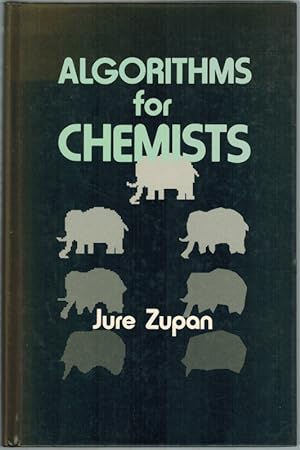
Algorithms for Chemists.
Zupan, Jure
ISBN 10: 0471921734 ISBN 13: 9780471921738
Edité par Chichester - New York - London - Sydney - Toronto - Singapore John Wiley & Sons, 1989
Ancien(s) ou d'occasion
Couverture rigide
Vendeur
Antiquariat Fluck, Berlin, Allemagne
Évaluation du vendeur 5 sur 5 étoiles

Vendeur AbeBooks depuis 10 avril 2003
Membre d'association :
Cet article spécifique n'est plus disponible.
A propos de cet article
Description :
Illustrierter Original-Pappband; 8°; xv (i) 290 (6) Seiten. Gutes Exemplar. Sprache: Englisch 610 gr. N° de réf. du vendeur 48291
Synopsis :
This text has been designed to introduce chemists to various computer methods. It aims to give chemists an overview of the basic techniques, methods and algorithms used for handling and understanding information on a computer. Emphasis is given to methods dealing with sets of data rather than with individual objects. The book is divided into three parts: data, preprocessing of data and data handling. In the first part, the representation of data in multi-dimensional measurement spaces, space metrics, the ways in which data can be stored in files and how those files can be manipulated are discussed. The second part contains a description of elementary methods of "polishing" data before "real" feature extraction is attempted. These methods include smoothing, differentiation, peak detection, integration and on-line correlation. Basic procedures for preprocessing are introduced, applicable in a variety of situations, and methods such as autocorrelation and principal component analysis are discussed. Emphasis is given to the Fast Fourier Transform (FFT) algorithm because of its wide applicability, but most of the methods described are suited for analyzing a large number of complex data. The third part of the book describes data handling, focusing on methods for clustering, pattern recognition, feature and knowledge extraction, learning and prediction of properties and expert systems. Ideas for the programming of fragment codes, connection tables and linear notations are described, together with an overview of fractal geometry and the fractal process. The section on expert systems concludes with an example of how most of the methods explained in the book can be used in the design of a chemical expert system based on different spectroscopies. The algorithms described are written as a mixture of BASIC, FORTRAN, PASCAL and Knuth's MIX, and should be understood by anyone with a basic knowledge of computer programming.
Les informations fournies dans la section « A propos du livre » peuvent faire référence à une autre édition de ce titre.
Détails bibliographiques
Titre : Algorithms for Chemists.
Éditeur : Chichester - New York - London - Sydney - Toronto - Singapore John Wiley & Sons
Date d'édition : 1989
Reliure : Couverture rigide
Meilleurs résultats de recherche sur AbeBooks

Image fournie par le vendeur
Algorithms for Chemists
Edité par
John Wiley & Sons Ltd, 1989
ISBN 10 : 0471921734
ISBN 13 : 9780471921738
Ancien ou d'occasion
Couverture rigide
Vendeur : Antiquarische Fundgrube e.U., Wien, Autriche
Évaluation du vendeur 5 sur 5 étoiles
Hardcover/Pappeinband. 290 Seiten Einband leicht berieben u. bestaubt, ehemaliges Bibliotheksexemplar m. Stempel am Titelblatt u. Etikettresten am Buchrücken Sl01 9780471921738 *.* Sprache: Englisch Gewicht in Gramm: 600. N° de réf. du vendeur 105381
Acheter D'occasion
EUR 45
Expédition à EUR 55
Expédition depuis Autriche vers Etats-Unis
Expédition depuis Autriche vers Etats-Unis
Quantité disponible : 1 disponible(s)
Image d'archives
Algorithms for Chemists
Edité par
John Wiley and Sons Ltd, United Kingdom, Chichester, 1989
ISBN 10 : 0471921734
ISBN 13 : 9780471921738
Ancien ou d'occasion
Paperback
Vendeur : WorldofBooks, Goring-By-Sea, WS, Royaume-Uni
Évaluation du vendeur 5 sur 5 étoiles
Paperback. Etat : Very Good. This text has been designed to introduce chemists to various computer methods. It aims to give chemists an overview of the basic techniques, methods and algorithms used for handling and understanding information on a computer. Emphasis is given to methods dealing with sets of data rather than with individual objects. The book is divided into three parts: data, preprocessing of data and data handling. In the first part, the representation of data in multi-dimensional measurement spaces, space metrics, the ways in which data can be stored in files and how those files can be manipulated are discussed. The second part contains a description of elementary methods of "polishing" data before "real" feature extraction is attempted. These methods include smoothing, differentiation, peak detection, integration and on-line correlation. Basic procedures for preprocessing are introduced, applicable in a variety of situations, and methods such as autocorrelation and principal component analysis are discussed. Emphasis is given to the Fast Fourier Transform (FFT) algorithm because of its wide applicability, but most of the methods described are suited for analyzing a large number of complex data. The third part of the book describes data handling, focusing on methods for clustering, pattern recognition, feature and knowledge extraction, learning and prediction of properties and expert systems. Ideas for the programming of fragment codes, connection tables and linear notations are described, together with an overview of fractal geometry and the fractal process. The section on expert systems concludes with an example of how most of the methods explained in the book can be used in the design of a chemical expert system based on different spectroscopies. The algorithms described are written as a mixture of BASIC, FORTRAN, PASCAL and Knuth's MIX, and should be understood by anyone with a basic knowledge of computer programming. The book has been read, but is in excellent condition. Pages are intact and not marred by notes or highlighting. The spine remains undamaged. N° de réf. du vendeur GOR009420563
Acheter D'occasion
EUR 193,08
Expédition à EUR 6,50
Expédition depuis Royaume-Uni vers Etats-Unis
Expédition depuis Royaume-Uni vers Etats-Unis
Quantité disponible : 1 disponible(s)