

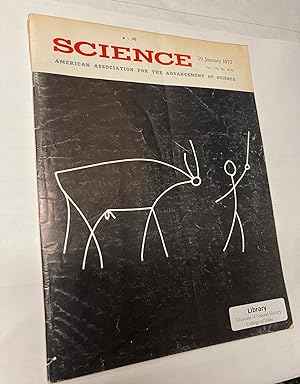
"On Being Sane in Insane Places" in "Science".
David L. Rosenhan
Edité par American Association for the Advancement of Science, 1973
Ancien(s) ou d'occasion
Soft cover
Vendeur
JF Ptak Science Books, Hendersonville, NC, Etats-Unis
Évaluation du vendeur 5 sur 5 étoiles

Vendeur AbeBooks depuis 28 juin 2016
Nous sommes désolés, cet exemplaire n'est plus disponible. Voici les résultats qui se rapprochent le plus pour "On Being Sane in Insane Places" in "Science"..
A propos de cet article
Description :
Rosenhan, D.L "On Being Sane in Insane Places" in Science 1973, vol 179 no. 4070, pp 250-258, (xiv, 228-316. Original wrappers. Cited by 5100 according to the AAAS website. The issue has an old shadow of a vertical crease that runs through most of the issue. There are also two stickers one small library sticker on the front cover and a mailing sticker on the rear wrapper. GOOD copy (say, a 5/10). "In 1973, Rosenhan published "On Being Sane in Insane Places", [the paper offered here] which describes what is now called the Rosenhan experiment. In this study report, Rosenhan uses "hard labeling" to argue that mental illnesses are manifested solely as a result of societal influence. The study experiments arranged for eight individuals with no history of psychopathology to attempt admission into twelve psychiatric hospitals, all with an aim for and subsequent admission with diagnoses of schizophrenia or bipolar disorder. The report goes on to describe psychiatrists then attempting to treat the individuals using psychiatric medications; all eight were described as being self-discharged within 7 to 52 days, after having stated that they accepted their diagnosis. Later a research and teaching hospital challenged Rosenhan to run a similar experiment involving its own diagnosis and admission procedures, where psychiatric staff were warned that at least one pseudo-patient might be sent to their institution. In that study, 83 out of 193 new patients were believed by at least one staff member to be actors; in fact, Rosenhan reports having sent no actors. The study concluded that existing forms of diagnosis were grossly inaccurate in distinguishing individuals without mental disorders from those with mental disorders, a conclusion that resulted in an explosion of controversy."--Wikipedia. N° de réf. du vendeur ABE-1700447216780
Détails bibliographiques
Titre : "On Being Sane in Insane Places" in "Science...
Éditeur : American Association for the Advancement of Science
Date d'édition : 1973
Reliure : Soft cover
Etat : Good
Meilleurs résultats de recherche sur AbeBooks

On Being Sane in Insane Places in Science 179 No. 4070, January 19, 1973
Edité par
American Association for the Advancement of Science, 1973
Ancien ou d'occasion
Edition originale
Vendeur : Atticus Rare Books, West Branch, IA, Etats-Unis
Évaluation du vendeur 5 sur 5 étoiles
1st Edition. FIRST EDITION IN ORIGINAL WRAPS OF THE ROSENHAN EXPERIMENT, A HIGHLY INFLUENTIAL EXPERIMENT CONDUCTED TO DETERMINE THE VALIDITY OF PSYCHIATRIC DIAGNOSIS. Rosenhan, psychologist and professor at Stanford, "sent eight â??sane' people to twelve psychiatric institutions. The pseudo-patients complained â??they had been hearing voices' and were admitted to psychiatric wards. Save one, all the rest were diagnosed with schizophrenia and discharged from the hospital less than a few months [later] because their symptoms were determined to be â??in remission'" (Tamao, The Politics of Psychiatric Experience, 71). The study concluded that "it is clear that we cannot distinguish the sane from the insane in psychiatric hospitals," and vehemently argued about the dangers of dehumanization and the type of labeling that takes place in psychiatric institutions. The core of the experiment was just that: could mental health professionals distinguish between psychologically well people and those with mental illnesses? Rosenhan believed not; at the time, some believed the same; soon, as a result of this paper, more would feel the same. "Experts in and out of the field [â??antipsychiatrists'] argued that these hospitals were â??superflous' institutions, sites of â??therapeutic tyranny' and â??merely a symptom of an outdated system that is crying for a complete remodeling' that should be â??liquidated as rapidly as can be done'. They believed "their case was proved. A scientific study in a premier [scientific journal] had shown psychiatrists did not know the sane from the insane. â??Worse still [they argued], the experience of segregation, powerlessness, depersonalization, mortification, and dehumanization. were enough to drive a normal person insane'" (Isaac, Madness in the Streets). Rosenhan and his study likely did more to cement public opinion against psychiatric hospitals than any other academic study" (Schaub). In 1973, the year Science published [this paper], California governor Ronald Reagan closed Modesto, Dewitt, and Mendocino State Hospitals. and announced plans to phase out all of the state's public psychiatric hospitals by 1982. Arguing in 1974, a lawyer summed up the prevailing view of the time: patients were â??better off outside of a hospital with no care than they were inside with no care'. Today, sociologists, historians, politicians, and many in the medical community believe the closing of so many psychiatric hospitals across the whole of the country has contributed greatly to the size of the current homeless population and the need of so many for both shelter and help. Though the veracity of the study remained in question, it continued (continues still) to have wide reverberations. Because of the issues of subjectivity of diagnosis raised by Rosenhan, the next taskforce charged with revising The Diagnostic and Statistical Manual of Mental Disorders was set on "achieving a systematized, streamlined diagnostic process. [They] skillfully used Rosenhan's arguments to deconstruct the conventional diagnosis process. While [they] disregarded the Rosenhan Experiment as â??junk,' it was a convincing tool to justify why psychiatry needed a radical reform" (Tamao). Ironically, the taskforce then used the questions surrounding the veracity of the paper to force the DSM still further toward systematic criteria. One repercussion of this is that by 1980, DSM diagnostic criteria had grown so finally systemized that the source of mental illness had been reduced almost entirely to â??biochemical irregularity.' In the biological model, symptoms are valued more than story or history, with clinicians increasingly disallowing the latter, relying largely on statistical data to provide diagnosis. CONDITION: 8vo. Complete. Lightly scuffed original wrappers; address sticker on rear. Clean throughout. Very good condition. N° de réf. du vendeur 1429
Acheter D'occasion
EUR 446,23
Expédition à EUR 8,23
Expédition nationale : Etats-Unis
Expédition nationale : Etats-Unis
Quantité disponible : 1 disponible(s)