Synopsis
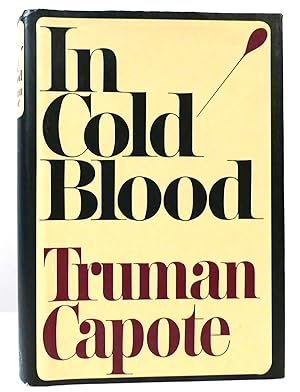
In Cold Blood With the publication of this book, Capote permanently ripped through the barrier separating crime reportage from serious literature. As he reconstructs the 1959 murder of a Kansas farm family and the investigation that led to the capture, trial, and execution of the killers, Capote generates suspense and empathy. Full description
Extrait
I
The Last to See Them Alive
THE village of Holcomb stands on the high wheat plains of western Kansas, a lonesome area that other Kansans call "out there." Some seventy miles east of the Colorado border, the countryside, with its hard blue skies and desert-clear air, has an atmosphere that is rather more Far West than Middle West. The local accent is barbed with a prairie twang, a ranch-hand nasalness, and the men, many of them, wear narrow frontier trousers, Stetsons, and high-heeled boots with pointed toes. The land is flat, and the views are awesomely extensive; horses, herds of cattle, a white cluster of grain elevators rising as gracefully as Greek temples are visible long before a traveler reaches them.
Holcomb, too, can be seen from great distances. Not that there is much to see--simply an aimless congregation of buildings divided in the center by the main-line tracks of the Santa Fe Railroad, a haphazard hamlet bounded on the south by a brown stretch of the Arkansas (pronounced "Ar-kan-sas") River, on the north by a highway, Route 50, and on the east and west by prairie lands and wheat fields. After rain, or when snowfalls thaw, the streets, unnamed, unshaded, unpaved, turn from the thickest dust into the direst mud. At one end of the town stands a stark old stucco structure, the roof of which supports an electric sign--DANCE--but the dancing has ceased and the advertisement has been dark for several years. Nearby is another building with an irrelevant sign, this one in flaking gold on a dirty window--HOLCOMB BANK. The bank closed in 1933, and its former counting rooms have been converted into apartments. It is one of the town's two "apartment houses," the second being a ramshackle mansion known, because a good part of the local school's faculty lives there, as the Teacherage. But the majority of Holcomb's homes are one-story frame affairs, with front porches.
Down by the depot, the postmistress, a gaunt woman who wears a rawhide jacket and denims and cowboy boots, presides over a falling-apart post office. The depot itself, with its peeling sulphur-colored paint, is equally melancholy; the Chief, the Super-Chief, the El Capitan go by every day, but these celebrated expresses never pause there. No passenger trains do--only an occasional freight. Up on the highway, there are two filling stations, one of which doubles as a meagerly supplied grocery store, while the other does extra duty as a café--Hartman's Café, where Mrs. Hartman, the proprietress, dispenses sandwiches, coffee, soft drinks, and 3.2 beer. (Holcomb, like all the rest of Kansas, is "dry.")
And that, really, is all. Unless you include, as one must, the Holcomb School, a good-looking establishment, which reveals a circumstance that the appearance of the community otherwise camouflages: that the parents who send their children to this modern and ably staffed "consolidated" school--the grades go from kindergarten through senior high, and a fleet of buses transport the students, of which there are usually around three hundred and sixty, from as far as sixteen miles away--are, in general, a prosperous people. Farm ranchers, most of them, they are outdoor folk of very varied stock--German, Irish, Norwegian, Mexican, Japanese. They raise cattle and sheep, grow wheat, milo, grass seed, and sugar beets. Farming is always a chancy business, but in western Kansas its practitioners consider themselves "born gamblers," for they must contend with an extremely shallow precipitation (the annual average is eighteen inches) and anguishing irrigation problems. However, the last seven years have been years of droughtless beneficence. The farm ranchers in Finney County, of which Holcomb is a part, have done well; money has been made not from farming alone but also from the exploitation of plentiful natural-gas resources, and its acquisition is reflected in the new school, the comfortable interiors of the farmhouses, the steep and swollen grain elevators.
Until one morning in mid-November of 1959, few Americans--in fact, few Kansans--had ever heard of Holcomb. Like the waters of the river, like the motorists on the highway, and like the yellow trains streaking down the Santa Fe tracks, drama, in the shape of exceptional happenings, had never stopped there. The inhabitants of the village, numbering two hundred and seventy, were satisfied that this should be so, quite content to exist inside ordinary life--to work, to hunt, to watch television, to attend school socials, choir practice, meetings of the 4-H Club. But then, in the earliest hours of that morning in November, a Sunday morning, certain foreign sounds impinged on the normal nightly Holcomb noises--on the keening hysteria of coyotes, the dry scrape of scuttling tumbleweed, the racing, receding wail of locomotive whistles. At the time not a soul in sleeping Holcomb heard them--four shotgun blasts that, all told, ended six human lives. But afterward the townspeople, theretofore sufficiently unfearful of each other to seldom trouble to lock their doors, found fantasy re-creating them over and again--those somber explosions that stimulated fires of mistrust in the glare of which many old neighbors viewed each other strangely, and as strangers.
THE master of River Valley Farm, Herbert William Clutter, was forty-eight years old, and as a result of a recent medical examination for an insurance policy, knew himself to be in first-rate condition. Though he wore rimless glasses and was of but average height, standing just under five feet ten, Mr. Clutter cut a man's-man figure. His shoulders were broad, his hair had held its dark color, his square-jawed, confident face retained a healthy-hued youthfulness, and his teeth, unstained and strong enough to shatter walnuts, were still intact. He weighed a hundred and fifty-four--the same as he had the day he graduated from Kansas State University, where he had majored in agriculture. He was not as rich as the richest man in Holcomb--Mr. Taylor Jones, a neighboring rancher. He was, however, the community's most widely known citizen, prominent both there and in Garden City, the close-by county seat, where he had headed the building committee for the newly completed First Methodist Church, an eight-hundred-thousand-dollar edifice. He was currently chairman of the Kansas Conference of Farm Organizations, and his name was everywhere respectfully recognized among Midwestern agriculturists, as it was in certain Washington offices, where he had been a member of the Federal Farm Credit Board during the Eisenhower administration.
Always certain of what he wanted from the world, Mr. Clutter had in large measure obtained it. On his left hand, on what remained of a finger once mangled by a piece of farm machinery, he wore a plain gold band, which was the symbol, a quarter-century old, of his marriage to the person he had wished to marry--the sister of a college classmate, a timid, pious, delicate girl named Bonnie Fox, who was three years younger than he. She had given him four children--a trio of daughters, then a son. The eldest daughter, Eveanna, married and the mother of a boy ten months old, lived in northern Illinois but visited Holcomb frequently. Indeed, she and her family were expected within the fortnight, for her parents planned a sizable Thanksgiving reunion of the Clutter clan (which had its beginnings in Germany; the first immigrant Clutter--or Klotter, as the name was then spelled--arrived here in 1880); fifty-odd kinfolk had been asked, several of whom would be traveling from places as far away as Palatka, Florida. Nor did Beverly, the child next in age to Eveanna, any longer reside at River Valley Farm; she was in Kansas City, Kansas, studying to be a nurse. Beverly was engaged to a young biology student, of whom her father very much approved; invitations to the wedding, scheduled for Christmas Week, were already printed. Which left, still living at home, the boy, Kenyon, who at fifteen was taller than Mr. Clutter, and one sister, a year older--the town darling, Nancy.
In regard to his family, Mr. Clutter had just one serious cause for disquiet--his wife's health. She was "nervous," she suffered "little spells"--such were the sheltering expressions used by those close to her. Not that the truth concerning "poor Bonnie's afflictions" was in the least a secret; everyone knew she had been an on-and-off psychiatric patient the last half-dozen years. Yet even upon this shadowed terrain sunlight had very lately sparkled. The past Wednesday, returning from two weeks of treatment at the Wesley Medical Center in Wichita, her customary place of retirement, Mrs. Clutter had brought scarcely credible tidings to tell her husband; with joy she informed him that the source of her misery, so medical opinion had at last decreed, was not in her head but in her spine--it was physical, a matter of misplaced vertebrae. Of course, she must undergo an operation, and afterward--well, she would be her "old self" again. Was it possible--the tension, the withdrawals, the pillow-muted sobbing behind locked doors, all due to an out-of-order backbone? If so, then Mr. Clutter could, when addressing his Thanksgiving table, recite a blessing of unmarred gratitude.
Ordinarily, Mr. Clutter's mornings began at six-thirty; clanging milk pails and the whispery chatter of the boys who brought them, two sons of a hired man named Vic Irsik, usually roused him. But today he lingered, let Vic Irsik's sons come and leave, for the previous evening, a Friday the thirteenth, had been a tiring one, though in part exhilarating. Bonnie had resurrected her "old self"; as if serving up a preview of the normality, the regained vigor, soon to be, she had rouged her lips, fussed with her hair, and, wearing a new dress, accompanied him to the Holcomb School, where they applauded a student p...
Les informations fournies dans la section « A propos du livre » peuvent faire référence à une autre édition de ce titre.