A propos de cet article
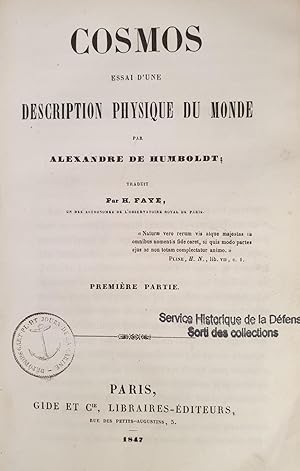
5 tomes reliés en 4 volumes In 8° (215 x 135 mm) Relié demi chagrin, dos lisses filets dorés, titre doré (reliure de l'époque), tranches rouges, cachet (4),VII,(1 bl.), VIII,580 pp -XIV,(2), 636 pp VIII,(2),363 pp., (1bl.) - VI (2) pp 365 pp-763 pp- VII,(1),806 pp,(1)f.bl., 4pp de catalogue Né à Berlin (1769-1859), Alexandre Humboldt fut très tôt passionné par les sciences naturelles et la minéralogie. Curieux de tout, il se livre à des expériences sur l'électricité et sur la météorolie. Il s'installe à Paris en 1797 puis il entreprend un voyage d'exploration en Amérique du Sud avec le botaniste français Bonpland, notamment en Amazonie puis à Cuba, au Pérou et dans les Andes, au Mexique et enfin aux états Unis. Après cinq années (1799-1804) passées à amasser des matériaux de toutes sortes dans de nombreux domaines (botanique, zoologie, climatologie, géographie, cartographie, géologie, etc.), ils regagnent Paris, qui est alors une grande capitale scientifique. Humboldt est alors considéré comme une encyclopédie vivante et fréquente Berthollet, Laplace, Gay-Lussac, etc. En 1826, il est obligé de rentrer en Prusse. Il ne se plaît pas beaucoup et entreprend, dès 1827, un voyage d'exploration dans l'Oural et en Sibérie. Son Cosmos est le véritable condensé et la lumineuse synthèse des connaissances humaines de l'époque sur la géographie et les phénomènes physiques inter-dépendants qui font de lui le créateur de la météorologie moderne, de la géophysique, l'inspirateur de Darwin de vin Buch et Agassiz, il fut aussi le père spirituel du Canal de Panama et c'est son tracé que retint Ferdinand de Lesseps. Humboldt fut aussi un philosophe largement inspiré des lumières qui l'amenèrent à combattre l'esclavage et à promouvoir l'instruction publique. Petites traces de mouillures sur quelques pages BEL EXEMPLAIRE 5 volumes bound in 4 volumes In 8° (215 x 135 mm) Bound in half-shell, smooth spine with gold binding, gilt spine, gilt title (contemporary binding), red edges, stamped. (4),VII,(1bl.), VIII,580 pp -XIV,(2), 636 pp - VIII,(2),363 pp,(1bl.) - VI (2) pp 365 pp-763 pp- VII,(1),806 pp,(1)f.b.b., 4pp catalogue Born in Berlin (1769-1859), Alexander Humboldt was fascinated by natural sciences and mineralogy from an early age. Curious about everything, he carried out experiments on electricity and meteorology. He settled in Paris in 1797 and then undertook a voyage of exploration in South America with the French botanist Bonpland, notably in the Amazon, then in Cuba, Peru and the Andes, Mexico and finally the United States. After five years (1799-1804) spent collecting materials of all kinds in many fields (botany, zoology, climatology, geography, cartography, geology, etc.), they returned to Paris, which was then a great scientific capital. Humboldt is then considered as a living encyclopedia and frequents Berthollet, Laplace, Gay-Lussac, etc. In 1826, he was forced to return to Prussia. He did not like it very much and in 1827 he undertook a journey of exploration in the Urals and Siberia. His Cosmos is the true compendium and luminous synthesis of the human knowledge of the time on geography and the interdependent physical phenomena that made him the creator of modern meteorology and geophysics, the inspiration for Darwin's wine Buch and Agassiz, he was also the spiritual father of the Panama Canal and it was his route that Ferdinand de Lesseps retained. Humboldt was also a philosopher largely inspired by the enlightenment that led him to fight slavery and promote public education. Small traces of water marks on a few pages BEAUTIFUL EXAMPLE.
N° de réf. du vendeur ABE-1593378802593
Contacter le vendeur
Signaler cet article