
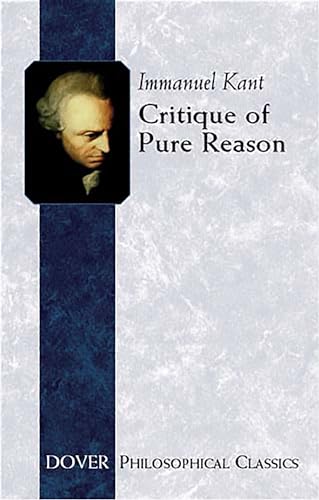
Critique of Pure Reason (Philosophical Classics)
Kant, Immanuel/ Meiklejohn, J. M. D.
ISBN 10: 0486432548 ISBN 13: 9780486432540
Edité par Dover Pubns, 2003
Neuf(s)
Paperback
Vendeur
Revaluation Books, Exeter, Royaume-Uni
Évaluation du vendeur 5 sur 5 étoiles

Vendeur AbeBooks depuis 6 janvier 2003
Cet article spécifique n'est plus disponible.
A propos de cet article
Description :
400 pages. 8.00x5.50x1.25 inches. In Stock. N° de réf. du vendeur x-0486432548
Synopsis :
In his monumental Critique of Pure Reason, German philosopher Immanuel Kant (1724-1804) argues that human knowledge is limited by the capacity for perception. He attempts a logical designation of two varieties of knowledge: a posteriori, the knowledge acquired through experience; and a priori, knowledge not derived through experience. Kant maintains that the most practical forms of human knowledge employ the a priori judgments that are possible only when the mind determines the conditions of its own experience. This accurate translation by J. M. Meiklejohn offers a simple and direct rendering of Kant's work that is suitable for readers at all levels.
Biographie de l'auteur: Immanuel Kant (22 April 1724 – 12 February 1804) was a German philosopher who is considered the central figure of modern philosophy. Kant argued that fundamental concepts of the human mind structure human experience, that reason is the source of morality, that aesthetics arises from a faculty of disinterested judgment, that space and time are forms of our sensibility, and that the world as it is "in-itself" is unknowable. Kant took himself to have effected a Copernican revolution in philosophy, akin to Copernicus' reversal of the age-old belief that the sun revolved around the earth. His beliefs continue to have a major influence on contemporary philosophy, especially the fields of metaphysics, epistemology, ethics, political theory, and aesthetics.
Les informations fournies dans la section « A propos du livre » peuvent faire référence à une autre édition de ce titre.
Détails bibliographiques
Titre : Critique of Pure Reason (Philosophical ...
Éditeur : Dover Pubns
Date d'édition : 2003
Reliure : Paperback
Etat : Brand New