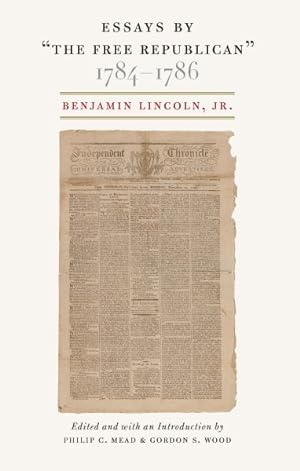
This is the first modern publication of ten essays published in the popular Boston newspaper The Independent Chronicle, a significant intellectual event in Massachusetts politics.
The essays deal primarily with the problem of mixed government in a republic. Lincoln writes, "Two distinct and different orders of men seems incident to every society," and these "two contending interests," fed by a "spirit of jealousy and distrust," would always be in dispute with one another. "Whether the parties to the contests style themselves the Rich and the Poor, the Great and the Small, the High and the Low, the Elders and People, Patricians and Plebeians, Nobility and Commons, still," the Free Republican writes, "the source and effects of the dispute are the same."
Lincoln saw this division of men directly linked with property: "Power, or the ability of controlling others, ever has been, and ever will be attached to property. . . . The glare of wealth, and the splendor of its favours, will create an influence which no civil constitution can control." To Lincoln the solution was obvious: "Let us therefore regulate an evil we cannot prevent." The interests of the "Few" and of the "Many" should be represented in a house of a bicameral legislature with the executive preserving the balance between the two parties. "A balance," Lincoln writes, "supposes three things, the two scales and the hand that holds it."
Lincoln's essays anticipate John Adams's Defence of the American Constitutions (1787) on every major point. It is doubtful that Adams read the essays, but the educated elites in Massachusetts had been discussing the problems of organizing government since 1776. The editors believe that Lincoln's essays grew out of a conversation that Massachusetts people were having about the problem of a bicameral legislature in a republic. The publication of these essays may provoke an entirely new appraisal of the political thinking of the founding era.
Philip C. Mead is historian and curator of the Museum of the American Revolution in Philadelphia, Pennsylvania.
Gordon S. Wood is Alva O. Way University Professor Emeritus at Brown University. He is the author of many works, including The Radicalism of the American Revolution (1992), which won the Pulitzer Prize for History and the Ralph Waldo Emerson Prize in 1993, and Empire of Liberty: A History of the Early Republic, 1789-1815 (2009), which was given the Association of American Publishers Award for History and Biography in 2009, the American History Book Prize by the New York Historical Society for 2010, and the Society of the Cincinnati History Prize in 2010. In 2011 he was awarded a National Humanities Medal by President Obama and the Arthur M. Schlesinger Jr. Award from the Society of American Historians.
The growth of serious interest during the last fifty years in the scholastic contribution to the development of economic thought has been very marked, and no-where more so than in the history of economic thought in Spain. This book begins in the Middle Ages and traces the effect on business practice and on thought of the presence of the Christian, Islamic and Jewish communities who lived side by side in the Peninsula. It shows how the economics of Plato and Aristotle were transmitted by way of Toledo to the Latin West.
In the second half of the book the author considers ‘Salamancan’ ideas and the views of the political economists and ‘projectors’ who preceded the Enlightenment. At the same time she surveys the present state of the subject and offers bibliographical guidance for the reader.