
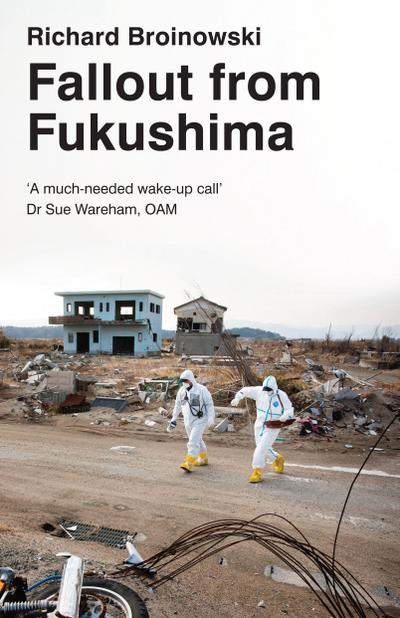
Fallout from Fukushima
Richard Broinowski
ISBN 10: 1922070165 ISBN 13: 9781922070166
Edité par SCRIBE PUBN, 2013
Neuf(s)
Taschenbuch
Vendeur
Che & Chandler Versandbuchhandlung, Fürstenberg OT Blumenow, Allemagne
Évaluation du vendeur 5 sur 5 étoiles

Vendeur AbeBooks depuis 17 juin 2009
Cet article spécifique n'est plus disponible.
A propos de cet article
Description :
Neu Neuware; Rechnung mit MwSt.; new item; 288 pp. Englisch. N° de réf. du vendeur INF1100357807
Synopsis :
On a calm afternoon in March 2011, a force-nine earthquake jolted the Pacific Ocean seabed east of Japan. Forty minutes later, a tsunami 21 metres high crashed onto the coast of Fukushima, Miyagi, and Iwate prefectures. Towns collapsed, villages were destroyed, and 16,000 people were swept away. The earthquake and tsunami also resulted in another terrifying calamity -- explosions and meltdowns at a nuclear plant near the city of Fukushima.
Fallout from Fukushima tells the story of Japan's worst nuclear disaster, and the attempts to suppress, downplay, and obscure its consequences. Former diplomat Richard Broinowski travelled into the irradiated zone to speak to those affected and to find out why authorities delayed warning the public about the severity of the radiation. Combining interviews, research, and analysis, he reveals the extent of the disaster's consequences: the ruinous compensation claims faced by electricity supplier TEPCO; the complete shutdown of Japan's nuclear reactors; and the psychological impact on those who, unable to return to their farms and villages, may become permanent nuclear refugees.
In this illuminating and persuasive account, Broinowski puts this nuclear tragedy in context, tracing the path back through Tokyo, Three Mile Island, and Chernobyl. Examining what the disaster will mean for the international nuclear industry, he explores why some countries are abandoning nuclear power, while others -- including Australia, through its export of uranium -- continue to put their faith in this dangerous technology.
À propos de l?auteur:
Richard Broinowski was a senior Australian diplomat who served in Japan, Myanmar, Iran, and the Philippines before becoming ambassador to Vietnam, the Republic of Korea, and Mexico. He was general manager of Radio Australia in the early 1990s, and on his retirement in 1997 became an adjunct professor, first at the University of Canberra, and then at the University of Sydney. In 2006, he initiated a program to send many student journalists in Australia to work in the newsroom of English-language newspapers throughout Asia.
Since his retirement, Richard has published six books, two of which are on nuclear matters: two editions of Fact or Fission? (Scribe 2003 and 2022), and Fallout from Fukushima (Scribe 2012). He was president of the NSW chapter of the Australian Institute of International Affairs from 2015 to 2018.
Richard became an Officer in the Order of Australia in the June 2019 honours list. He lives with his wife, Dr Alison Broinowski AM, in Sydney.
Les informations fournies dans la section « A propos du livre » peuvent faire référence à une autre édition de ce titre.
Détails bibliographiques
Titre : Fallout from Fukushima
Éditeur : SCRIBE PUBN
Date d'édition : 2013
Reliure : Taschenbuch
Etat : Neu
Meilleurs résultats de recherche sur AbeBooks

Image fournie par le vendeur
Fallout from Fukushima
Edité par
Scribe US, Australia & New Zealand, 2012
ISBN 10 : 1922070165
ISBN 13 : 9781922070166
Ancien ou d'occasion
Paperback
Vendeur : Goulds Book Arcade, Sydney, Newtown, Sydney, NSW, Australie
Évaluation du vendeur 5 sur 5 étoiles
Paperback. Etat : Good. 273 pages. The cover has a little wear. The page edges are lightly tanned. The last quarter of the book has some water damage. Books listed here are not stored at the shop. Please contact us if you want to pick up a book from Newtown. N° de réf. du vendeur 170631
Acheter D'occasion
EUR 11,27
Expédition à EUR 21,17
Expédition depuis Australie vers Etats-Unis
Expédition depuis Australie vers Etats-Unis
Quantité disponible : 1 disponible(s)
Image d'archives
Fallout from Fukushima.
Edité par
Scribe Publications, Melbourne, Brunswick, 2012
ISBN 10 : 1922070165
ISBN 13 : 9781922070166
Ancien ou d'occasion
Couverture souple
Edition originale
Vendeur : BOOKHOME SYDNEY, Annandale Sydney, NSW, Australie
Évaluation du vendeur 5 sur 5 étoiles
1st ed. Paperback trade, very good condition, pages lightly toned, minor edgewear. 273 pp. The story of Japan's worst nuclear disaster, and the attempts to suppress, downplay, and obscure its consequences. The author, a former diplomat travelled into the irradiated zone to speak to those affected, and to find out why authorities delayed warning the public about the severity of the radiation. Combining interviews, research and analysis, he reveals the extent of the disaster's consequences. N° de réf. du vendeur 27402
Acheter D'occasion
EUR 11,27
Expédition à EUR 24,48
Expédition depuis Australie vers Etats-Unis
Expédition depuis Australie vers Etats-Unis
Quantité disponible : 1 disponible(s)
Image d'archives
Fallout from Fukushima
Edité par
Scribe Publications, Melbourne, 2012
ISBN 10 : 1922070165
ISBN 13 : 9781922070166
Ancien ou d'occasion
Soft cover
Edition originale
Vendeur : Ripponlea Books, Melbourne, VIC, Australie
Évaluation du vendeur 3 sur 5 étoiles

Soft cover. Etat : Fine. 1st Edition. xi+273pp., Pictorial full colour photographic covers, maps of North- Eastern Japan & location around Fukushima Dai-ichi, plan of Fukushima Dai-ichi reactor building, intro., appends., bibliog., ack., index. Fallout from Fukushima tells the story of Japan's worst nuclear disaster and the attempts to suppress, downplay, and obscure its consequences. In this illuminating and persuasive account, Broinowski puts this nuclear tragedy in context, tracing the path back through Tokyo, Three Mile Island, and Chernobyl. Examining what the disaster will mean for the international nuclear industry. Size: Small Octavo. Book. N° de réf. du vendeur 004054
Acheter D'occasion
EUR 19,41
Expédition à EUR 15,25
Expédition depuis Australie vers Etats-Unis
Expédition depuis Australie vers Etats-Unis
Quantité disponible : 1 disponible(s)
Image fournie par le vendeur
Fallout from Fukushima (Paperback)
Edité par
Scribe Publications, Carlton North, 2012
ISBN 10 : 1922070165
ISBN 13 : 9781922070166
Neuf
Paperback
Vendeur : Grand Eagle Retail, Bensenville, IL, Etats-Unis
Évaluation du vendeur 5 sur 5 étoiles
Paperback. Etat : new. Paperback. On a calm afternoon in March 2011, a force-nine earthquake jolted the Pacific Ocean seabed east of Japan. Forty minutes later, a tsunami 21 metres high crashed onto the coast of Fukushima, Miyagi, and Iwate prefectures. Towns collapsed, villages were destroyed, and 16,000 people were swept away. The earthquake and tsunami also resulted in another terrifying calamity explosions and meltdowns at a nuclear plant near the city of Fukushima. Fallout from Fukushima tells the story of Japan's worst nuclear disaster, and the attempts to suppress, downplay, and obscure its consequences. Former diplomat Richard Broinowski travelled into the irradiated zone to speak to those affected and to find out why authorities delayed warning the public about the severity of the radiation. Combining interviews, research, and analysis, he reveals the extent of the disaster's consequences: the ruinous compensation claims faced by electricity supplier TEPCO; the complete shutdown of Japan's nuclear reactors; and the psychological impact on those who, unable to return to their farms and villages, may become permanent nuclear refugees. In this illuminating and persuasive account, Broinowski puts this nuclear tragedy in context, tracing the path back through Tokyo, Three Mile Island, and Chernobyl. Examining what the disaster will mean for the international nuclear industry, he explores why some countries are abandoning nuclear power, while others including Australia, through its export of uranium and continue to put their faith in this dangerous technology. 'The definitive analysis of the Fukushima accident . . . If you are tempted to see a role for nuclear energy, you should read this book.' Professor Ian Lowe, AO On 11 March 2011, a force-9 earthquake jolted the seabed 66 kilometres due east of Japan. Within 20 minutes, a black tsunami wave 14 metres high rolled in from above the epicentre. While struggling with the unfolding destruction, Japan had to cope with a third calamity -- the malfunctioning of a nuclear-power complex near the town of Fukushima. Shipping may be from multiple locations in the US or from the UK, depending on stock availability. N° de réf. du vendeur 9781922070166
Acheter neuf
EUR 20,62
Livraison gratuite
Expédition nationale : Etats-Unis
Expédition nationale : Etats-Unis
Quantité disponible : 1 disponible(s)
Image fournie par le vendeur
Fallout from Fukushima (Paperback)
Edité par
Scribe Publications, Carlton North, 2012
ISBN 10 : 1922070165
ISBN 13 : 9781922070166
Neuf
Paperback
Vendeur : CitiRetail, Stevenage, Royaume-Uni
Évaluation du vendeur 5 sur 5 étoiles
Paperback. Etat : new. Paperback. On a calm afternoon in March 2011, a force-nine earthquake jolted the Pacific Ocean seabed east of Japan. Forty minutes later, a tsunami 21 metres high crashed onto the coast of Fukushima, Miyagi, and Iwate prefectures. Towns collapsed, villages were destroyed, and 16,000 people were swept away. The earthquake and tsunami also resulted in another terrifying calamity explosions and meltdowns at a nuclear plant near the city of Fukushima. Fallout from Fukushima tells the story of Japan's worst nuclear disaster, and the attempts to suppress, downplay, and obscure its consequences. Former diplomat Richard Broinowski travelled into the irradiated zone to speak to those affected and to find out why authorities delayed warning the public about the severity of the radiation. Combining interviews, research, and analysis, he reveals the extent of the disaster's consequences: the ruinous compensation claims faced by electricity supplier TEPCO; the complete shutdown of Japan's nuclear reactors; and the psychological impact on those who, unable to return to their farms and villages, may become permanent nuclear refugees. In this illuminating and persuasive account, Broinowski puts this nuclear tragedy in context, tracing the path back through Tokyo, Three Mile Island, and Chernobyl. Examining what the disaster will mean for the international nuclear industry, he explores why some countries are abandoning nuclear power, while others including Australia, through its export of uranium and continue to put their faith in this dangerous technology. 'The definitive analysis of the Fukushima accident . . . If you are tempted to see a role for nuclear energy, you should read this book.' Professor Ian Lowe, AO On 11 March 2011, a force-9 earthquake jolted the seabed 66 kilometres due east of Japan. Within 20 minutes, a black tsunami wave 14 metres high rolled in from above the epicentre. While struggling with the unfolding destruction, Japan had to cope with a third calamity -- the malfunctioning of a nuclear-power complex near the town of Fukushima. Shipping may be from our UK warehouse or from our Australian or US warehouses, depending on stock availability. N° de réf. du vendeur 9781922070166
Acheter neuf
EUR 22,49
Expédition à EUR 42,53
Expédition depuis Royaume-Uni vers Etats-Unis
Expédition depuis Royaume-Uni vers Etats-Unis
Quantité disponible : 1 disponible(s)
Image fournie par le vendeur
Fallout from Fukushima (Paperback)
Edité par
Scribe Publications, Carlton North, 2012
ISBN 10 : 1922070165
ISBN 13 : 9781922070166
Neuf
Paperback
Vendeur : AussieBookSeller, Truganina, VIC, Australie
Évaluation du vendeur 5 sur 5 étoiles
Paperback. Etat : new. Paperback. On a calm afternoon in March 2011, a force-nine earthquake jolted the Pacific Ocean seabed east of Japan. Forty minutes later, a tsunami 21 metres high crashed onto the coast of Fukushima, Miyagi, and Iwate prefectures. Towns collapsed, villages were destroyed, and 16,000 people were swept away. The earthquake and tsunami also resulted in another terrifying calamity explosions and meltdowns at a nuclear plant near the city of Fukushima. Fallout from Fukushima tells the story of Japan's worst nuclear disaster, and the attempts to suppress, downplay, and obscure its consequences. Former diplomat Richard Broinowski travelled into the irradiated zone to speak to those affected and to find out why authorities delayed warning the public about the severity of the radiation. Combining interviews, research, and analysis, he reveals the extent of the disaster's consequences: the ruinous compensation claims faced by electricity supplier TEPCO; the complete shutdown of Japan's nuclear reactors; and the psychological impact on those who, unable to return to their farms and villages, may become permanent nuclear refugees. In this illuminating and persuasive account, Broinowski puts this nuclear tragedy in context, tracing the path back through Tokyo, Three Mile Island, and Chernobyl. Examining what the disaster will mean for the international nuclear industry, he explores why some countries are abandoning nuclear power, while others including Australia, through its export of uranium and continue to put their faith in this dangerous technology. 'The definitive analysis of the Fukushima accident . . . If you are tempted to see a role for nuclear energy, you should read this book.' Professor Ian Lowe, AO On 11 March 2011, a force-9 earthquake jolted the seabed 66 kilometres due east of Japan. Within 20 minutes, a black tsunami wave 14 metres high rolled in from above the epicentre. While struggling with the unfolding destruction, Japan had to cope with a third calamity -- the malfunctioning of a nuclear-power complex near the town of Fukushima. Shipping may be from our Sydney, NSW warehouse or from our UK or US warehouse, depending on stock availability. N° de réf. du vendeur 9781922070166
Acheter neuf
EUR 25,13
Expédition à EUR 31,34
Expédition depuis Australie vers Etats-Unis
Expédition depuis Australie vers Etats-Unis
Quantité disponible : 1 disponible(s)
Image fournie par le vendeur
Fallout from Fukushima
Vendeur : Rarewaves USA, OSWEGO, IL, Etats-Unis
Évaluation du vendeur 5 sur 5 étoiles
Paperback. Etat : New. N° de réf. du vendeur LU-9781922070166
Acheter neuf
EUR 29,97
Livraison gratuite
Expédition nationale : Etats-Unis
Expédition nationale : Etats-Unis
Quantité disponible : 12 disponible(s)
Image fournie par le vendeur
Fallout from Fukushima
Vendeur : Rarewaves USA United, OSWEGO, IL, Etats-Unis
Évaluation du vendeur 5 sur 5 étoiles
Paperback. Etat : New. N° de réf. du vendeur LU-9781922070166
Acheter neuf
EUR 31,61
Expédition à EUR 42,35
Expédition nationale : Etats-Unis
Expédition nationale : Etats-Unis
Quantité disponible : 12 disponible(s)
Image d'archives
Fallout from Fukushima
Edité par
Scribe US, 2012
ISBN 10 : 1922070165
ISBN 13 : 9781922070166
Ancien ou d'occasion
Softcover
Vendeur : Ammareal, Morangis, France
Évaluation du vendeur 5 sur 5 étoiles
Softcover. Etat : Bon. Edition 2012. Ammareal reverse jusqu'à 15% du prix net de cet article à des organisations caritatives. ENGLISH DESCRIPTION Book Condition: Used, Good. Edition 2012. Ammareal gives back up to 15% of this item's net price to charity organizations. N° de réf. du vendeur F-988-703
Acheter D'occasion
EUR 36,99
Expédition à EUR 16,50
Expédition depuis France vers Etats-Unis
Expédition depuis France vers Etats-Unis
Quantité disponible : 1 disponible(s)