
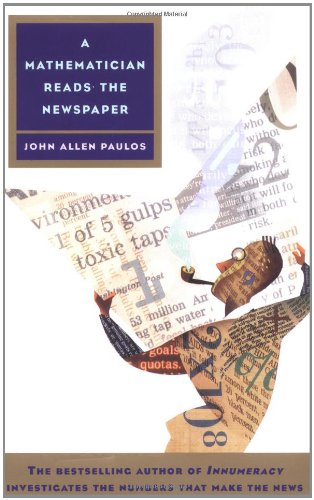
A Mathematician Reads the Newspaper
Paulos, John Allen
ISBN 10: 038548254X ISBN 13: 9780385482547
Edité par Anchor, 1997
Ancien(s) ou d'occasion
Paperback
Vendeur
Orion Tech, Kingwood, TX, Etats-Unis
Évaluation du vendeur 5 sur 5 étoiles

Vendeur AbeBooks depuis 18 février 2015
Cet article spécifique n'est plus disponible.
A propos de cet article
Description :
N° de réf. du vendeur 038548254X-3-26326596
Synopsis :
Book by Paulos John Allen
Extrait:
The Top 10 list has become a staple of newspapers, television, and magazines for a variety of reasons, the top ten being:
1. Ten is a common and familiar number, the base of our number system. Numbers are rounded to 10 or to multiples of ten or tenths. The resulting distortion, of course, need not have much to do with reality. We're told, for example, that we use 10 percent of our brain power, that 10 percent of us consume 90 percent of the world's resources, and that decades define us. (Is there anything more vapid than explanation by decade? In the free love, antiwar sixties, hippies felt so and so; the greed of the eighties led yuppies to do such and such; sullen and unread Generation Xers never do anything.)
2. People like information to be encapsulated; they're impatient with long, discursive explanations. They want the bare facts, and they want them now.
3. The list is consistent with a linear approach to problems. Nothing is complex or convoluted; every factor can be ranked. If we do a, b, or c, then x, y, or z will happen. Proportionality reigns.
4. It's a kind of ritual. Numbers are often associated with rites, and this is a perfect example.
5. It has biblical resonance, the Ten Commandments being one of its first instances. Others are the ten plagues on the Egyptians, the ten days between Rosh Hashanah and Yom Kippur, the requirement that at least ten men be present for public prayer, and Joseph's ten brothers.
6. The list can be a complete story. It has a beginning: 1, 2, 3; a middle: 4, 5, 6, 7; and an end, 8, 9, 10. Many stories in the news are disconnected; the list is unitary.
7. It's easy to write; there is no need to come up with transitions. Or even complete sentences. The same holds for the 10, 50, and 100 years ago today fillers.
8. It's flexible and capable of handling any subject. Since there are never any clear criteria for what constitutes an entry on such a list, items on short lists can easily be split, and those on long lists can just as easily be combined.
9. Lists are widely read (or heard) and talked about, but don't require much room in the paper or much airtime.
10. People realize it's an artificial form and like to see if it's going to run out of good points before it gets to 10.
Les informations fournies dans la section « A propos du livre » peuvent faire référence à une autre édition de ce titre.
Détails bibliographiques
Titre : A Mathematician Reads the Newspaper
Éditeur : Anchor
Date d'édition : 1997
Reliure : Paperback
Etat : Good